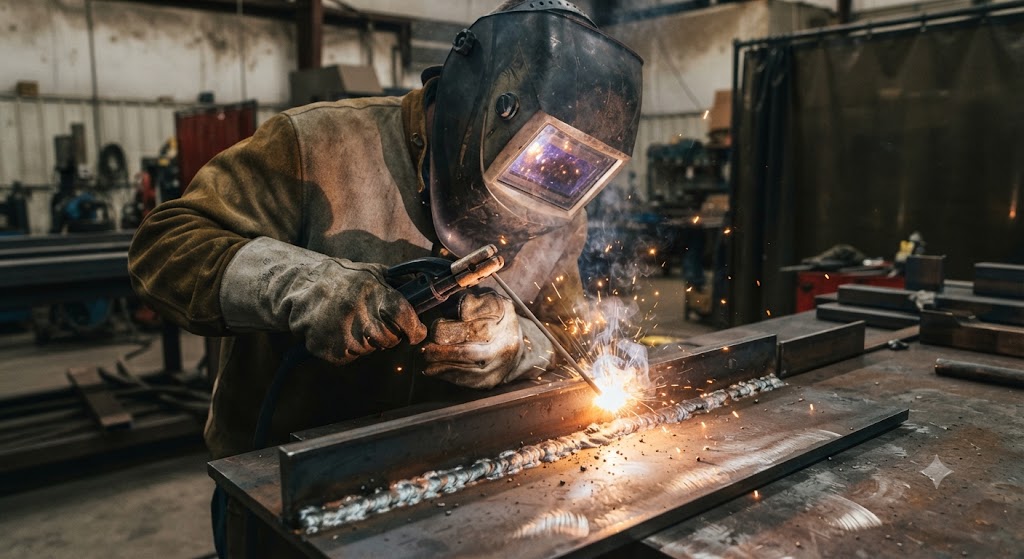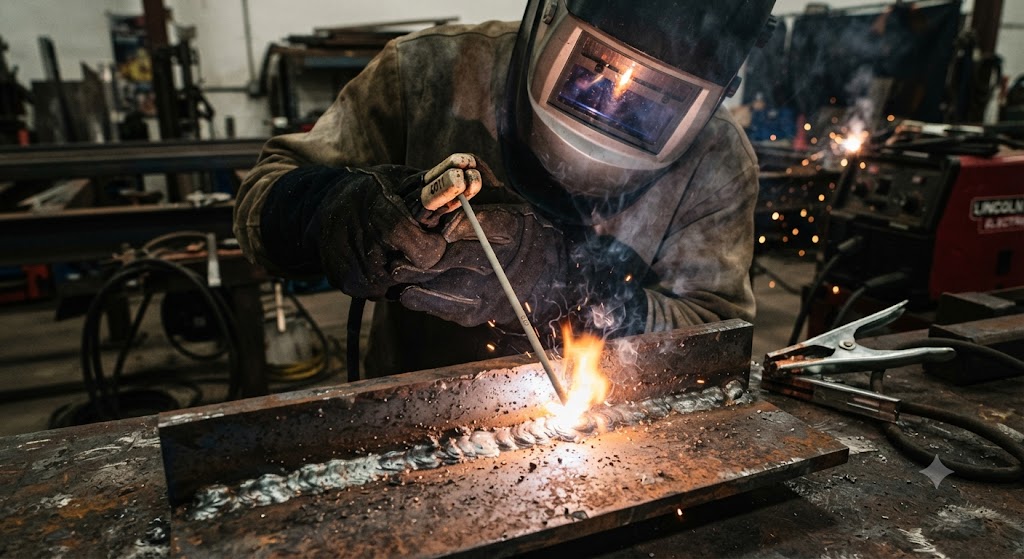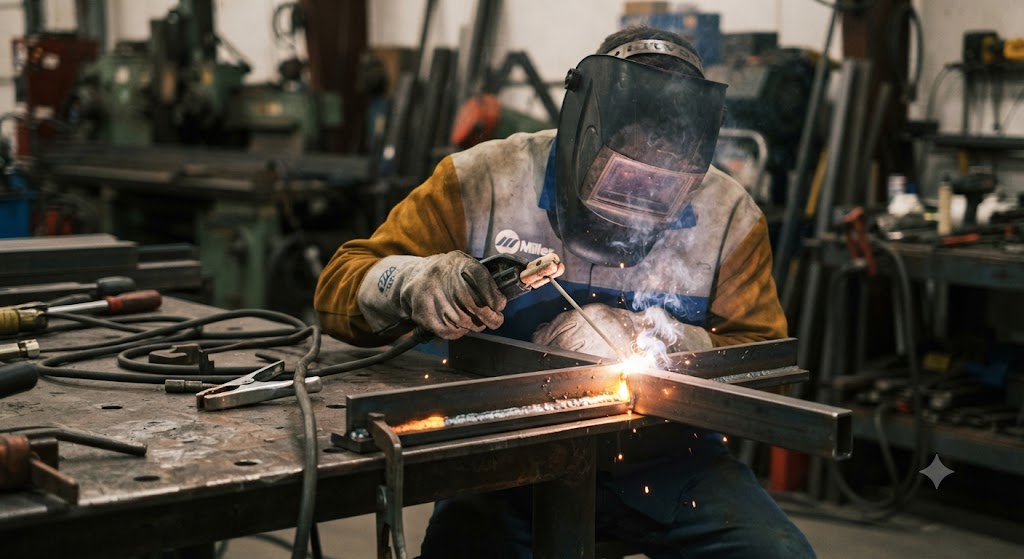
El mejor soldador de alambre para el hogar y el taller: tres selecciones que se ganan el sustento
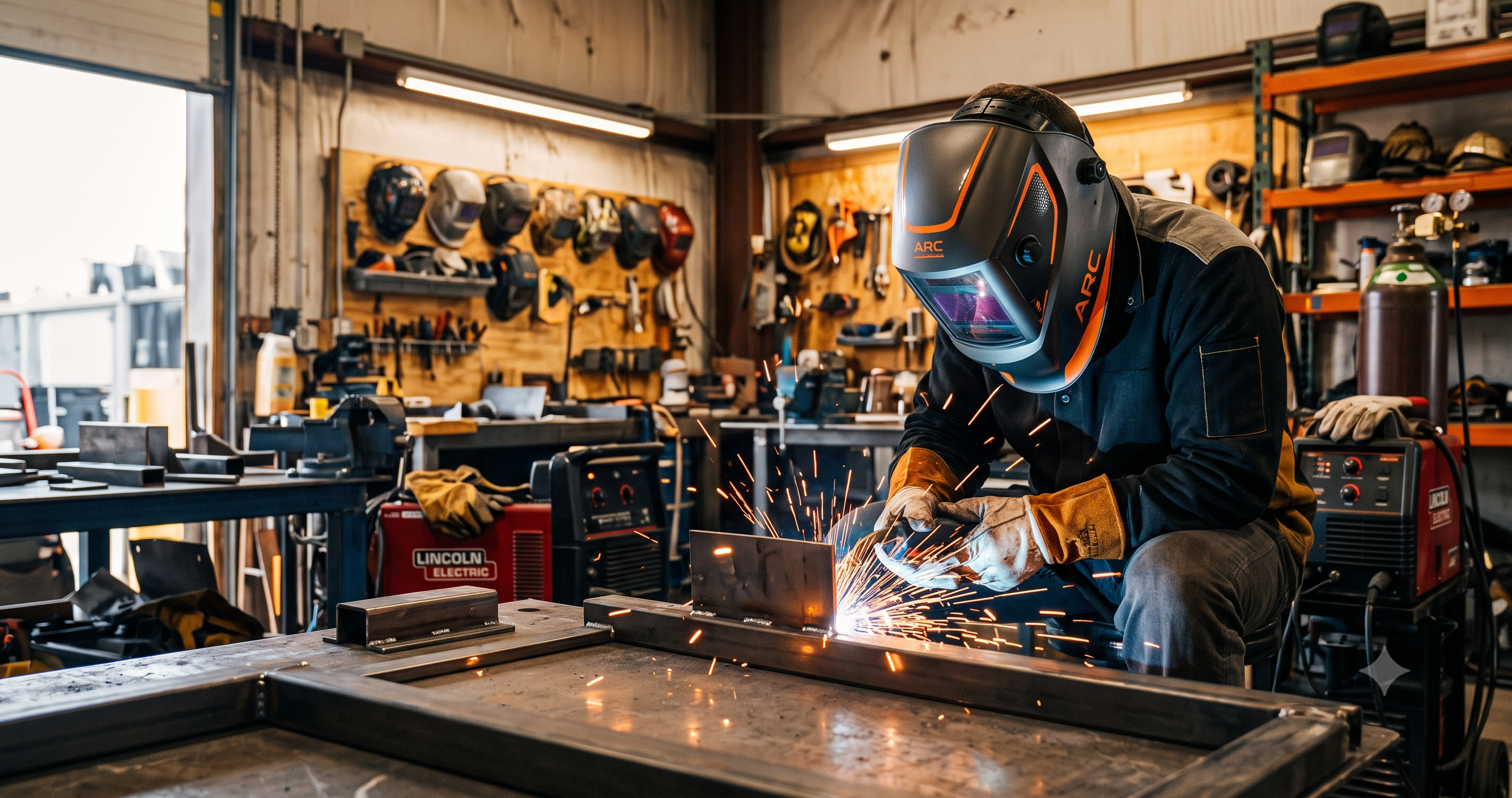
The Best Wire Welder Is the One That Matches Your Work
A 140-amp machine looks like plenty until you clamp the ground to a rusty trailer tongue and watch the arc stutter. The difference between a machine you keep and one you resell in a year usually comes down to two things the spec sheet buries: duty cycle at the amperage you actually use, and how the wire feeder is built. Here is what separates a good wire welder from one that will frustrate you.
A wire welder, or MIG welder, feeds a solid or flux-cored wire continuously through a gun, melting it into the joint with an electric arc. The wire acts as both electrode and filler metal. The best wire welder for your shop depends on the thickness of metal you work with most often, the power you have available, and whether you need to run gas-shielded MIG or just flux-cored wire.
The Hobart Handler 210 MVP is the best all-around wire welder for most home and small shop users. It runs on both 115V and 230V power, outputs 25 to 210 amps, and handles everything from 24-gauge sheet metal to 3/8-inch plate in a single pass. The all-metal wire drive and infinite feed speed control give you consistent wire delivery without the slipping you get from plastic drive systems on lesser machines.
The Hobart Handler 210 MVP: The One I Would Keep
I have watched the 210 MVP run daily in a farm shop for over a year without a single issue. It welded trailer frames, fence panels, angle iron brackets, and 3/16-inch plate without breaking a sweat. The MVP (Multi-Voltage Plug) system lets you swap between 115V and 230V without tools, which means you can plug into a standard outlet for light work and switch to 230V for thicker material.
The wire drive is all metal with a quick-release tension lever. It feeds .023 to .035 solid wire and .030 to .045 flux-cored without changing drive rolls, thanks to the dual-groove design. The spool gun circuitry is built in, so you can run aluminum with a Hobart spool gun without buying an adapter.
The flaw: it uses transformer technology, not inverter. That means it weighs 79 pounds and takes up more bench space than newer inverter machines. The duty cycle is 30% at 150 amps on 230V, which sounds low until you realize that 150 amps is already more than you need for 1/4-inch steel. At 90 amps, which is where most home shop work lives, the duty cycle is effectively 100%.
Who should skip this machine: anyone who needs to carry the welder to remote job sites regularly. At 79 pounds, it is portable in the sense that you can move it, not in the sense that you want to. If you weld on a bench or near a 230V outlet, this is your machine.
Lincoln Electric Handy MIG K2185-1: The Light-Duty Pick
The Lincoln Electric Handy MIG is a 115V-only machine that outputs 35 to 88 amps. It welds 24-gauge to 1/8-inch mild steel with both MIG and flux-cored wire. It comes with practically everything you need to start welding: gun, work cable, gas regulator, a spool of solid wire, and a spool of flux-cored wire.
The Handy MIG is the machine I would hand to someone who has never welded before. Four voltage settings and continuous wire speed adjustment keep the learning curve shallow. The cold contactor safety feature means the wire is not electrically live until you pull the trigger, which prevents accidental arcs when you set the gun down.
The flaw: 88 amps is the ceiling. You will weld 1/8-inch steel at the top of the machine’s range, and anything thicker requires multiple passes or a bigger machine. The four voltage taps give you less fine control than the seven settings on the Hobart 210 MVP. The wire drive is adequate but not in the same league as the all-metal Hobart system.
Who should skip this machine: anyone who thinks they might want to weld thicker than 1/8-inch steel. You cannot turn an 88-amp machine up. If there is a chance you will tackle trailer repairs, fence frames, or 3/16-inch plate, buy the 140-amp or 210-amp machine now instead of upgrading later.
Hobart Handler 140EZ: The Middle Ground
The Hobart Handler 140EZ replaced the older Handler 140 and runs on 115V household power. It outputs 25 to 140 amps, which covers 24-gauge to 1/4-inch steel. It comes set up for both MIG and flux-cored welding, with a gas regulator and hose included.
The 140EZ hits a sweet spot for home shops that do not have 230V power. At 140 amps, you can weld 1/4-inch plate in a single pass with proper joint prep. The wire drive uses the same all-metal construction as the 210 MVP, and the quick-change drive roll handles .023 to .035 solid wire and .030 to .045 flux-cored.
The flaw: it is 115V only. If you ever want to run a spool gun for aluminum or push past 140 amps, you are done. The machine also uses tapped voltage settings (seven of them) rather than infinite control, which means you pick the closest tap and adjust wire speed to fine-tune. It works, but it is not as precise as a machine with infinite voltage control.
Who should skip this machine: anyone with 230V power available. If you have a 230V outlet in your shop, the 210 MVP gives you more headroom, better duty cycle, and spool gun capability for about the same footprint.
How the Three Compare
| Feature | Hobart 210 MVP | Lincoln Handy MIG | Hobart 140EZ |
|---|---|---|---|
| Input Power | 115V / 230V | 115V only | 115V only |
| Output Range | 25 to 210A | 35 to 88A | 25 to 140A |
| Max Steel Thickness | 3/8 in. | 1/8 in. | 1/4 in. |
| Wire Drive | All metal | Standard | All metal |
| Spool Gun Ready | Yes (built in) | No | Yes |
| Voltage Control | 7 taps (230V) / 4 taps (115V) | 4 taps | 7 taps |
| Weight | 79 lbs | ~30 lbs | ~50 lbs |
| Warranty | 5/3/1 industrial | 1 year | 5/3/1 industrial |
Wire Compatibility: What Each Machine Runs
All three machines run ER70S-6 solid MIG wire, which is the AWS A5.18 classification for mild steel filler. The 210 MVP handles .023 to .035 solid wire and .030 to .045 flux-cored. The Handy MIG is best with .023 to .030 solid wire because of its lower amperage range. The 140EZ covers .023 to .035 solid and .030 to .045 flux-cored.
For stainless steel work, all three can run ER308L wire classified under AWS A5.9, though you will need a 90/10 argon-CO2 gas mix instead of the 75/25 you use for mild steel. The 210 MVP handles .023 to .035 stainless wire. The Handy MIG and 140EZ can run .023 to .030 stainless.
The wire diameter you choose should match your material thickness. For 24-gauge to 18-gauge sheet metal, run .023. For 16-gauge to 1/8-inch, run .030. For 3/16-inch and thicker, step up to .035. Running .035 wire on a 115V machine at the top of its range will give you a globular transfer and ugly beads. Run .030 instead and slow down.
What Actually Matters in a Wire Welder
The spec sheet tells you amperage and duty cycle. What it does not tell you is how the wire feeder feels in your hand. A wire welder with a smooth, consistent feed will produce better welds than a machine with higher amperage and a jerky drive. The Hobart machines win here because of their all-metal drive systems and quick-release tension levers that let you dial in feed pressure by feel.
Duty cycle matters more than peak amperage. A machine rated at 140 amps with a 20% duty cycle at that amperage means you weld for two minutes and wait for eight. In real shop work, you rarely weld at peak amperage continuously, so the effective duty cycle is higher. But if you are running long beads on thick material, the 210 MVP on 230V gives you 30% at 150 amps, which is enough to keep working without constant breaks.
The 75/25 argon-CO2 shielding gas mix is what most shops run for mild steel with solid wire. It produces a stable arc with low spatter. If you plan to weld outdoors or in windy conditions, consider flux-cored wire instead, which does not require shielding gas. The gas you use does not depend on the welder. It depends on the wire and the base metal.
Frequently Asked Questions
What is the best wire welder for a beginner?
The Lincoln Electric Handy MIG K2185-1 is the best wire welder for a beginner because it plugs into a standard 115V outlet, comes with everything you need to start, and has simple controls. If you think you will weld thicker material later, start with the Hobart Handler 140EZ instead.
Can a 115V wire welder weld 1/4-inch steel?
Yes, but only at the top of its range. A 140-amp machine like the Hobart Handler 140EZ can weld 1/4-inch steel in a single pass with proper beveling and a .035 wire. An 88-amp machine like the Lincoln Handy MIG cannot reach 1/4-inch in a single pass.
What wire should I use with my MIG welder?
For mild steel, use ER70S-6 solid wire with 75/25 argon-CO2 shielding gas. ER70S-6 has higher manganese and silicon deoxidizers that handle light rust and mill scale. For outdoor work without gas, use E71T-11 flux-cored wire. For stainless steel, use ER308L with a 90/10 argon-CO2 mix.
What is the difference between a transformer and inverter welder?
Transformer welders use a heavy copper transformer to step down voltage and increase current. They are durable and simple but heavy. Inverter welders use electronics to convert power, making them lighter and more efficient, but they are more complex and can be less repairable. The Hobart 210 MVP is a transformer machine. Many newer budget welders are inverters.
Do I need a spool gun for aluminum welding?
Yes, if you want to weld aluminum with a MIG welder. Aluminum wire is soft and will birdnest in a standard drive roll. A spool gun mounts the spool directly on the gun, eliminating the long wire feed path. The Hobart 210 MVP has built-in spool gun circuitry. The Lincoln Handy MIG does not support a spool gun.
What duty cycle do I need for home shop welding?
For intermittent home shop work, a 20% duty cycle at your working amperage is sufficient. You will rarely weld continuously for more than two minutes on home projects. If you plan to run long beads on thick material or weld production parts, look for 30% or higher at your working amperage.
What shielding gas should I use with solid MIG wire?
For mild steel, use 75/25 argon-CO2 (also called C25). It produces a stable arc with minimal spatter and good bead profile. For stainless steel, use 90/10 argon-CO2. Do not use 100% argon for MIG welding steel, as it will not provide enough penetration or arc stability.
References
- Hobart Welders: Handler 210 MVP Product Page
- Lincoln Electric: Handy MIG Welder Product Page
- Miller Welds: Duty Cycle: What It Is and Why It Is Important
- AWS A5.18/A5.18M: Specification for Carbon Steel Electrodes and Rods for Gas Shielded Arc Welding
- ESAB: ER70S-2, ER70S-3, ER70S-6: Selecting the Right Welding Wire
- Weld Guru: Hobart Handler 210 MVP Review