Explicación de la junta a tope: una explicación clara para el uso en taller y dibujo
Butt Joint Explained: A Clear Explanation for Shop and Drawing Use
Of all the ways to join two pieces of metal, the butt joint is the one everybody pictures first: two pieces laid end to end, edges together, welded along the seam. It looks like the simplest joint there is, and in layout it is. What makes it worth a closer look is that its strength depends almost entirely on something invisible in the finished weld, how deeply the weld penetrated and how the edges were prepared before the arc ever struck.
A butt joint is formed when two pieces of metal are placed edge to edge in the same plane and welded along the seam between them. It is one of the most common joints in fabrication, used anywhere two plates, pipes, or sheets need to become one continuous piece. The weld that fills a butt joint is called a groove weld, and how that groove is prepared is what decides whether the joint is strong or merely looks it.
Why edge preparation is everything
On thin material, you can often weld two square edges together and get full fusion straight through. But as the metal gets thicker, the arc cannot reach all the way to the bottom of the seam from one side. Weld only the top and the joint looks finished while the lower portion never fused, leaving a weak joint that can fail under load.
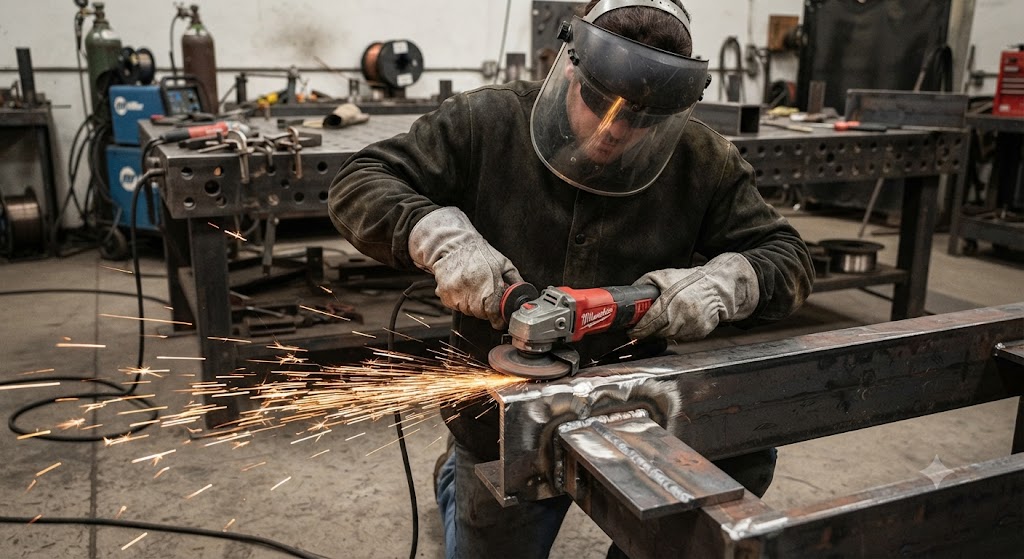
The solution is joint preparation: shaping the edges before welding so the weld can reach full depth. Beveling the edges, grinding them to an angle, creates a V shaped groove that gives the arc access to the root of the joint. On thicker material the edges may be prepared into other groove shapes, and often welded from both sides, so the weld fuses through the entire thickness. This is why a good welder spends real time on prep: the strength of a butt joint is built before any welding happens.
Penetration and the terms around it
The measure of a butt joint’s soundness is penetration, how far the weld fuses into the thickness of the metal.
A joint welded through its entire thickness has complete, or full, penetration, and it is as strong as the base metal for critical work. A joint welded only partway through has partial penetration, which is acceptable for some non critical uses but weaker. The root of the joint, the bottom of the seam, is the make or break zone: a weld that fails to fuse at the root has a built in crack waiting to grow, no matter how good the top looks.
| Term | Meaning |
|---|---|
| Groove weld | The weld that fills a prepared butt joint |
| Bevel | An angled edge ground to give the arc access |
| Root | The bottom of the joint, where fusion is critical |
| Complete penetration | Weld fuses through the full thickness |
| Partial penetration | Weld fuses only part of the way through |
Welding a butt joint well
Good results come from a few disciplined habits. Fit the pieces with a consistent gap, since the right root opening lets the arc reach the bottom, while a sloppy or uneven gap gives inconsistent penetration. Tack the pieces at intervals first to hold alignment, because a butt joint pulls and distorts as it cools.
On thicker material, weld in multiple passes: a root pass to fuse the bottom, then fill passes to build up the joint, then a cap. Clean between passes so no slag is trapped. Because a long butt weld pours heat into a line, expect some distortion and plan for it with tacking and, where needed, welding from both sides.
Reading it on a drawing
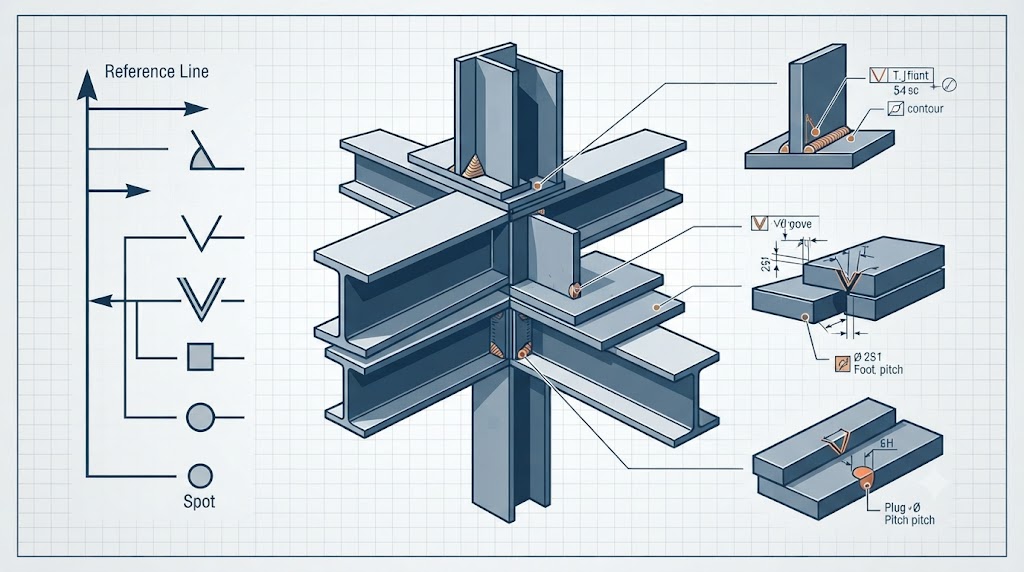
On a drawing, a butt joint is called out with a groove weld symbol that tells you the type of groove, such as a V or a square edge, and the dimensions. The symbol communicates how the edges should be prepared and how deep the weld should be, so reading it correctly tells you the prep before you cut a single bevel. The weld symbol and the joint work together: the symbol specifies, and your understanding of the joint executes.
The takeaway
A butt joint is two pieces welded edge to edge, and while it is the simplest joint to picture, its strength is decided by edge preparation and penetration, not by how the surface looks. Bevel thick edges, fit a consistent gap, weld the root soundly, and read the groove symbol to know what the drawing wants. Do that and the plainest joint in the shop becomes one of the strongest.
Frequently asked questions
What is a butt joint? Two pieces of metal placed edge to edge in the same plane and welded along the seam. The weld filling it is called a groove weld.
Why do I need to bevel the edges? On thicker metal, the arc cannot reach the bottom of a square seam from one side. Beveling creates a groove that lets the weld fuse to full depth.
What is the difference between complete and partial penetration? Complete penetration fuses through the full thickness and is as strong as the base metal. Partial penetration fuses only part way and is weaker.
Why does my butt joint crack at the bottom? Likely a lack of fusion at the root. If the weld does not fuse the bottom of the joint, it leaves a built in crack that can grow under load.
How do I stop a butt joint from warping? Tack at intervals to hold alignment, weld in passes, and where possible weld from both sides. A long single hot pass distorts the metal as it cools.
How is a butt joint shown on a drawing? With a groove weld symbol that specifies the groove type, such as a V or square, and the dimensions, telling you both the edge prep and the weld depth.
References
- OSHA, Welding, Cutting, and Brazing: https://www.osha.gov/welding-cutting-brazing
- American Welding Society, standards and codes: https://www.aws.org/standards-and-publications/codes-and-standards/d1-1/