Explicación de los diferentes tipos de uniones soldadas: una explicación clara para el uso en taller y en planos
Different Kinds of Welding Joints Explained: A Clear Explanation for Shop and Drawing Use
Beginners naturally focus on the bead, on making the weld itself look good. But experienced fabricators know a quieter truth: choosing the right joint for the job matters just as much as laying a clean bead. A perfect weld on the wrong joint can still fail, while the right joint often makes the weld easier and stronger. Understanding the different kinds of welding joints, and when to reach for each, is what turns a person who can weld into someone who can build.
The different kinds of welding joints are the standard ways two pieces of metal can be arranged to be joined. The trade recognizes five basic joints, butt, lap, tee, corner, and edge, and each arranges the metal differently, carries load differently, and calls for a particular type of weld. Knowing them lets you pick the arrangement that best fits the strength, appearance, and access a given job needs.
The five joints at a glance
Butt joint. Two pieces edge to edge in the same plane, filled with a groove weld. It creates one continuous flat piece and, with full penetration, can be as strong as the base metal. Thicker material needs beveled edges.
Lap joint. Two pieces overlapping, joined with a fillet weld along the edge. It is the easiest to fit up because there is no gap to control, and it is very common on sheet and plate.
Tee joint. One piece meeting another at an angle to form a T, filled with a fillet weld on each side. It is a workhorse for frames, bases, and stiffeners.
Corner joint. Two pieces meeting at their edges to form a corner, like a box. It uses a fillet or groove weld and suits frames, enclosures, and boxes.
Edge joint. Two parallel edges welded together, used mostly on thin material for light duty and sealing rather than heavy load.
| Joint | Ease of fit up | Load handling | Best for |
|---|---|---|---|
| Butt | Moderate, needs prep | High with full penetration | Continuous flat pieces |
| Lap | Easiest | Good in the right directions | Sheet, plate, fast work |
| Tee | Easy | Strong for perpendicular loads | Frames, bases, stiffeners |
| Corner | Moderate | Depends on weld and fit | Boxes, frames, enclosures |
| Edge | Easy | Light duty only | Thin metal, sealing |
How to choose the right joint
Selecting a joint comes down to weighing a few practical factors against each other.
Strength and load direction. Ask how the joint will be loaded. A butt joint handles direct pull along the pieces well, while tee and lap joints resist their loads through fillet welds that are strong in some directions and weaker in others. Match the joint to the way force will actually act on it.
Metal thickness. Thin material often suits lap and edge joints, which are easy to fit and do not need beveling. Thicker material for strong joints usually means butt or tee joints with prepared edges so the weld can penetrate fully.
Appearance and surface. If you need a smooth, flush surface, a butt joint gives one continuous plane. If an overlap is acceptable, a lap joint is faster and more forgiving.
Access and fit up. Consider how easily you can reach the joint and hold the pieces. A lap joint tolerates rough fit up, while a butt joint needs a controlled gap. Sometimes the joint you can actually access and clamp is the right one.
Joints and welds are not the same thing
A distinction worth repeating: the joint is how the pieces are arranged, and the weld is the bead that fills it. A fillet weld commonly fills lap, tee, and corner joints, while a groove weld fills butt joints and prepared corners. So you describe a weld by naming both the joint and the weld type together. Keeping them separate is what lets you plan work and read drawings without confusion.
Reading joints on a drawing
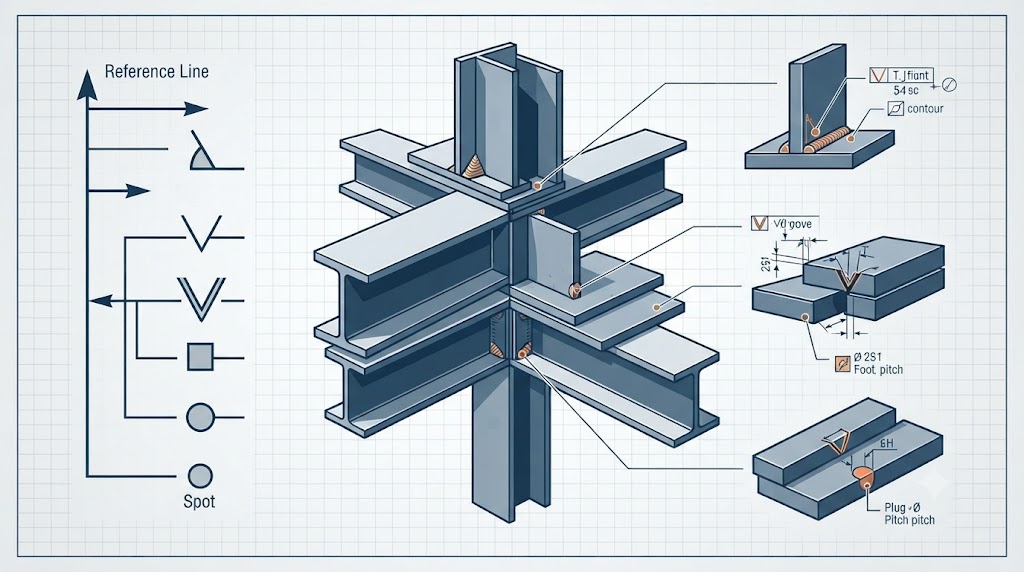
Drawings rarely spell out joint names. Instead a welding symbol on a reference line points at the joint and, by its shape, tells you the weld type, a triangle for a fillet, various shapes for grooves, along with size and instructions. Recognizing the joint in the metal and reading the symbol together tell you exactly what the designer wants. The joint is what you see; the symbol is what is specified.
The takeaway
The different kinds of welding joints, butt, lap, tee, corner, and edge, are the vocabulary of how metal gets arranged to be joined, and choosing well among them is as important as welding well. Weigh load direction, thickness, appearance, and access, keep the joint separate from the weld that fills it, and read both the metal and the drawing symbol. Master that and you move from making welds to designing sound joints.
Frequently asked questions
What are the different kinds of welding joints? The five basic joints are butt, lap, tee, corner, and edge. Each arranges the two pieces differently and calls for a particular type of weld.
How do I choose the right joint? Weigh how the joint will be loaded, the metal thickness, the appearance needed, and how easily you can access and fit the pieces. Match the joint to those.
Which joint is easiest to weld? The lap joint, since it needs no controlled gap or edge prep. The tee joint is also straightforward with a fillet weld on each side.
Which joint is strongest? A full penetration butt joint can match the base metal for direct loads, but the best joint depends on load direction, not strength alone.
What is the difference between a joint and a weld? The joint is how the pieces are positioned; the weld is the bead that fills it. A fillet weld, for example, can fill a lap, tee, or corner joint.
How are the different joints shown on drawings? With welding symbols on a reference line pointing at the joint. The symbol shape shows the weld type and size rather than naming the joint in words.
References
- OSHA, Welding, Cutting, and Brazing: https://www.osha.gov/welding-cutting-brazing
- American Welding Society, standards and codes: https://www.aws.org/standards-and-publications/codes-and-standards/d1-1/