Soldadura por arco con núcleo fundente: equipos, configuraciones y problemas comunes
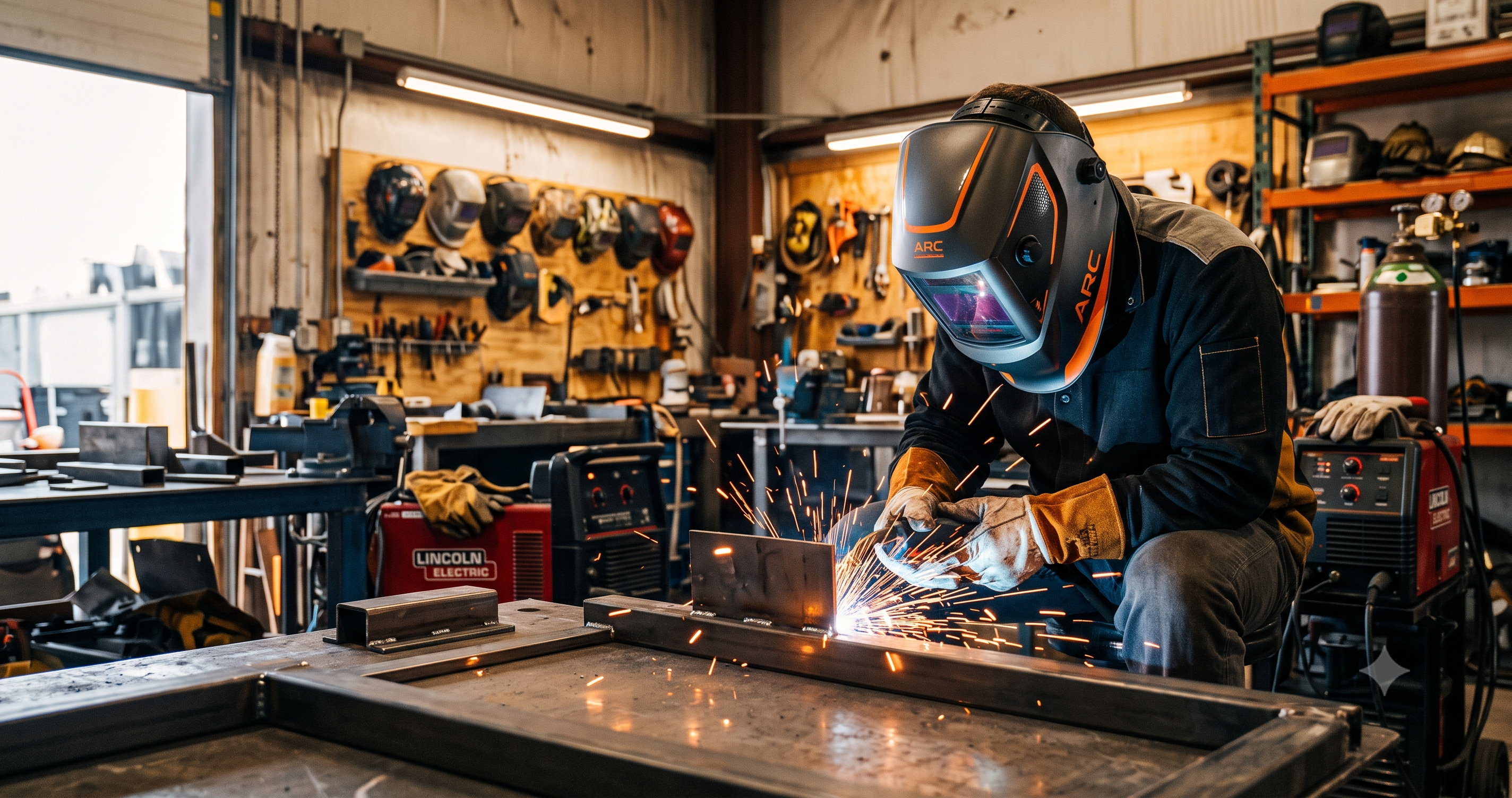
Ask ten welders why their flux core beads look bad and nine will talk about technique. In practice, most of the problem sits upstream of the gun: a crushed wire in the drive rolls, a liner packed with debris, a contact tip that has been burned open, or leads wired for the wrong polarity.
Flux core arc welding is a mechanical process wearing an artistic disguise. Fix the machine and your hand suddenly looks much better.
What flux core arc welding is
Flux core arc welding uses a tubular wire filled with flux, fed continuously through a gun. The flux burns at the arc to shield the puddle and forms slag over the cooling bead. Self-shielded wire needs no gas cylinder and runs on DC electrode negative; gas-shielded wire adds an external gas and runs on DC electrode positive.
The direct answer on getting good results: use knurled drive rolls at moderate tension, match the liner and contact tip to your wire diameter, run 1/2 inch stickout with a 15 to 20 degree drag angle, and balance voltage against wire feed speed until the arc makes a steady crackle rather than an irregular pop.
The equipment that decides your welds
Drive rolls
Flux cored wire is hollow. A smooth V-groove roll designed for solid wire, cranked down to stop slipping, will flatten it. Crushed wire feeds erratically, jams in the liner, and produces an arc that surges.
Use a knurled roll matched to your wire diameter and set tension so the wire just stops slipping when you pinch the outgoing wire with a gloved hand. If the wire slips, tighten a quarter turn at a time.
Liner
The liner is the single most neglected part of any wire feed machine. Flux dust accumulates inside it, and once it does, feeding becomes inconsistent no matter what you do at the drive rolls. Blowing it out with dry compressed air occasionally, and replacing it when the feeding never quite settles, solves problems people spend weeks chasing.
Liner size must match wire diameter. Running 0.030 inch wire through a liner sized for 0.045 inch produces a wandering feed.
Contact tip
A tip worn oval by wire passing through it loses electrical contact quality, which shows up as an arc that flickers and a bead with irregular fusion. Tips are consumables, not permanent parts. Keep spares in the correct size.
Nozzle
Self-shielded welding coats the nozzle in spatter fast. Many machines specify a different nozzle for gasless operation, often shorter or removed entirely. Follow the manual, keep it clean, and use anti-spatter spray.
Polarity leads
Open the wire feed compartment and verify. This one check prevents the majority of complaints about spatter and poor fusion.
Settings, and how to find them by ear
The published chart inside the machine door is your starting point. Refining it goes like this:
- Set voltage for thickness according to the chart.
- Set wire feed speed mid-range.
- Run a test bead on scrap of the same thickness in the same position.
- Listen and look.
| Symptom | Likely cause | Fix |
|---|---|---|
| Loud irregular popping | Wire speed too low for voltage | Increase wire speed |
| Soft sputtering, wire pushing into puddle | Wire speed too high | Reduce wire speed |
| Bead tall and narrow, poor fusion at edges | Voltage too low | Move up a voltage tap |
| Wide flat bead with undercut | Voltage too high | Move down a tap |
| Wire burning back to the tip | Stickout too short or feed too slow | Lengthen stickout, increase feed |
Manufacturer data sheets give real numbers rather than guesses. The Lincoln Innershield NR-211-MP documentation publishes wire feed speed, voltage, current and deposition rate by diameter, which is a far better reference than generic advice.
Wire selection by job
Lincoln NR-211-MP in 0.030 inch is the wire that flatters small machines: all-position, forgiving of gaps, clean slag release. Its ceiling is plate thickness, recommended to around 5/16 inch in smaller diameters. Anyone welding heavier structural steel needs to size up.
Hobart E71T-11 in 0.035 inch on a 10 pound spool is the choice for 3/16 inch and heavier on a 240 volt machine, with higher deposition and better penetration. It is too hot for sheet metal, where burn-through comes quickly.
Blue Demon E71T-11 in 0.030 inch is a good value small spool for a machine used occasionally. Spatter is heavier than the premium wires, meaning more nozzle maintenance.
Forney 42302 E71T-GS in 0.035 inch suits single-pass repairs on medium stock. Its classification means it should not be used for multipass structural joints.
For stainless repairs on the same machine, Blue Demon 308LFC-O in 0.035 inch runs on the same polarity with a matching liner. It generates hexavalent chromium fume, so extraction is required rather than recommended.
Machines and what each gives up
The Lincoln Electric Handy Core is the simplest entry: household power, gasless only, up to about 1/8 inch. Tapped settings and a small duty cycle make it a light repair tool that most people outgrow within a year.
The YESWELDER FLUX-135 adds synergic control and stick and lift TIG modes on the same 120 volt supply. Good value, basic gun, thinner support network.
The YESWELDER 165A dual voltage multiprocess machine is the more sensible buy for anyone who will weld anything over 3/16 inch, since 240 volt operation roughly doubles usable output. It carries the same caveats about accessories and support.
The Millermatic 142 is the quality reference in the 120 volt class. Its drive system and gun are on a different level, and automatic parameter setting genuinely helps. It is limited to about 3/16 inch and costs considerably more, so heavy fabricators should look at larger dual-voltage machines instead.
Common defects, and what actually causes them
Porosity. Wrong polarity, excessive stickout, damp wire, or welding over paint, oil or galvanising. Check polarity first, every time.
Slag inclusions. Pushing the gun instead of dragging, or skipping cleaning between passes. Both are habits rather than settings.
Lack of fusion at the toes. Voltage too low, travel too fast, or the gun angled so the arc is not reaching both members of the joint.
Excessive spatter. Wrong polarity, wire speed mismatch, dirty nozzle, or worn contact tip.
Undercut. Too much voltage, travel too fast, or too steep a gun angle. Slow slightly and reduce a tap.
Erratic wire feed. Crushed wire from over-tight drive rolls, a clogged liner, or a worn tip. Work backwards from the tip toward the spool.
Fume management is part of the equipment discussion
Self-shielded flux core produces heavy fume, more than gas-shielded MIG, because the flux burns openly at the arc. In an enclosed garage that plume builds fast. Position extraction close to the arc, keep your head out of the rising smoke, and treat galvanised or painted material as requiring proper local exhaust rather than an open door.
Final verdict
Flux core arc welding rewards mechanical discipline more than hand skill. Correct drive rolls at sensible tension, a clean liner, the right tip, verified polarity, half an inch of stickout, and a dragging gun. Get those right and average wire on an average machine produces welds that hold.
The test worth running once a month: cut one of your beads in half with a cut-off wheel and look at the cross section. Penetration, fusion at the root, trapped slag, they are all visible in ten seconds. Nobody who does this regularly stays a bad flux core welder for long.
Frequently asked questions
What drive rolls should I use for flux cored wire? Knurled rolls matched to your wire diameter, with tension set just past the point where the wire stops slipping. Smooth rolls at high tension crush tubular wire.
How do I know if my polarity is correct? Self-shielded wire needs DC electrode negative. If you see heavy spatter, a hunting arc and beads that will not fuse at the edges on a healthy machine, check the leads inside the wire feed compartment.
What causes porosity in flux core welds? Excess stickout, incorrect polarity, damp or rusty wire, and coatings such as paint or galvanising on the base metal.
How often should I replace the contact tip? Whenever the bore becomes oval or the arc starts flickering without another explanation. Tips are consumables and should be kept in stock.
Why does my wire birdnest at the drive rolls? Over-tight tension crushing the wire, a clogged or wrong-size liner, or a blocked contact tip creating back pressure.
What is the best flux core wire for general work? An E71T-11 wire in 0.030 inch for lighter work and 0.035 inch for 3/16 inch and heavier. E71T-GS is fine for single-pass repairs only.
Can the same machine run MIG and flux core? Many can. Switch the polarity leads, change to the correct drive roll and liner, and add gas for solid wire.
Do I need to clean slag between every pass? Yes. Slag left under a following pass becomes a permanent inclusion that must be ground out to repair.