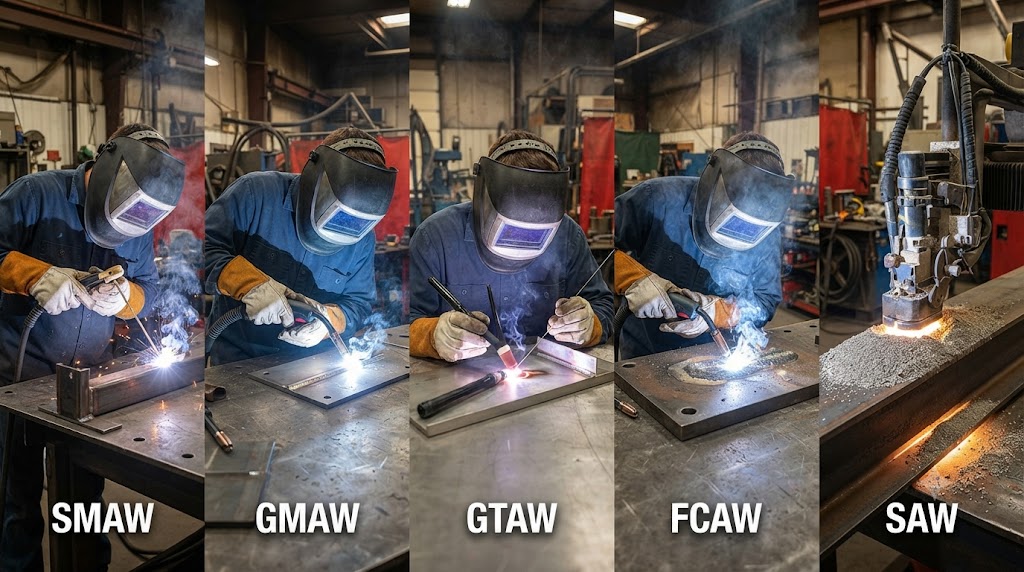
Soldadura por arco con núcleo fundente: elección, polaridad y configuración del alambre
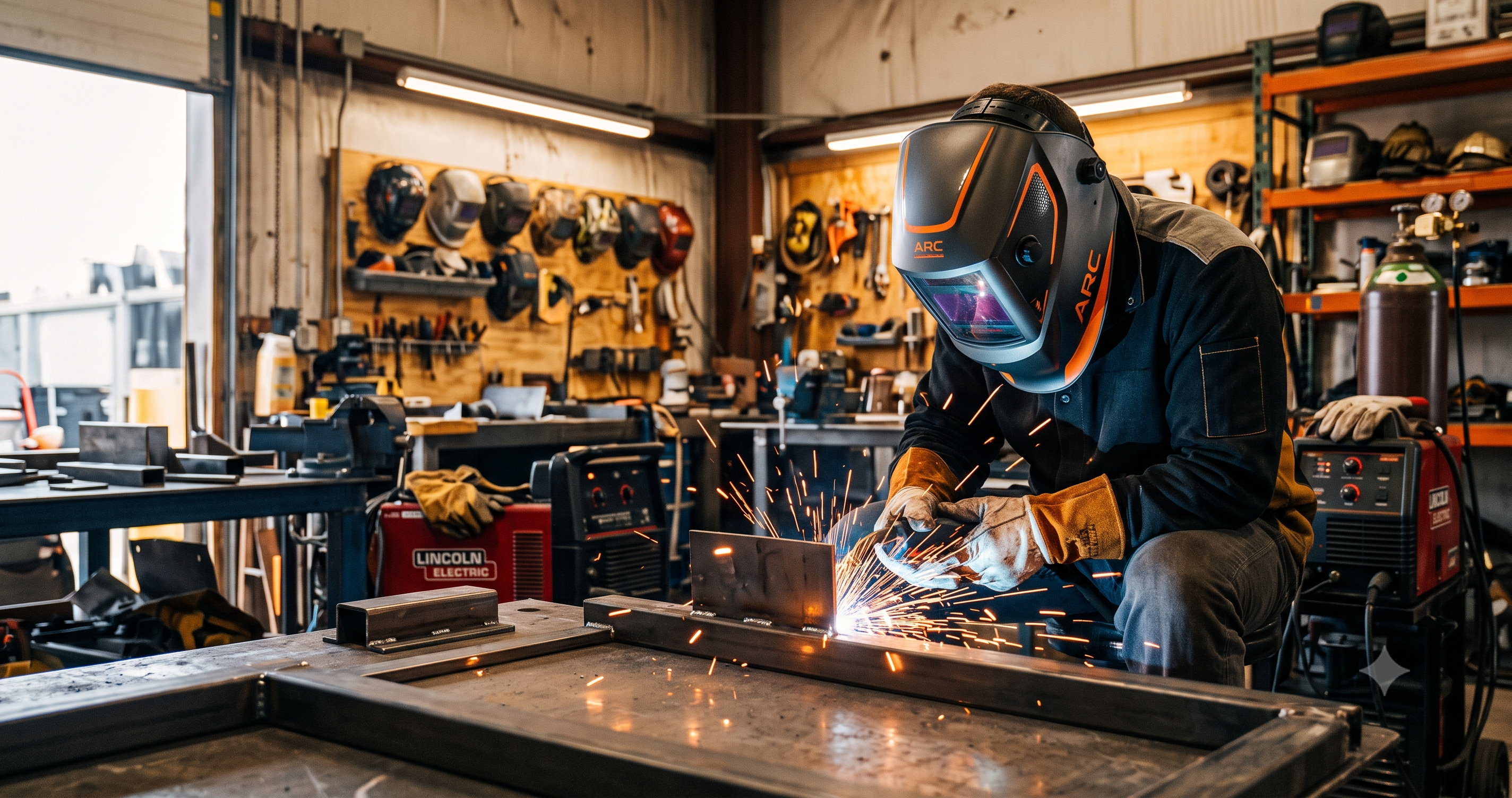
On a structural steel job, a welder running gas-shielded flux core can lay metal down several times faster than the same person running stick. On a farm gate in an open field, that same wire would produce a porous mess, while a self-shielded wire on a small machine works perfectly.
Both are flux cored arc welding. Treating them as one process is why so much advice on this subject contradicts itself.
What flux cored arc welding is
Flux cored arc welding (FCAW) is a wire feed process using a continuously fed tubular electrode filled with flux. The flux performs several jobs at once: it generates shielding gas, it forms slag that protects the cooling weld, it stabilises the arc, and in many wires it adds alloying elements to the deposit.
The process splits into two branches. FCAW-S is self-shielded, needing no external gas, and runs on DC electrode negative. FCAW-G uses flux plus an external shielding gas, usually carbon dioxide or an argon mix, and runs on DC electrode positive. Everything from bead appearance to wind tolerance follows from which branch you are using.
Reading wire classifications
AWS wire designations look cryptic and tell you everything. Take E71T-11:
- E for electrode
- 7 for 70,000 psi minimum tensile strength
- 1 for all-position capability (a 0 here means flat and horizontal only)
- T for tubular, meaning flux cored
- -11 identifies the usability class, in this case self-shielded, all-position, DC electrode negative
That single string tells you strength, positions, and shielding type before you buy. A few classes worth recognising:
| Classification | Shielding | Polarity | Typical use |
|---|---|---|---|
| E71T-11 | Self-shielded | DCEN | General fabrication, all-position, thin to medium plate |
| E71T-GS | Self-shielded | DCEN | Single pass repair on light material |
| E71T-1 | Gas-shielded | DCEP | Structural, high deposition, all-position |
| E70T-1 | Gas-shielded | DCEP | Flat and horizontal, high productivity |
| E308LFC-O | Self-shielded | DCEN | Stainless repair and fabrication |
The practical takeaway: E71T-11 wires can handle limited multipass work, while E71T-GS is intended for single pass. People routinely use GS wire for multipass joints and then wonder about inclusions.
Polarity, and the mistake everyone makes once
Self-shielded FCAW runs on DC electrode negative. Gas-shielded FCAW runs on DC electrode positive, the same as solid MIG wire.
Machines ship configured one way or the other, and the leads inside the wire feed compartment must be swapped when you change. Get it backwards and you see immediate symptoms: heavy spatter, poor fusion at the toes of the bead, an arc that hunts and hisses, and a bead that piles up rather than wetting out.
Manufacturer documentation states this per wire. Lincoln’s Innershield NR-211-MP data lists DC negative operation and gives wire feed speed, voltage and deposition rate figures by diameter, which is a more reliable starting point than any generic chart.
Deposition rate, the reason industry uses this process
Flux cored arc welding puts down metal faster than stick welding, and gas-shielded FCAW faster again than self-shielded. Published operating data for common self-shielded wire shows deposition rates climbing steadily with current, into the range of several pounds per hour at higher settings on larger diameters.
That productivity is the whole reason structural fabricators run this process. For a home shop the number matters less, but it explains why a small flux core machine feels so much quicker than a stick welder on the same bracket.
Setting up FCAW-S correctly
Stickout of 1/2 inch to 3/4 inch. Self-shielded wire needs the extra distance for the flux to work and for preheating of the wire through electrical resistance.
Drag angle of 15 to 20 degrees. Slag must trail the puddle, never lead it.
Knurled drive rolls, moderate tension. Tubular wire crushes under the tension you might use for solid wire.
Voltage and wire feed speed matched. Listen for a steady crackle. Irregular popping means the two are out of balance.
Clean between every pass. Non-negotiable in multipass work.
Setting up FCAW-G correctly
Everything above, with three changes. Polarity flips to electrode positive. You need shielding gas, typically 100 percent carbon dioxide for deep penetration or a 75/25 argon and carbon dioxide mix for a smoother arc and less spatter. And you lose wind tolerance, so this is an indoor or sheltered process.
In exchange you get better bead appearance, higher deposition rates, and easier out-of-position work with the right wire.
Wires worth buying, with honest limits
Lincoln NR-211-MP in 0.030 inch is the benchmark self-shielded wire for small machines. All-position, tolerant of poor fit-up, easy slag removal, and a bead appearance that flatters the process. Lincoln recommends it up to about 5/16 inch plate in the smaller diameters, so heavy structural sections need a different wire.
Hobart E71T-11 in 0.035 inch is the practical choice for 3/16 inch and heavier work on a 240 volt machine. It runs hotter and deposits faster than 0.030 inch wire. The downside is that it is too aggressive for sheet metal, where it will blow through before you can react.
Blue Demon E71T-11 in 0.030 inch is a reasonable value option on a small spool, useful for a machine that sits unused between projects. It spatters more than the premium wires, so nozzle cleaning becomes a routine part of the job.
Forney 42303 E71T-GS in 0.035 inch on a 10 pound spool suits high volume single-pass work such as long fillet runs on light structure. Its classification limits it to single pass, so it is the wrong choice for building thickness on heavy joints.
Where FCAW is the wrong choice
Thin sheet metal below 16 gauge, where the heat input and slag are both problems. Precision or cosmetic work where the bead is visible. Aluminium, which has no practical self-shielded flux cored option. And confined spaces without extraction, because the fume volume from this process is high.
Fume, seriously
Self-shielded FCAW produces more visible fume than almost any other common process, because the flux burns openly at the arc rather than inside a gas envelope. That plume contains metal oxides and, on coated steel, materials you do not want in your lungs. OSHA’s guidance on controlling welding fume and NIOSH’s work on manganese exposure both apply directly here. Extraction at the arc is the answer, not a fan across the room.
Final verdict
Choose self-shielded flux cored arc welding for outdoor work, repair, and situations where equipment must stay simple. Choose gas-shielded for shop production where speed and bead quality justify the cylinder. Read the wire classification before buying, set the polarity to match, and treat slag removal as part of welding rather than as cleanup afterwards.
The detail that separates people who like this process from people who do not is diameter selection. Most beginners run 0.030 inch wire on everything and then complain about penetration on 1/4 inch plate. Matching wire size to plate thickness fixes more problems than any other single adjustment in flux cored welding.
Frequently asked questions
What does FCAW stand for? Flux cored arc welding. FCAW-S is self-shielded and FCAW-G is gas-shielded.
What polarity is flux cored arc welding? Self-shielded wire uses DC electrode negative. Gas-shielded wire uses DC electrode positive. The wire label states which.
What is the difference between E71T-11 and E71T-GS? E71T-11 supports limited multipass welding and generally offers better mechanical properties. E71T-GS is intended for single pass work on light material.
Is flux cored arc welding faster than stick welding? Yes. Continuous wire feed and higher deposition rates make it substantially faster on most joints, particularly with gas-shielded wire.
Can flux cored arc welding be used outdoors? Self-shielded wire performs well outdoors and tolerates moderate wind. Gas-shielded wire does not, because wind disturbs the gas envelope.
What shielding gas does gas-shielded flux core use? Usually 100 percent carbon dioxide for deeper penetration, or a 75/25 argon and carbon dioxide mix for a smoother arc and reduced spatter.
Can you weld aluminium with flux cored wire? Not practically. There is no widely available self-shielded flux cored aluminium wire suitable for structural work. Use a spool gun with solid aluminium wire or TIG.
How thick can flux core weld? With self-shielded wire on a small machine, up to about 5/16 inch with the common wires. Heavier plate needs larger diameter wire, more machine capacity, and multiple passes.