Una mirada práctica a la mesa de soldadura portátil: configuración, estabilidad y espacio de trabajo
A Practical Look at Portable Welding Table: Setup, Stability and Working Space
Every weld you make is only as square as the surface under it. You can own a great machine and steady hands, but if the parts shift while you tack them, the finished piece comes out twisted. That is why a portable welding table, humble as it looks, quietly decides the quality of a lot of small shop work.
A portable welding table is a steel topped work surface built to be moved, usually with folding or removable legs and a grid of fixture holes for clamping. It gives you three things at once: a flat datum surface to build against, a conductive steel top you can ground to, and a pattern of holes that turn the whole table into a clamping system.
The three things that actually matter
Flatness. The top is your reference. If it is bowed, everything you build on it inherits that bow. Thicker steel plate stays flatter under heat and clamping load, and it resists the gradual warping that thin tops develop after repeated welding. When you compare tables, plate thickness tells you more about long term flatness than almost any other spec.
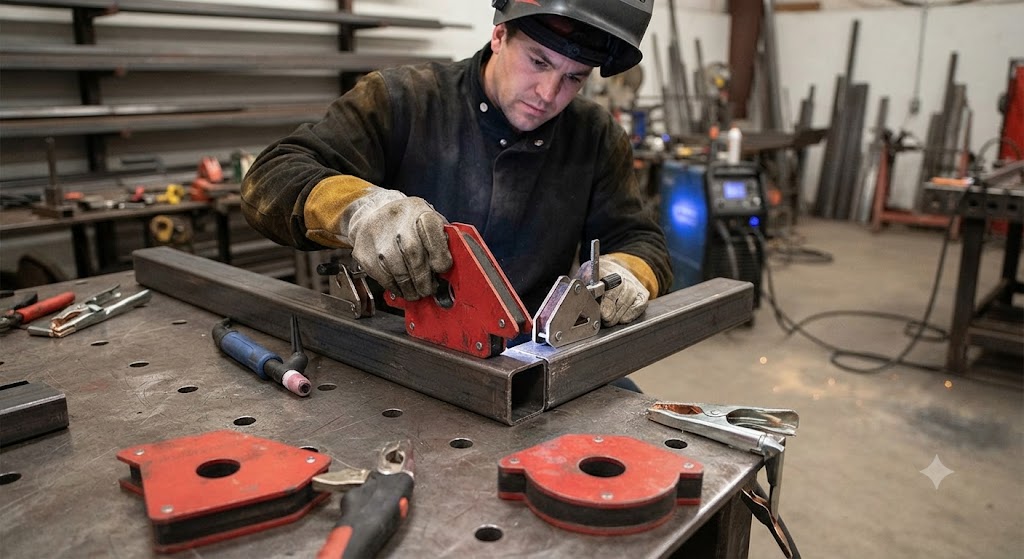
The fixture hole grid. Rows of holes, commonly 16 mm, let you drop in clamps, stops, and pins anywhere on the surface. This is what separates a real welding table from a plain steel bench. A locating stop in one hole and a workholding clamp in another hold a part square without you touching it, which frees both hands for the torch.
Stability. A light table that skates across the floor when you lean on it is worse than no table. Look for anti slip feet that adapt to an uneven slab, a rigid frame that does not rack side to side, and enough weight or footprint to stay planted. Adjustable feet matter more than people expect, because almost no shop floor is truly level.
Matching a table to your work
For a first table that covers hobby and light fabrication, the Klutch steel welding table with fit up tool kit pairs a holed steel top with a starter set of clamps and stops, so you can fixture work the day it arrives. Its honest limit is size and capacity: it is a bench scale table, not a platform for heavy structural pieces.
If you want more surface and load capacity, the VEVOR welding table 36 by 24 inch, 800 pound capacity gives you room to lay out mid size assemblies with fixture holes spaced for clamping. For a thicker, higher capacity top, the VEVOR welding table 36 by 18 inch rated to 1200 pounds trades some width for a sturdier surface. The fair warning on budget steel tables generally is that surface flatness out of the box varies, so check it with a straightedge and expect to do minor dressing on a high spot or two.
| Table | Best for | The honest limit |
|---|---|---|
| Klutch with fit up kit | First table, comes ready to clamp | Bench scale, light capacity |
| VEVOR 36x24, 800 lb | Mid size layouts, more room | Flatness varies, verify on arrival |
| VEVOR 36x18, 1200 lb | Heavier work, sturdier top | Narrower working width |
Setting it up so it earns its place
Ground to the table, not just the part. With a steel top, clamping your work lead to the table gives every piece on it a return path, which saves you moving the clamp constantly. Keep the contact point clean, since paint and heavy mill scale interrupt the ground.
Level the feet before your first weld. Adjust each foot until the table sits without rocking, then check the top with a straightedge in a few directions so you know your reference before you trust it.
Keep the surface clean and lightly protected. Spatter sticks to a bare top and creates high spots that throw off flat work. A quick scrape after each session and a wipe of anti spatter keeps the datum surface honest. If your top has a nitrided surface, spatter releases more easily, which is a genuine convenience over a raw plate.
Portability without the wobble
A folding table only helps if it locks solid when open. Before you buy, check that the legs latch positively rather than just resting in place, and that the folded package is a size and weight you will actually carry. A table that folds but weighs as much as a fixed bench has given up its main advantage.
Final read
The best portable welding table is the flattest one you can keep stable and still move. Prioritize a thick, flat top and a solid fixture hole grid, level the feet before you trust the surface, and ground to the steel to save yourself constant clamp shuffling. Get those right and the table becomes the quiet partner that keeps everything you build square.
Frequently asked questions
What fixture hole size should I look for? 16 mm holes are the most common standard, which means a wide range of clamps and stops will fit. Match your clamps to the hole size the table uses.
How flat does a welding table need to be? Flat enough that your parts sit without rocking and your reference lines stay true. Thicker plate holds flatness better under heat and clamping, so favor a heavier top for precise work.
Can I ground my welder to the table? Yes, and it is one of the main benefits of a steel top. Clamp the work lead to a clean spot on the table and every part on the surface has a return path.
Will a portable table hold up to heavy welding? Within its rated capacity, yes. Do not exceed the stated load, and expect a bench scale table to flex under weights it was never designed for.
How do I keep spatter from ruining the surface? Apply anti spatter, scrape the top after each session, and keep it clean. A nitrided surface releases spatter more easily than raw steel.
Are folding legs strong enough for real work? Good ones are, provided they latch positively when open. Check the latching mechanism before buying, since a leg that only rests in place can collapse under a side load.
References
- OSHA, Welding, Cutting, and Brazing: https://www.osha.gov/welding-cutting-brazing
- American Welding Society, standards and codes: https://www.aws.org/standards-and-publications/codes-and-standards/d1-1/