3M Speedglas 9100 vs G5 Series Compared
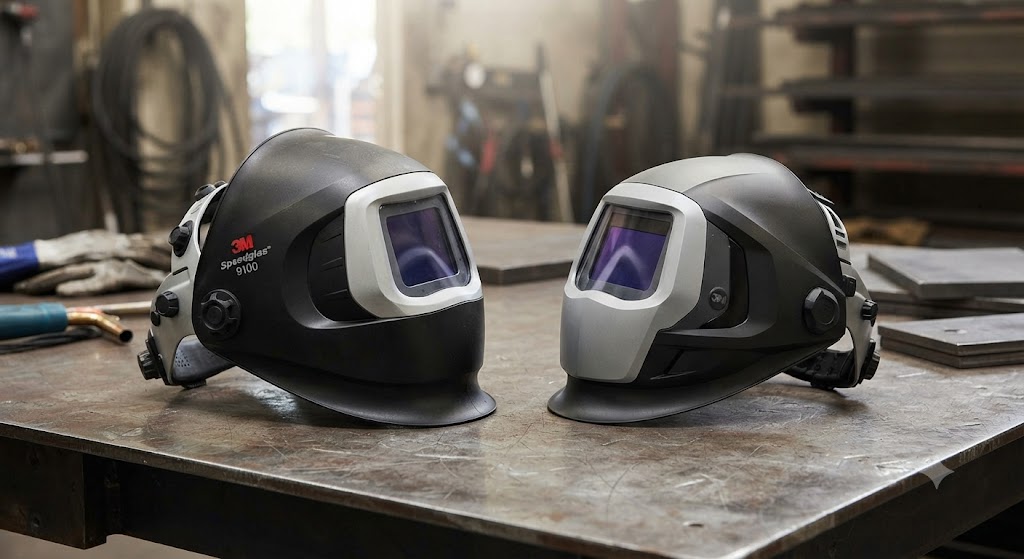
You’re standing in a distributor’s showroom holding a 9100XXi in one hand and a G5 spec sheet in the other. Both are 3M. Both are Speedglas. Both cost serious money. The salesperson keeps saying “it depends on your application,” which tells you nothing you didn’t already know.
Here’s what actually separates them: the 9100 series is a precision tool built around one outstanding auto-darkening filter. The G5 series is a platform - a heavy-duty shell engineered from the ground up to work with powered air and grinding visors in ways the 9100 family was never designed to handle. That distinction will tell you which one belongs on your head.
The 3M Speedglas 9100 lineup runs from the entry-level 9100V to the 9100XXi, its top model. The G5 series includes the G5-01 and the G5-02, with the G5-03 Pro shell added for PAPR-dedicated setups. Each targets a different tier of welder.
If you’re doing production TIG, MIG, or Stick in a shop without a forced-air requirement, the 9100XXi is likely the right call. If you’re welding in confined spaces, high-particulate environments, or you need respiratory protection baked into your helmet system, the G5 is worth the additional investment.
How the 9100XXi Compares to the G5-01
The 9100XXi filter sits at 2.87 x 4.21 inches (73 x 107 mm), which is a solid viewing area by any standard. The G5-01 pushes past it with a 12.3 square inch welding filter and a flip-up grinding visor that opens to 27.4 square inches - more than double the 9100XXi’s field when you flip it up.
Both run 3M’s Natural Color Technology, which reduces the green tint that cheaper ADF lenses layer over your weld puddle. The G5-01 goes a step further with Variable Color Technology on the G5-01VC filter, letting you tune the color tone of the dark state to match your environment. If you’re switching between indoor MIG and outdoor stick, that adjustment matters.
Switching speed on the 9100XXi is 0.1 ms at room temperature, with a light state of shade 3 and a dark range of shade 5 and 8 to 13. The G5-01 filter hits a light state of 2.5, meaning you get a slightly clearer view of your workpiece before the arc fires. That half-shade difference is genuinely noticeable in tight TIG setups where you’re positioning precisely.
Weight is where the 9100 wins back ground. The 9100 helmet shell checks in around 0.75 lb (339 g) without the filter. The G5-01 runs roughly 1.11 lb (503 g) without the filter, and heavier once you add the ADF. On a full-day production run, that 10 to 12 oz difference accumulates.
The G5-02: 3M’s High-End TIG Helmet
The G5-02 is the outlier in this comparison. It features the world’s first curved auto-darkening filter, a genuinely different approach to ADF optics. The curved glass follows the natural field of your vision rather than presenting a flat window, which reduces distortion at the edges and widens the effective field of view without adding filter area on paper.
Light state on the G5-02 is 2.5, shade range runs through ISO 16321 TIG+ standards, and it ships with Bluetooth connectivity and four arc sensors. The G5-02 is positioned specifically for precision TIG welding where edge distortion and light transmission are the primary concerns.
Flip side: the G5-02’s curved filter is a proprietary design. Replacement filters cost significantly more than 9100XXi replacements, and availability through regional distributors is spottier. If you’re in a shop that keeps spare filters on the shelf, factor that in.
G5 Series and PAPR Use
This is where the G5 separates cleanly from the 9100. Both the G5-01 and G5-03 Pro shells are built to integrate with the 3M Adflo Powered Air Purifying Respirator system. The helmet shell has dedicated airflow controls, two independent channels that let you direct purified air toward the visor/face area and top/sides in whatever combination works for your weld position.
The 9100 series is compatible with certain 3M respirators via adapter, but it was not designed around PAPR integration. The fit and airflow distribution on a G5 PAPR setup is tighter, more ergonomic, and significantly more comfortable over a long shift than a retrofitted 9100 with an adapter.
If your shop requires powered air or you’re welding stainless, chrome alloys, or galvanized material with any regularity, the G5 is the only real choice here. The Adflo system carries an APF of 1000 for full-face PAPR configurations.
Grinding Visor Option
The G5 series includes a clear flip-up grinding visor as a core design element. On the G5-01 and G5-03 Pro, you flip the helmet shell forward to expose a wide polycarbonate visor rated for grinding and setup work. This is a significant time saver on production floors where welders alternate between welding and grinding constantly.
The 9100 series does not include a flip-up grinding visor. You can adapt it for grinding by switching to grind mode on the ADF, but you’re still looking through a filtered lens rather than a clear one. For occasional grinding this is fine. For continuous alternating welding and grinding, the G5’s flip-up visor is noticeably faster.
Verdict: Which Speedglas Do You Actually Need?
For most shop welders running MIG, Stick, or TIG without powered air requirements, the 9100XXi is the smarter buy. It’s lighter, the filter replacement ecosystem is mature, and the 9100XXi ADF is one of the most proven high-performance filters 3M makes. Verified on Amazon: 3M Speedglas Welding Helmet 9100 with 9100XXi ADF.
For welders who need PAPR integration, work in high-particulate environments, or do precision TIG where the G5-02’s curved ADF would directly improve their view, the G5 is worth the premium. The G5-02 is listed on Amazon at : 3M Speedglas Welding Helmet G5-02.
The G5-01 standalone helmet is primarily sold through industrial distributors and safety supply channels rather than directly on Amazon. If PAPR use is your priority, start with your 3M distributor for a complete G5-01 Adflo bundle.
Comparison Table
| Feature | 9100XXi | G5-01 | G5-02 |
|---|---|---|---|
| Viewing area (weld) | 2.87 x 4.21 in | 12.3 sq in | Curved wide-view |
| Light state | Shade 3 | Shade 2.5 | Shade 2.5 |
| Dark state range | Shade 5, 8-13 | Shade 5-13 | Shade 5-13 |
| Switching speed | 0.1 ms | 0.1 ms | 0.1 ms |
| Grinding visor | No | Yes (flip-up) | Yes (flip-up) |
| PAPR integration | Adapter only | Full Adflo | Full Adflo |
| Bluetooth | No | No | Yes |
| Shell weight (no ADF) | 0.75 lb | 1.11 lb | ~1.26 lb |
FAQ
What is the difference between the 9100 and G5 series? The 9100 series centers on a proven ADF in a lightweight shell with no grinding visor or native PAPR integration. The G5 series is a heavier-duty platform designed around flip-up grinding visors and full Adflo PAPR compatibility, with wider viewing areas and a higher light-state transmission.
Is the G5 worth the upgrade from the 9100XXi? For most shop welders without PAPR requirements, no. The 9100XXi is lighter and its ADF is excellent. The G5 justifies its premium when you need powered air, constant grinding alternation, or the G5-02’s curved lens for precision TIG.
Which is better for PAPR use? The G5 series, unequivocally. The G5-01 and G5-03 Pro shells are built around Adflo PAPR integration with dual airflow controls and an ergonomic fit that purpose-built PAPR helmets achieve. The 9100 can be adapted, but it was not designed for it.
Can I use 9100 filters in a G5 helmet? No. The G5 series uses its own dedicated filters (G5-01TW, G5-01VC, G5-02 curved ADF). They are not interchangeable with 9100 series filters.
Is the 9100FX different from the 9100 with 9100XXi? The 9100FX is a larger 9100 shell with a flip-up front visor, positioned between the 9100 and the G5. It offers a bigger grinding shield than the standard 9100 while remaining lighter than the G5-01. It takes the same 9100-series filters.
Which model is best for TIG welding under 30 amps? The G5-02 or G5-01 with a 2.5 light state. At very low amperages, a lighter transmission in the bright state lets you position the torch with greater accuracy before you strike the arc. The 9100XXi at shade 3 is workable but darker.
Where can I find 3M Speedglas spec sheets? Official specs live at 3m.com’s Speedglas product pages. The 3M Speedglas comparison chart PDF is hosted at multimedia.3m.com and compares every current model side by side.
If you are choosing between the 9100XXi and a G5 model, the honest question is whether you need what only the G5 provides. Most welders don’t - and they’re better served by a lighter, simpler helmet that does one thing extremely well.
References
- https://multimedia.3m.com/mws/media/1508378O/3m-speedglas-welding-helmet-9100-and-9100-air-technical-specification.pdf
- https://multimedia.3m.com/mws/media/1967041O/speedglas-comparison-chart.pdf
- https://www.3m.com/3M/en_US/speedglas-welding-helmets-us/speedglas-9100xxi/
- https://www.3m.com/3M/en_US/speedglas-welding-helmets-us/products/g5-02/
- https://www.3m.com/3M/en_US/p/d/b5005081009/
- https://www.apexweldingsafety.com.au/blog/what-are-the-key-differences-between-the-speedglas-g5-01-and-the-speedglas-9100-fx-air
Slug: 3m-speedglas-9100-vs-g5-series-compared Excerpt: The 9100XXi is lighter and proven for everyday shop welding. The G5 series is a PAPR-ready platform with a wider view and a flip-up grinding visor. Here’s exactly where each one earns its place and where it falls short.