ESAB Sentinel A50 vs Hobart Welding Helmet Compared
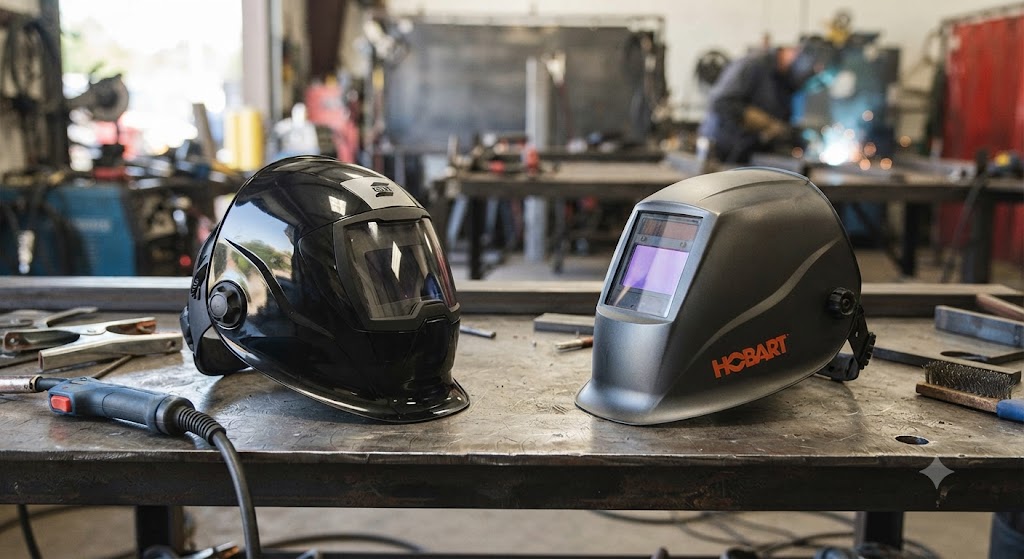
You can tell a lot about a welding helmet by how it feels after four hours. Not the first fifteen minutes, when everything feels fine. The question is whether you are still making clean welds at the end of a shift or quietly resenting the headgear. The ESAB Sentinel A50 and the Hobart Inventor 770890 are both serious helmets aimed at professional and serious hobbyist welders, but they answer the comfort and control questions differently.
The ESAB Sentinel A50 (model 0700000800) is a professional auto-darkening welding helmet with a curved low-profile shell, HALO five-point headgear, a color touchscreen control panel, shade 5 to 13, four arc sensors, external grind button, and real-color lens technology. It is available on Amazon.
The Hobart Inventor (model 770890) is a high-performance auto-darkening helmet with a 9.3 square-inch PureColor lens, four independent arc sensors, shade 9 to 13, analog controls, grind mode, and an ergonomic ratcheting headgear. It is available on Amazon.
Direct answer: if comfort over long sessions and optical clarity are your main priorities, the ESAB Sentinel A50’s HALO headgear and true-color lens are the reason welders keep coming back to it. If you want consistent arc detection, simple analog controls that survive rough shop life, and a wider viewing area, the Hobart Inventor 770890 is a reliable professional workhorse.
Lens and optics: Sentinel real-color vs. Hobart PureColor
The ESAB Sentinel A50 uses ESAB’s real-color lens technology with an optical rating of 1/1/1/2. That second number in the rating reflects diffusion of light, where a rating of 2 rather than 1 is a minor spec concession at this price tier. In practice, the Sentinel A50’s real-color view is a step above standard ADF helmets, with noticeably less of the green tint that basic lenses carry.
The Hobart Inventor 770890 uses PureColor lens technology, which Hobart describes as providing true-to-life color accuracy and improved clarity. Its 9.3 square-inch viewing area is a genuine advantage for positional work and larger joint setups where a bigger window reduces repositioning. The Inventor’s viewing field of 3.94 inches by 2.36 inches is wide in horizontal terms.
The honest flaw on the Sentinel A50’s optics: the 3.93-inch by 2.36-inch viewing area is comparable to the Inventor’s, but the A50’s curved shell design and lens position mean some welders find the lens geometry slightly more restrictive in certain down-hand positions than a flatter shell design. This is personal and varies by face shape.
Headgear: HALO is the A50’s main selling point
The ESAB Sentinel A50’s HALO headgear is a five-point contact system that spreads helmet weight around the head more evenly than a standard two or three-point ratchet design. The result is that the A50 sits on your head rather than pressing on it, which matters enormously over a four to eight hour shift.
Welders who switch to the Sentinel from a standard ratchet headgear often describe the comfort difference as significant enough to affect how long they can weld before taking a break. If headgear pressure points are currently shortening your work sessions, the A50’s HALO design is the most practical fix available in this price tier.
The Hobart Inventor 770890 comes with Hobart’s ergonomic ratcheting headgear. It adjusts reliably and fits a wide range of head sizes. It is a quality system for a production helmet. The honest flaw is that it is a conventional ratchet headgear, and some welders with longer welding sessions will feel that comparison against the A50’s five-point HALO system after a few hours.
Controls: analog reliability vs. touchscreen versatility
The Hobart Inventor uses analog dials for shade, sensitivity, and delay adjustments, plus a grind mode switch. These are physical controls you can operate with gloved hands without looking at them. In gritty shop conditions with grinding dust and repeated exposure to rough handling, analog dials are mechanically simpler and less prone to interface degradation over time.
The ESAB Sentinel A50 uses a color touchscreen control panel on the inside of the helmet, with eight memory settings for different welding processes. The touchscreen is genuinely useful when you are switching between TIG at low amperage and MIG at higher amperage, because you can store those settings and call them back without re-dialing every time.
The honest flaw on the Sentinel A50 that experienced fabricators consistently raise: the touchscreen interface is less reliable than analog controls in dirty shop conditions. Fine grinding dust and moisture affect responsiveness, and the delicate surface is not immune to damage from the kind of accidental bench contact that a physical dial shrugs off. This is the trade the A50 makes for its versatility.
Shade range: A50 covers more ground
The ESAB Sentinel A50 covers shade 5 to 13, which includes the lighter shades needed for gas welding and cutting applications. This gives the A50 a functional range advantage for shops that mix arc and gas processes without wanting to swap helmets.
The Hobart Inventor 770890 runs shade 9 to 13 in weld mode, with shade 3 in grind mode. For MIG, stick, and most TIG work, shade 9 to 13 is the right range. For shops doing gas work or plasma cutting where a lighter shade is needed, the Inventor does not cover that ground.
Sensor performance
Both helmets carry four independent arc sensors. On the Hobart Inventor, the four-sensor layout provides solid detection for standard welding positions and decent coverage when torch angles shift. The switching speed of 1/25,000 second means you are not waiting for the lens to react when you strike an arc.
The ESAB Sentinel A50’s four sensors similarly provide reliable detection across MIG, TIG, and stick processes down to two amps on TIG, which is one of the lower low-amperage ratings available in a professional helmet. That two-amp floor matters specifically for precision TIG work on thin material where many helmets would fail to detect the arc reliably.
Comparison table
| Feature | ESAB Sentinel A50 | Hobart Inventor 770890 |
|---|---|---|
| Viewing area | 3.93” x 2.36” | 9.3 sq in (3.94” x 2.36”) |
| Shade range | 5 to 13 | 9 to 13 (weld), 3 (grind) |
| Arc sensors | 4 | 4 |
| Optical rating | 1/1/1/2 | PureColor |
| Controls | Color touchscreen | Analog dials |
| Headgear | HALO 5-point | Ratchet headgear |
| Low-amp TIG | Down to 2 amps | 10 amps |
| Memory settings | 8 | None |
| Amazon | Check on Amazon | Check on Amazon |
Which has better sensor reliability?
Both helmets have four arc sensors, which is the configuration that handles the widest range of positions reliably. The Hobart Inventor’s four-sensor layout performs consistently in standard and overhead positions. The Sentinel A50 adds the two-amp TIG rating, which indicates the sensor and electronics are calibrated for lower-signal detection than the Inventor’s ten-amp floor.
For standard production welding at typical amperages, both helmets detect reliably. For precision TIG at very low amperages, the A50’s two-amp rating is a meaningful technical advantage.
Which has the more comfortable headgear?
The ESAB Sentinel A50’s HALO five-point headgear is the more comfortable system for most welders. This is not a close comparison for long sessions. The Hobart Inventor’s ratchet headgear is well-made and adjustable, but it uses the same basic architecture as most mid-tier helmets. The A50 was specifically engineered around the HALO headgear as a defining product feature, and that shows in daily wear.
Final verdict
Buy the ESAB Sentinel A50 if you weld for long sessions, run low-amperage TIG, need shade 5 to 13 coverage for mixed processes, or want the HALO headgear comfort that makes a real difference by the end of a full day.
Buy the Hobart Inventor 770890 if you want dependable analog controls that survive rough shop conditions, a wide 9.3 square-inch viewing area, and four-sensor performance without the touchscreen durability concern.
Skip the Sentinel A50 if your helmet is going to live in a rough production environment with heavy grinding dust and daily physical contact that could compromise the touchscreen over time.
FAQ
Which is the better value, Sentinel A50 or Hobart Inventor?
For welders who prioritize long-session comfort and low-amperage TIG capability, the Sentinel A50 delivers more features that directly affect daily performance. For welders who want straightforward reliability, simple controls, and a wide viewing area without a touchscreen to worry about, the Hobart Inventor 770890 is the better practical choice.
Which has better sensor reliability?
Both have four arc sensors, so standard detection is comparable. The ESAB Sentinel A50 is rated for TIG detection down to two amps, while the Hobart Inventor is rated to ten amps. For standard MIG and stick, both are reliable. For precision TIG on thin material, the A50’s two-amp floor is the technical edge.
Which has the more comfortable headgear?
The ESAB Sentinel A50. The HALO five-point headgear distributes weight more evenly around the head than the Hobart’s ratchet system. This is consistently the reason welders who switch to the Sentinel report less fatigue during extended sessions.
Does the ESAB Sentinel A50 touchscreen hold up in dirty environments?
It functions in normal shop conditions, but the touchscreen interface is more vulnerable than analog dials to grinding dust buildup and physical contact over time. Welders in heavy grinding environments report more touchscreen responsiveness issues than those working primarily on welding. This is a known long-term concern with the A50.
What is the low-amperage TIG rating for each helmet?
The ESAB Sentinel A50 is rated for low-amperage TIG detection at two amps or greater. The Hobart Inventor is rated for low-amperage TIG at ten amps. The A50’s lower floor makes it the more capable choice for precision TIG on thin aluminum and stainless.
Can the Hobart Inventor 770890 detect high-frequency TIG starts?
The Hobart Inventor’s four-sensor design handles standard TIG arc detection reliably. For high-frequency start TIG processes, confirm your specific machine’s characteristics, as interference sensitivity varies between helmet designs. The Inventor is generally used successfully across standard HF-start TIG setups.
Are replacement parts available for both helmets?
Yes. ESAB Sentinel A50 cover lenses, headgear assemblies, and inner cover plates are available on Amazon and through ESAB distributors. Hobart Inventor cover lenses and headgear are available through Hobart’s dealer network and welding supply stores.
References
- https://esab.com/us/nam_en/products-solutions/product/ppe-safety/head-and-face/sentinel-a50/
- https://www.hobartwelders.com/en-us/safety-products/helmets/inventor/inventor-series-welding-helmets-m30204/inventor-black-770890
- Check on Amazon
- Check on Amazon
- https://store.cyberweld.com/products/hobart-inventor-purecolor-welding-helmet-black-770890
- https://www.osha.gov/sites/default/files/publications/OSHAFACTSHEET-EYEPROTECTION-DURING-WELDING.pdf
- https://www.aws.org/magazines-and-media/welding-digest/2025/november/wd-nov-2025—complete-welding-lens-shade-chart—safety-guide-for-eye-protection/