ESAB Sentinel A60 vs A70 Pro: Which Sentinel Belongs in Your Shop?
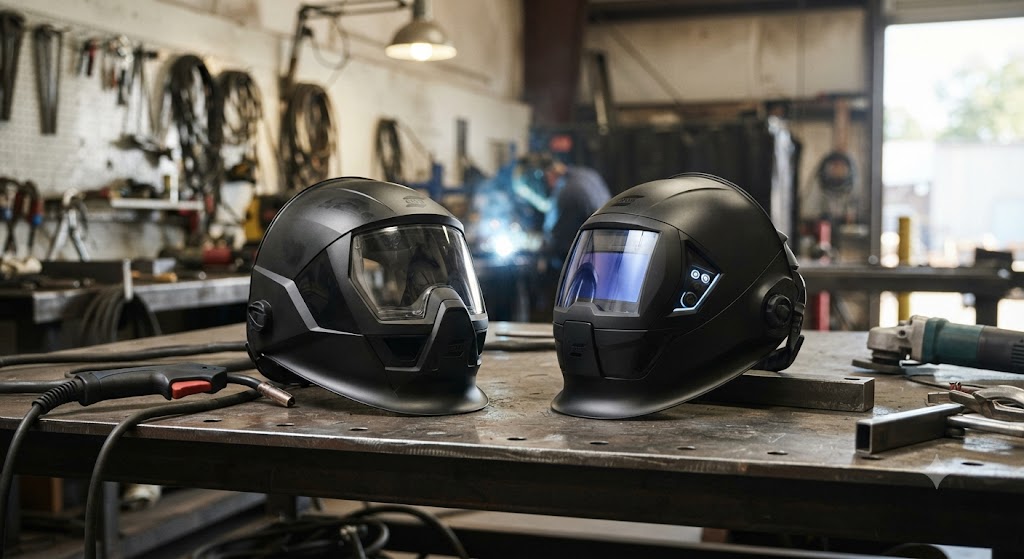
You strike an arc, finish a pass, then need to grind the tack before the next. If you’re wearing a standard auto-darkening helmet, that means lifting it off, swapping to a face shield, and starting again. On a full production day that sequence adds up fast. The Sentinel A60 and the Sentinel A70 Pro both solve the problem of arc visibility better than most helmets in their weight class, but they disagree fundamentally on how to handle the grinding side of the job. One asks you to choose. The other does not.
ESAB built the Sentinel line on a specific premise: heavy-impact nylon shell, generous viewing area, and a lens so optically clear it stops feeling like you are looking through glass. The A60 is the established version of that formula. The A70 Pro, launched in 2026, adds a flip-up ADF, an integrated LED work light, Bluetooth connectivity, and an oversized grinding shield. It is the more capable helmet. It is also significantly heavier, considerably more expensive, and designed for a production environment that actually needs everything it offers.
Here is the honest answer before the breakdown: the A60 is the right choice for most welders. The A70 Pro is the right choice for welders who move between welding and grinding without leaving the booth, work long shifts in heavy industry, and will actually use the flip-up mechanism every day.
What Separates the Two Helmets at a Glance
The A60 runs a fixed ADF format. Its viewing area measures 4.65 inches by 2.80 inches, which is larger than the standard 3.93 by 2.36 you find on the A50. The shell is low-profile high-impact nylon, and the headgear uses ESAB’s pivot system that distributes weight across the crown rather than just the forehead. The ADF uses solar and battery power with a color touch screen for shade and sensitivity settings.
The A70 Pro adds a flip-up ADF bracket that can be removed entirely for certain applications. The viewing area on the ADF measures 4.8 inches by 3.0 inches (a slight increase), and the grinding shield behind it is oversized so when you flip the ADF up, you still have face coverage during prep work. The part number is 0700900700. It ships with a rear FR head covering, front FR chest cover, carry bag, and LED work light powered by a standard AA battery. The LED work light is mounted above the ADF so it throws light directly into the joint when you are in tight corners. Bluetooth connects to the ESAB app for remote shade control.
The A70 Pro weighs in at 32 ounces. The A60 is meaningfully lighter. On an eight-hour shift, that difference is felt in the neck and upper back by early afternoon.
The A60: Where It Wins
The A60 delivers ESAB’s lens clarity at a price point that does not require sign-off from your shop owner. The optical class on the ADF and the 4.65 by 2.80 viewing area make it one of the best-value lenses currently available. For structural welding, pipe, fabrication work, and any situation where you move the helmet off your head to grind rather than flipping the ADF up, the A60 does everything a professional needs.
It is also the better choice for welders who work primarily on TIG. TIG passes are slower, the arc is tighter, and the larger fixed lens gives you an unobstructed view of the puddle edge without an articulated bracket in the optical path.
Named flaw: The A60 has no flip-up mechanism. If your workflow regularly alternates between welding and grinding, you are lifting the helmet off your head, setting it aside, working with a separate face shield, and reversing the process. Over a long shift this is a genuine productivity drain, and it is not a knock on build quality, it is a limitation of the design choice.
Who should skip it: Any welder whose daily work involves repeated weld-grind-weld cycles without leaving the immediate work area. The A70 Pro exists specifically for that welder.
Check the ESAB Sentinel A60 on Amazon
The A70 Pro: Where It Wins
The flip-up design is not a gimmick on the A70 Pro because ESAB built the grinding shield to be genuinely protective rather than an afterthought. The oversized shield means your face is covered with hard shell when the ADF is up. Other flip-up helmets leave you with a thin polycarbonate plate and a prayer. The A70 Pro’s grinding position gives you real face protection from sparks and slag.
The integrated LED work light is a specific win in industrial environments where overhead lighting is uneven. If you have ever tried to read a root pass in the shadow of your own helmet, the work light solves exactly that problem.
For shipbuilding, heavy fab, pressure vessel work, or any environment where you weld and grind inside the same confined space, the A70 Pro removes the helmet-swap completely. That is real time saved at scale.
Named flaw: At 32 ounces, the A70 Pro is a heavy helmet. By comparison, most standard auto-darkening helmets run 18 to 24 ounces. The neck fatigue is real over a full production shift, and welders with existing neck or shoulder issues should handle it before committing. The weight is the trade-off for the flip-up mechanism, the grinding shield, and the work light. None of those features are light.
Who should skip it: Hobbyists, light fabricators, and welders who primarily TIG. The A70 Pro is built for production-volume heavy industry. If you are welding a few hours a week or running delicate TIG passes on thin material, you are paying for features you will not use and carrying weight you do not need.
Note: As of this writing, the A70 Pro (part 0700900700) is available through ESAB authorized dealers and select distributors. Verify current Amazon availability before purchasing; the A60 link above is active and ships Prime.
Spec-by-Spec Comparison
| Feature | Sentinel A60 | Sentinel A70 Pro |
|---|---|---|
| ADF format | Fixed | Flip-up, removable |
| Viewing area | 4.65” x 2.80” | 4.80” x 3.00” |
| Grinding shield | Standard | Oversized |
| Integrated work light | No | Yes (LED, AA battery) |
| Bluetooth | No | Yes |
| FR head/chest cover included | No | Yes |
| Weight | Lighter (standard) | 32 oz |
| Part number | 0700000830 | 0700900700 |
Is the A70 Pro Worth It for Grinding Work?
Yes, if grinding is a daily, repeated part of your workflow inside the booth. The flip-up ADF with the oversized grinding shield is the entire reason the A70 Pro exists. If you grind occasionally or step away from the welding position to use a bench grinder or angle grinder elsewhere, the A60 is a better value for your specific use case.
The A70 Pro’s flip-up is most valuable in confined spaces (pipe racks, structural steel corners, inside tanks) where taking the helmet off and putting it back on is physically awkward rather than just inconvenient.
Which Is Better for Heavy Industrial Use?
The A70 Pro is designed specifically for heavy industrial use. The FR head and chest covers are included because ESAB built the helmet for environments where your collar and neck regularly catch sparks. The Bluetooth app control means a production welder does not break workflow to adjust shade between MIG and stick passes.
For light fabrication or small-shop work, the A60 delivers a better value. For pipeline, shipbuilding, heavy structural, or pressure vessel work, the A70 Pro pays for itself in reduced non-weld time.
Bottom Line
The Sentinel A60 is one of the best standard auto-darkening helmets on the market. Its lens is the standout feature: clear, fast, and large enough to see the whole puddle on most joint configurations. Buy it if your work does not demand a flip-up.
The A70 Pro is a purpose-built industrial tool. Its weight is a real trade-off that you feel by hour six. But if you work in heavy industry and spend the day moving between welding and grinding inside the same tight space, the flip-up mechanism with the proper grinding shield is a genuine workflow upgrade, not a spec-sheet checkbox.
The decision is simpler than the price difference suggests: do you flip up every day, or don’t you?
FAQ
What is the difference between the ESAB Sentinel A60 and A70 Pro? The A60 is a fixed-ADF helmet with a large 4.65” x 2.80” viewing area in a lightweight low-profile shell. The A70 Pro adds a flip-up ADF, an oversized grinding shield, an integrated LED work light, Bluetooth connectivity, and included FR head and chest protection. The A70 Pro weighs 32 ounces and is built for heavy industrial use; the A60 is better suited for welders who do not need flip-up capability.
Is the A70 Pro worth it for grinding work? If grinding is a daily, repeated part of your booth work, yes. The oversized grinding shield gives real face protection when the ADF is flipped up, which separates it from cheaper flip-up designs. If you grind occasionally or away from the welding position, the A60 is a better value.
Which is better for heavy industrial use? The A70 Pro. It was designed for production welding environments where you cycle between welding and grinding without leaving the work area. The FR head and chest covers, integrated work light, and Bluetooth shade control are all features built for industrial volume.
Can you remove the ADF on the A70 Pro? Yes. The flip-up ADF bracket on the A70 Pro is designed to be fully removable, giving you access to the grinding shield alone for cutting and prep work.
Does the A60 have a grind mode? Yes. The A60 includes a grind mode that locks the lens at shade 3 (passive) so you can grind without the ADF switching off. What it lacks is a physical flip-up mechanism; the ADF stays in the fixed position during grinding.
What shell material does the A60 use? High-impact resistance nylon. It is the same core shell architecture ESAB uses across the Sentinel line, designed to handle the incidental impacts common in fabrication environments.
Is the A70 Pro on Amazon? As of this writing, the A70 Pro (part 0700900700) is newly launched and available through ESAB authorized distributors. Check Amazon for current availability; the A60 is actively listed and ships Prime.
References
- https://esab.com/us/nam_en/products-solutions/product/ppe-safety/head-and-face/sentinel-a70-pro/
- https://esab.com/us/nam_en/about/news-folder/esab-launches-sentinel-a70-pro-premium-flip-up-welding-helmet/
- https://www.esab.com/us/nam_en/products-solutions/product/ppe-safety/head-and-face/sentinel-a60/
URL slug: esab-sentinel-a60-vs-a70-pro Excerpt: The A60 and A70 Pro both carry ESAB’s best optics, but one flips up and one does not. Here is the real difference between the two Sentinel helmets, which is worth the extra weight, and who should skip the upgrade entirely.