ESAB Sentinel vs. Savage A40 Compared
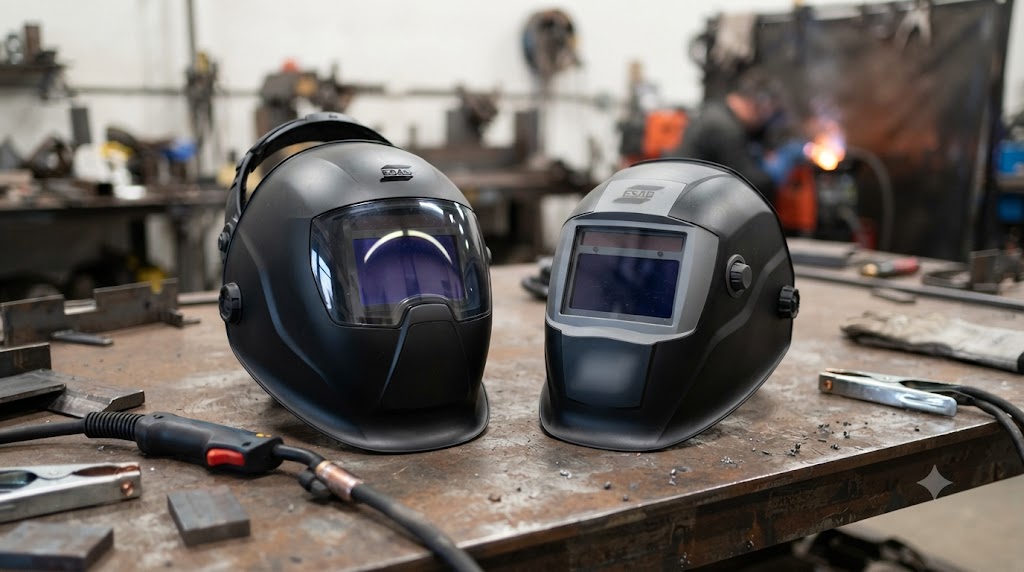
ESAB produces two distinct tiers of welding helmets: the Sentinel flagship line and the Savage budget line. Both have strong followings - but they are built for fundamentally different buyers.
ESAB Helmet Lineup Overview
| Line | Flagship | Budget |
|---|---|---|
| Name | Sentinel A50 | Savage A40 |
| Target buyer | Professional, daily use | Hobbyist, occasional welder |
| Search “ESAB Sentinel A50” | ||
| Price | ~$300–350 | ~$80–110 |
ESAB Savage A40 Specifications
- Viewing area: ~7.73 sq. in.
- Shade range: DIN 9–13
- Switching speed: 1/25,000 sec
- Arc sensors: 4
- Solar + battery powered
- Grind mode: Yes
- True color lens: Limited (not ESAB’s Halo lens)
- Headgear: Standard
- Weight: ~15 oz.
ESAB Sentinel A50 Specifications
- Viewing area: 9.3 sq. in.
- Shade range: DIN 5–13
- Switching speed: 1/25,000 sec
- Arc sensors: 4
- Lens: Halo lens (ESAB’s true-color technology)
- Solar + battery powered
- Grind mode: Yes
- Distinctive curved shell design
- Digital controls (external adjustment dial)
- Weight: ~19 oz.
What Is the Difference Between the Sentinel and Savage Lines?
| Feature | Savage A40 | Sentinel A50 |
|---|---|---|
| Viewing area | 7.73 sq. in. | 9.3 sq. in. |
| True-color lens | Basic | Halo (premium) |
| Shade range low | DIN 9 | DIN 5 (TIG capable) |
| Shell design | Conventional | Distinctive curved |
| Controls | Basic knobs | External digital dial |
| Weight | ~15 oz. | ~19 oz. |
| Price | ~$80–110 | ~$300–350 |
Critical difference: DIN 5 shade on the Sentinel enables TIG welding at low amperages. The Savage A40’s DIN 9 minimum excludes it from TIG use.
Is the Savage A40 a True Budget Option?
Yes - the Savage A40 is ESAB’s entry-level product, designed to bring ESAB branding and 4-sensor reliability to the sub-$100 price tier.
What you give up vs. the Sentinel:
- No Halo true-color lens
- Smaller viewing area
- No TIG capability (DIN 9 minimum)
- No curved ergonomic shell
- Less comfortable headgear
What you keep:
- ESAB brand quality control
- 4-arc sensors
- 1/25,000 sec switching speed
- Solar + battery power
Which Is Better for Occasional Home Welding?
MIG-only hobbyist: The Savage A40 is excellent value. 4 sensors, fast switching, ESAB reliability for ~$90.
TIG welder (any experience level): The Sentinel A50 is required - TIG at low amperages needs DIN 5 shade minimum.
Frequent welder doing mixed processes: Sentinel A50 - the Halo lens and larger viewing area make multi-hour sessions significantly more comfortable.
ESAB Savage A40 vs. YESWELDER LYG-M800H
For the same ~$85–95 price, the YESWELDER M800H offers:
- True-color lens (YESWELDER’s feature, absent on Savage A40)
- 9.3 sq. in. viewing area (vs. 7.73)
- 4 sensors, 1/25,000 sec
In the budget tier, YESWELDER’s true-color lens and larger viewing area make it the stronger value. The Savage A40 wins on brand name recognition.
FAQs
What is the difference between the Sentinel and Savage lines? Price tier, lens quality, viewing area, shade range, and shell design. The Sentinel A50 is a premium helmet; the Savage A40 is an entry-level product.
Is the Savage A40 a true budget option? Yes - it is ESAB’s entry-level helmet, not a stripped-down professional model.
Which is better for occasional home welding? For MIG-only use, the Savage A40 is a strong buy. For TIG or multi-process welding, the Sentinel A50 is required.