Fiberglass vs Carbon Felt Welding Blanket: Which One Do You Actually Need?
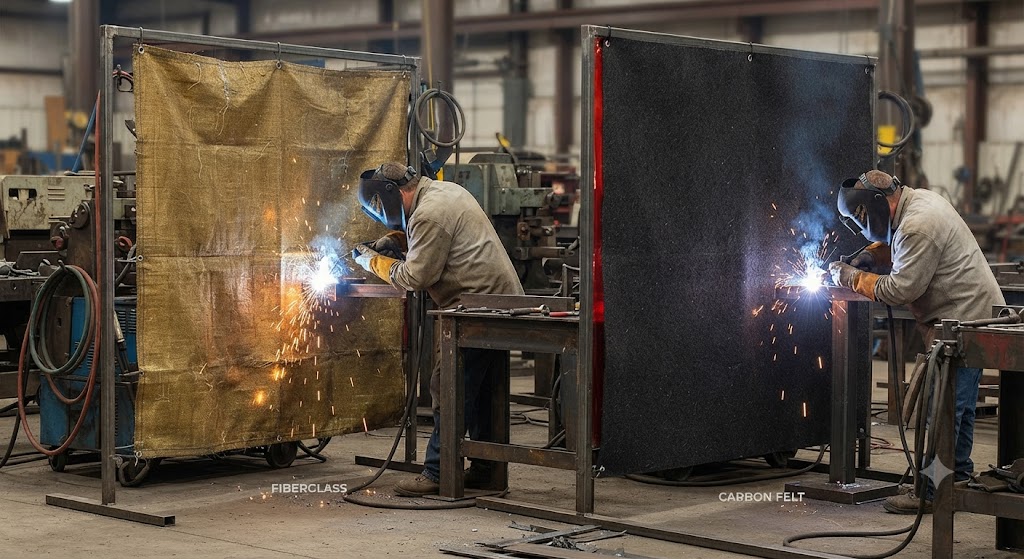
Most welders buy a fiberglass blanket because it’s the default. It works, it’s affordable, it shows up in every welding supply catalog. Then they run into a job — stress relief on chrome-moly pipe, high-preheat work on thick plate — where the fiberglass is smoking and degrading inside an hour, and they start asking questions.
A fiberglass welding blanket is made from woven glass strands, sometimes coated for durability, rated for working temperatures typically in the 1000°F to 1200°F range. A carbon felt welding blanket is made from carbonized PAN fibers in a non-woven mat form, typically rated to 1800°F. Both protect surfaces from weld spatter and heat. They are not interchangeable in all applications.
The honest verdict: for standard MIG, TIG, and stick welding spatter protection, fiberglass is the right call. It covers more area, costs less, and hangs easily as a curtain. For applications where the blanket takes sustained heat above 1200°F — stress relief, preheat work, high-amperage TIG on exotic materials — carbon felt is the appropriate material.
How the Materials Actually Work
Fiberglass is glass drawn into fine strands and woven into fabric. Glass has a high melting point, which is why fiberglass works well as a heat shield. The main failure mode is physical: woven glass strands break down under repeated impact from heavy spatter or sustained heat above the rated working temperature. Coatings (acrylic, vermiculite, silicone) extend performance by protecting the glass fabric from abrasion and increasing thermal capacity.
Carbon felt starts as PAN (polyacrylonitrile) fiber that has been oxidized and carbonized in an inert atmosphere — the same general process used to make carbon fiber. The resulting material doesn’t melt or combust under normal welding conditions; it chars and maintains structure at temperatures significantly higher than fiberglass. The non-woven felt structure is softer and more flexible than woven fiberglass, and it can be cut to shape without fraying.
Head-to-Head Comparison
| Factor | Fiberglass | Carbon Felt |
|---|---|---|
| Working temperature | 1000°F to 1200°F (varies by weight and coating) | Up to 1800°F |
| Drape and curtain use | Excellent (grommets, bound edges) | Limited (no grommets typically) |
| Cuttable to shape | Limited (bound edges) | Yes |
| Feel when handled | Scratchy, glass shedding possible | Soft, no irritation |
| Typical coverage area | Large (4x6 ft to 10x10 ft readily available) | Small to medium (most under 4x4 ft) |
| Cost for large coverage | Lower | Higher |
| Best application | Spatter protection, welding curtains | High-temp shielding, preheat, stress relief |
Temperature: Where the Numbers Actually Matter
Standard fiberglass blankets from Tillman (590 series, 24 oz acrylic coated) are rated at 1000°F. Tillman’s heavy vermiculite-impregnated 596B is rated at 1200°F for flat surfaces and 1700°F for vertical plane applications, per the Tillman product listing. YESWELDER and VEVOR fiberglass blankets are each rated at 1022°F (550°C) per their respective Amazon listings.
Carbon felt blankets from Waylander and Hansway are rated at 1800°F per manufacturer data. Tillman’s ThermoFelt panoxidized felt also carries a 1800°F working temperature rating per the Amazon listing.
For most MIG and stick welding on carbon steel, you’ll never push a quality fiberglass blanket past its rating. Spatter hits, cools, and drops. The blanket surface sees temperatures well within the 1000°F range. Standard fiberglass handles this easily.
Where the temperature gap becomes real: post-weld heat treatment setups where the blanket wraps around a heated part for extended periods. Preheat applications where you’re holding pipe at elevated temperature before welding. High-amperage TIG on stainless or titanium where heat soak into adjacent material is significant. In those applications, carbon felt is the correct material.
Which Is Safer for Overhead Welding?
Overhead welding creates a different risk profile than flat or vertical work. Hot spatter falls, and anything it lands on takes a direct impact.
For overhead applications, you want a blanket that handles the impact of falling spatter without burning through. Heavier fiberglass — the Tillman 596B at 25 oz vermiculite — handles this well on the vertical plane, where it’s rated to 1700°F. Carbon felt handles overhead temperature exposure well too, but without grommets or bound edges, securing carbon felt overhead requires additional hardware and planning.
If you need overhead protection and have a proper hanging setup, either material works. The Tillman 596B is more purpose-built for vertical and overhead use given its built-in grommets and FM-approved curtain rating.
Is Carbon Felt More Durable Than Fiberglass?
In high-temperature applications: yes. Carbon felt maintains structural integrity at temperatures that degrade woven fiberglass.
In standard shop use with repeated spatter impact: the comparison is closer. Fiberglass blankets with coatings (vermiculite, acrylic) are physically tough and designed for repeated impact. Carbon felt is softer and can be punctured or torn by sharp heavy slag on direct impact.
Durability is application-specific. A fiberglass blanket in a standard shop environment may outlast carbon felt simply because it’s designed for that use. Carbon felt in a high-temperature application will outlast fiberglass because fiberglass isn’t designed for that use at all.
Recommended Products for Each Type
Fiberglass picks:
- Tillman 590 for standard shop use: Amazon link
- Tillman 596B for heavy duty and overhead: Amazon link
- YESWELDER for value-oriented shop coverage: Amazon link
Carbon felt picks:
- Waylander for the overall top pick: Amazon link
- Hansway for smaller format and bench work: Amazon link
FAQ
Which welding blanket material handles more heat? Carbon felt. Waylander and Hansway carbon felt blankets are rated to 1800°F per manufacturer data. Tillman’s ThermoFelt panoxidized felt also carries a 1800°F working temperature rating. Standard fiberglass blankets are rated to 1000°F; heavy vermiculite fiberglass (Tillman 596B) reaches 1200°F flat / 1700°F vertical. For applications above 1200°F, carbon felt is the appropriate material.
Is carbon felt more durable than fiberglass? In high-temperature applications, yes. In standard shop environments where the primary hazard is weld spatter impact, heavy fiberglass (24 to 25 oz) is durable and purpose-built. Carbon felt is more thermally capable but softer and more susceptible to puncture from sharp slag. Durability depends on the specific application.
Which is safer for overhead welding? Both materials can handle overhead welding applications. The Tillman 596B vermiculite fiberglass is specifically rated at 1700°F on the vertical plane and includes built-in grommets for straightforward hanging. Carbon felt handles the temperature but requires additional hardware to hang securely overhead. For purpose-built overhead protection, the 596B is more convenient to rig and hang.
Can I use a fiberglass blanket for stress relief? Fiberglass blankets are generally not recommended for post-weld heat treatment (PWHT) applications where the blanket wraps around a heated part for extended periods at high temperatures. Carbon felt handles sustained heat above 1200°F significantly better. For stress relief work, use a blanket rated appropriately for the temperature specified in your welding procedure.
Which is more affordable for large coverage areas? Fiberglass. Large fiberglass blankets (6x8 ft, 8x10 ft, 10x10 ft) are widely available and cost less per square foot than equivalent carbon felt coverage. For standard shop spatter protection where high-temperature performance isn’t required, fiberglass is the practical and economical choice.
Can I use carbon felt as a welding curtain? Carbon felt can function as a hanging curtain but requires improvised attachment (clamps, wire) since most carbon felt blankets don’t include grommets. Fiberglass blankets with brass grommets are purpose-built for curtain applications and are easier to hang, adjust, and reposition.
Does fiberglass release harmful particles when heated? Fiberglass blankets may release airborne fibers during use, particularly as they age and surface fibers break down. NIOSH recommends adequate ventilation when working with fiberglass insulation products. Carbon felt releases fine carbon dust when cut. Both materials should be used in well-ventilated areas.
References
- Tillman Blanket Product Line — jtillman.com
- Waylander Product Page — waylanderwelding.com
- OSHA Hot Work Safety — osha.gov
- NIOSH Fiberglass and Synthetic Vitreous Fibers — cdc.gov/niosh
- AWS Safety and Health Fact Sheets — aws.org
URL slug: fiberglass-vs-carbon-felt-welding-blanket Excerpt: Fiberglass welding blankets handle most shop spatter up to 1000°F to 1200°F. Carbon felt goes to 1800°F. This comparison covers verified heat ratings, overhead use, durability, and a clear verdict on which to buy for your application.