Flap Disc vs Sanding Disc for Metal: Which Should You Use?
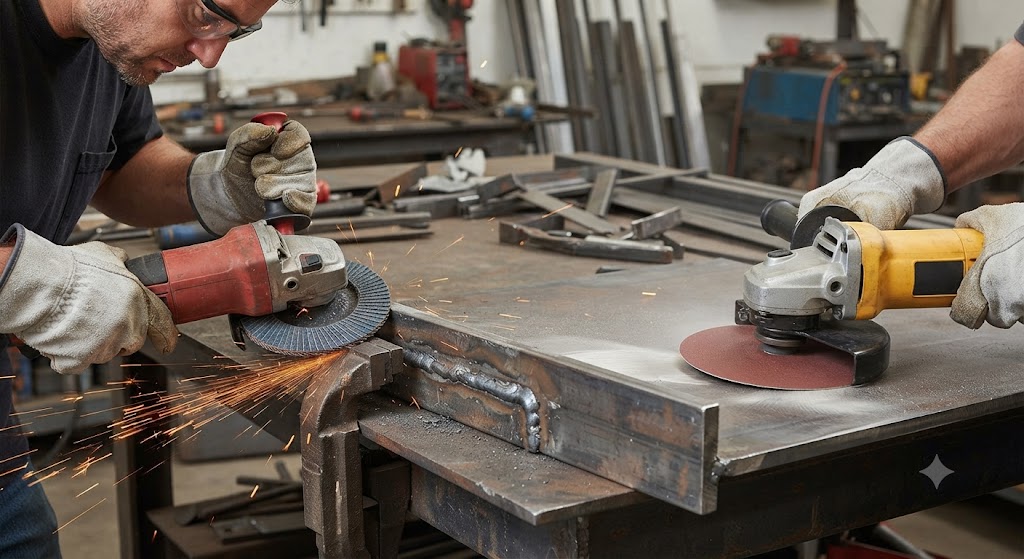
Both spin on your angle grinder, both wear away metal, and both leave a smoother surface than you started with. So why do fabricators keep both in the drawer? Because a flap disc and a resin fiber sanding disc are built differently and shine at different jobs. Reach for the wrong one and you will either wear through a stack of discs on a job the other would breeze through, or leave a finish that needs redoing.
A flap disc uses overlapping abrasive flaps to grind and finish in one step, while a resin fiber sanding disc is a single flat abrasive sheet that runs on a backing pad. Flap discs remove metal faster and last longer, while sanding discs are thinner, more flexible, and shine at aggressive flat sanding and contour work. Here is how to choose.
How they are built
The difference in construction drives everything else:
- A flap disc is made of many overlapping flaps of abrasive cloth arranged around a rigid backing. As the top flaps wear, fresh abrasive underneath is exposed, so the disc keeps cutting and lasts a long time.
- A resin fiber sanding disc is a single flat sheet of abrasive on a vulcanized fiber backing, mounted on a separate rubber backing pad on your grinder. It is thin, flexible, and follows contours, but once that single layer of grit wears, the disc is done.
That is the core trade-off: many layers of abrasive (flap disc) versus one flexible layer (sanding disc).
Direct answer: which should you use?
Match the disc to the job:
- Weld seam cleanup and blending, heavy daily grinding: flap disc, which removes metal fast and lasts.
- Aggressive flat sanding, stripping, and paint or rust removal on flat panels: resin fiber sanding disc, which lies flat and cuts hard.
- Contours, curves, and following a shape: resin fiber sanding disc, thanks to its flexible backing.
- One-step grind and finish: flap disc, since it blends as it grinds.
- Light, frequent surface prep: resin fiber sanding discs, which give a fresh sharp abrasive each swap, though flap discs last longer per disc.
For weld cleanup specifically, the flap disc usually wins. For flat panel prep and contour sanding, the fiber sanding disc has the edge.
Material removal and speed
On stock removal, the flap disc generally cuts faster and more consistently thanks to its many layers of abrasive that keep exposing fresh grit. It holds its cut rate through its life, which is why it dominates weld cleanup. A resin fiber sanding disc can be very aggressive too, especially in coarse grits on flat surfaces, but its single abrasive layer wears out sooner, so you swap discs more often on heavy jobs. For knocking down welds and grinding steel all day, the flap disc’s endurance pulls ahead.
Finish and control
Finish quality is where the sanding disc earns its keep. Because it is a flat, flexible sheet on a backing pad, a resin fiber disc conforms to contours and lays down an even, uniform scratch pattern, which is handy for surface prep before paint. A flap disc also finishes as it grinds, blending welds nicely, but its firmer construction is happiest on flatter work and edges. For following curves and prepping large flat panels evenly, the sanding disc gives more control; for blending a weld into surrounding metal, the flap disc does it in one step.
Lifespan
Think about how long each disc lasts on the job:
- Flap discs have many layers of abrasive that keep exposing fresh grit, so they last much longer and you change discs far less often on heavy grinding.
- Sanding discs wear through their single abrasive layer sooner, which suits occasional use or jobs where you want a fresh, sharp abrasive often, but you go through more of them on heavy work.
For a busy shop grinding welds daily, the longer-lasting flap disc often makes sense. For occasional flat sanding, keeping a stack of fresh fiber discs on hand works fine.
Which discs to buy
Here is one of each to cover both jobs.
- MIDO 4.5 inch flap discs, 40/60/80/120 grit assortment (20 pack) grind and finish weld seams in one step and last through heavy cleanup, with a range of grits included. Their limitation is that flap discs are firmer, so they follow tight contours less easily than a flexible sanding disc.
- BHA zirconia resin fiber sanding discs, 4.5 inch (25 pack) are flexible flat discs that excel at aggressive sanding, blending welds, and following contours on metal, wood, and fiberglass. The trade-off is that a single abrasive layer wears out sooner than a flap disc on heavy grinding, so you swap discs more often. Note they require a separate rubber backing pad on your grinder.
How to choose: for weld cleanup, blending, and heavy daily grinding, use a flap disc. For aggressive flat sanding, paint and rust stripping, and contour work, use a resin fiber sanding disc (with a backing pad). Many welders keep both.
The bottom line
A flap disc and a resin fiber sanding disc solve different problems. The flap disc grinds and finishes in one step, removes metal fast, and lasts, which makes it the go-to for weld cleanup and heavy daily grinding. The resin fiber sanding disc is flexible and flat, so it shines at aggressive sanding, paint and rust stripping, and following contours, laying down an even finish. For blending welds, reach for the flap disc; for flat panel prep and curves, reach for the sanding disc. Keeping both covers you.
FAQ
Which is better for smoothing a weld bead, a flap disc or sanding disc? For smoothing and blending a weld bead, a flap disc is usually better because it grinds and finishes in one step and lasts through heavy cleanup. A resin fiber sanding disc can work but wears faster on the concentrated grinding a weld seam needs.
Does a flap disc remove metal faster than a sanding disc? Generally yes on sustained grinding, because a flap disc has many layers of abrasive that keep exposing fresh grit and hold their cut rate. A coarse sanding disc is aggressive too, but its single abrasive layer wears out sooner.
Which lasts longer on stainless steel? A flap disc, especially a ceramic one, typically lasts longer on stainless because of its multiple abrasive layers and cooler cut. Resin fiber discs work on stainless but need replacing more often during heavy grinding.
Do sanding discs need a backing pad? Yes. A resin fiber sanding disc is a flat sheet that mounts on a separate rubber or phenolic backing pad on your angle grinder. A flap disc has its own built-in backing and needs no separate pad.
Can one disc do both grinding and finishing? Yes, a flap disc grinds and finishes in one step, blending a weld as it removes it, which is why it is favored for weld cleanup. A resin fiber sanding disc is better suited to sanding and contour work than to heavy weld removal.
Can I use a sanding disc for contour work on metal? Yes. A resin fiber sanding disc is flexible and conforms to curves and contours better than a firmer flap disc, which makes it a good choice for following shapes and prepping irregular surfaces.
References
- Benchmark Abrasives and Red Label Abrasives comparisons of flap discs vs resin fiber sanding discs, covering removal rate, finish, and lifespan (industry suppliers), benchmarkabrasives.com, redlabelabrasives.com.
- Norton Abrasives guidance on coated abrasive disc types and applications (manufacturer), nortonabrasives.com.
- 3M abrasive disc selection resources for metalworking (manufacturer), 3m.com.