Flux Core vs Solid MIG Wire: Which Should You Use?
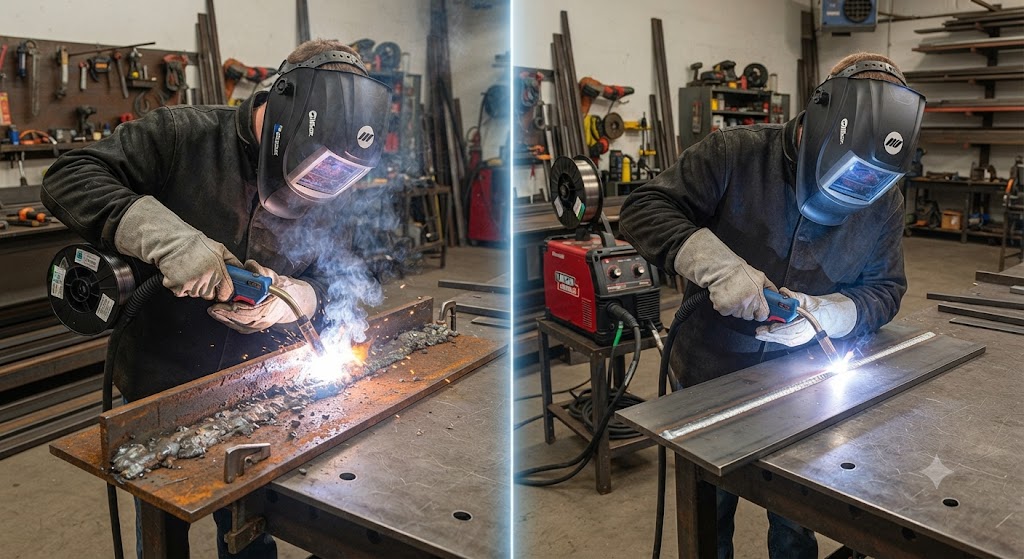
Stand a spool of flux-cored wire next to a spool of solid MIG wire and they look like twins. Same reels, same feel, both feed through the same gun. But pull the trigger and they behave like different processes, one dragging a bottle of gas behind it, the other shielding itself and throwing sparks. Choosing between them is one of the first real decisions a wire welder makes, and it shapes everything from your cleanup time to whether you can weld in the backyard on a breezy day.
Solid MIG wire needs an external shielding gas and produces clean, low-spatter welds best suited to thin metal and indoor work, while self-shielded flux-cored wire carries its own shielding, needs no gas bottle, and excels outdoors and on thicker or dirtier steel. The right choice depends on where you weld, what you weld, and whether you want to run a gas bottle. Here is the head-to-head.
The core difference
Both wires feed through a MIG gun, but they protect the weld pool differently. Solid wire is a plain metal electrode that relies on an external shielding gas (usually 75 percent argon, 25 percent CO2) flowing from the nozzle to keep air away from the molten metal. Flux-cored wire is tubular, packed with flux that burns to create its own shielding, so self-shielded versions need no gas at all.
That one difference (gas from a bottle versus gas from the wire) drives every practical trade-off between them.
Head-to-head comparison
| Factor | Solid MIG wire | Self-shielded flux core |
|---|---|---|
| Shielding gas | Required (bottle) | None needed |
| Best environment | Indoors, no wind | Outdoors, windy |
| Weld appearance | Clean, low spatter | More spatter, slag to chip |
| Metal thickness | Thin to medium | Medium to thick |
| Dirty or rusty metal | Prefers clean | More tolerant |
| Portability | Less (gas bottle) | More (no bottle) |
| Polarity | DC electrode positive | DC electrode negative |
| Slag cleanup | Minimal | Chip and brush |
Neither wins outright. Solid wire wins on cleanliness and thin-metal finesse; flux core wins on portability, outdoor use, and forgiving performance on thicker or dirtier steel.
Direct answer: which should you use?
Decide by matching your situation:
- Use solid MIG wire if you weld indoors on clean, thin to medium steel, you have or will buy a shielding gas bottle, and you want the cleanest welds with minimal spatter and no slag to chip. It is the choice for auto body, sheet metal, and tidy shop work.
- Use self-shielded flux core if you weld outdoors or in wind, you do not want a gas bottle, you work on thicker or dirtier steel, or you want maximum portability. It is the choice for farm repairs, field work, trailers, and heavier fabrication.
Many welders keep both: solid wire for clean indoor jobs and flux core for outdoor and heavy work. If you can only pick one to start, choose based on where you weld most.
The gas question decides a lot
For many people, the deciding factor is simply the gas bottle. A shielding gas setup adds a cylinder to buy or rent, refill, store, and haul, plus a regulator and hose. That is fine for a fixed shop, but a hassle for occasional or portable use. Self-shielded flux core skips all of it, which is a big reason entry-level welders and field welders favor it. On the other hand, if you already have gas or want the cleanest possible welds on thin metal, solid wire rewards you with far less spatter and no slag to chip. Weigh the convenience of no bottle against the cleaner results of gas.
Do not forget the polarity switch
One setup detail catches almost everyone who owns a machine that runs both: solid MIG wire uses DC electrode positive (DCEP), while self-shielded flux-cored wire uses DC electrode negative (DCEN). When you switch wire types, you must switch the polarity at the machine, or the weld will be a spattery mess. Flux core also wants knurled drive rolls, since the tubular wire is softer than solid wire and can crush under smooth rolls. Change the wire, change the polarity, check the rolls.
Which wire to buy
Here is a solid option from each family so you can start with whichever fits your work.
- INEFIL ER70S-6 solid MIG wire (.030 inch, 10 lb spool) is the pick for clean indoor welding with shielding gas, feeding smoothly and welding with low spatter on mild steel. Its limitation is the gas requirement, which hurts it outdoors and adds a bottle to your setup.
- INETUB BA71TGS self-shielded flux-core wire (.030 inch, 10 lb spool) is the pick for gasless, portable, outdoor-capable welding, running without a bottle and tolerating wind and less-than-clean steel. The trade-off is more spatter and slag to clean than solid wire.
How to choose: if your welding lives in a garage or shop on clean steel and you have gas, go solid. If it happens outdoors, on the farm, or wherever you cannot drag a bottle, go self-shielded flux core. When in doubt, flux core gets you welding with the least setup.
The bottom line
Solid MIG wire and self-shielded flux core are not better or worse, they are built for different situations. Solid wire needs gas and rewards you with clean, low-spatter welds on thin, clean metal indoors. Flux core shields itself, skips the bottle, and shines outdoors on thicker or dirtier steel with more cleanup. Match the wire to where and what you weld, remember to switch polarity when you swap, and either one will serve you well.
FAQ
Is flux core or solid MIG wire better? Neither is universally better. Solid wire gives cleaner, low-spatter welds on thin clean metal indoors but needs a gas bottle. Self-shielded flux core needs no gas, works outdoors and on thicker or dirtier steel, but leaves more spatter and slag.
Does flux core wire need gas? Self-shielded flux-cored wire does not need gas, which makes it portable and good outdoors. Solid MIG wire always needs an external shielding gas, and gas-shielded (dual shield) flux core does too.
Which is stronger, flux core or solid wire? Both can make strong welds. Flux core often penetrates better on thicker steel and tolerates dirty metal, while solid wire gives cleaner welds on thin material. Strength depends more on technique and proper settings than on wire type alone.
Can I use the same machine for both? Most wire feed welders run both, but you must switch polarity (DCEP for solid, DCEN for self-shielded flux core) and ideally use knurled drive rolls for the softer flux-cored wire.
Which is better for a beginner? Self-shielded flux core is often easier to start with because it needs no gas bottle and tolerates outdoor conditions and dirtier metal. Solid wire is better if you weld indoors on clean, thin metal and want the cleanest results.
Why is my weld so spattery after switching wires? Most likely you did not switch polarity. Solid wire runs DC electrode positive and self-shielded flux core runs DC electrode negative. Set the correct polarity for the wire you loaded.
References
- Miller Electric, solid wire versus flux-cored wire: when to use them and why (manufacturer), millerwelds.com.
- Hobart Brothers, weldability of gas- and self-shielded flux-cored wires (manufacturer), hobartbrothers.com.
- Lincoln Electric GMAW and FCAW process guidance and AWS A5.18 / A5.20 classifications, lincolnelectric.com.