Flux Core Welding vs MIG: Which Option Fits Your Setup Better?
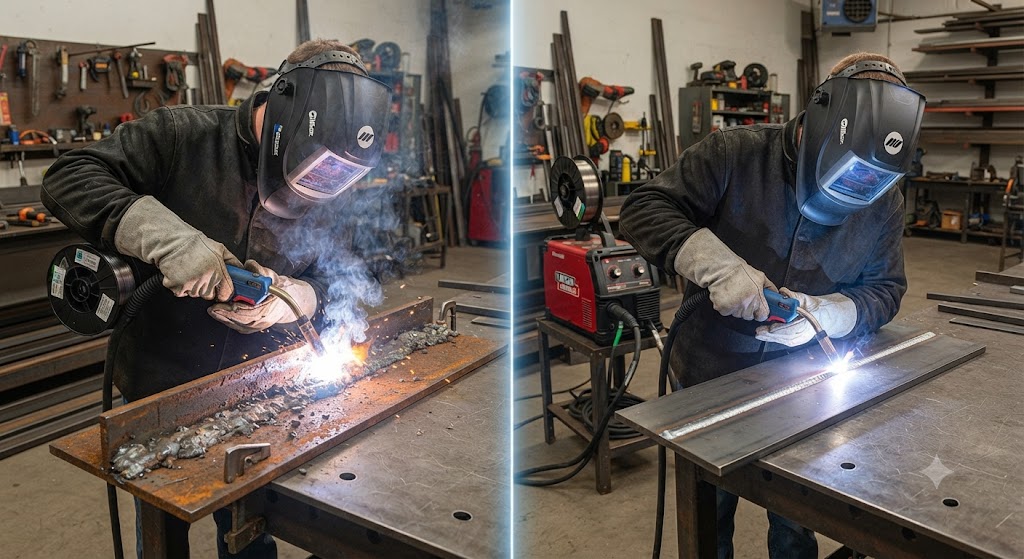
Two welders, same machine, same steel, same afternoon. One is welding a gate in a windy driveway with flux core wire and getting clean, deep beads. The other rolled a gas bottle out to the same spot, ran solid wire, and is now grinding out a porous mess.
That is the comparison in one image. Not which process is better, but which one matched the conditions on that particular day.
What separates the two processes
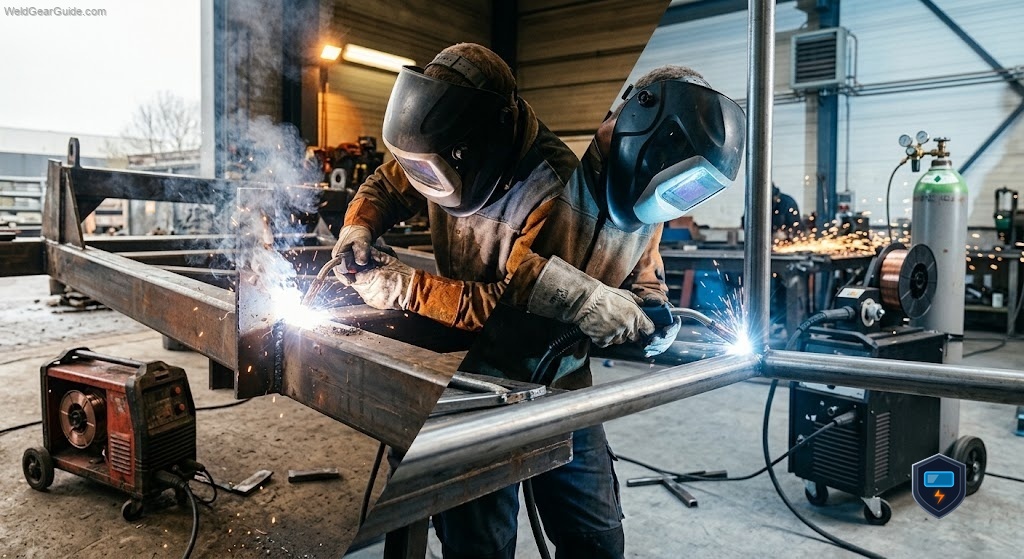
MIG welding, properly gas metal arc welding, feeds a solid wire and shields the puddle with gas from a cylinder. Flux cored arc welding feeds a hollow wire filled with flux that generates its own shielding as it burns, leaving slag on top of the bead.
The direct answer for most buyers: run flux core if you weld outdoors, work on thicker or less-than-clean steel, or want to avoid buying and refilling a gas cylinder. Run MIG if you weld indoors on thin, clean material and care about how the finished bead looks. Most home machines do both by swapping polarity and wire, so this is more often a per-job decision than a permanent one.
Where flux core clearly wins
Wind. A breeze around 5 miles per hour is enough to disturb MIG shielding gas. Self-shielded flux core carries its protection inside the wire, so it works on a job site, in an open barn, or in a driveway.
Dirty and rusty steel. Flux core tolerates mill scale, light rust and surface contamination far better than solid wire. Real repair work is rarely clean.
Penetration on thicker sections with small machines. A 140 amp machine running flux core reaches deeper into 1/4 inch plate than the same machine running solid wire, which is why so many entry-level welders ship configured for it.
No cylinder. No rental, no refill trips, no bottle rolling around a truck bed. For occasional welders, this alone decides it.
Where MIG clearly wins
Thin material. Below about 16 gauge, flux core gets aggressive and blows through. Solid wire with gas gives finer control.
Appearance. MIG beads come out clean with almost no cleanup. Flux core leaves slag over every inch, and the underlying bead is rougher.
Speed on prepared work. No chipping, no brushing between passes. On a production run of clean parts, that time adds up fast.
Less smoke. Self-shielded flux core produces a substantial plume. Indoors without ventilation, this becomes a genuine health issue rather than an inconvenience.
Head to head
| Flux core (self-shielded) | MIG (solid wire, gas) | |
|---|---|---|
| Outdoors | Excellent | Poor without shelter |
| Thin sheet | Difficult | Excellent |
| Thick plate on a small machine | Better penetration | Limited |
| Dirty or rusty steel | Tolerant | Needs clean metal |
| Bead appearance | Rough under slag | Clean and tidy |
| Cleanup | Chip and brush every pass | Minimal |
| Smoke and fume | Heavy | Moderate |
| Equipment needed | Machine and wire | Machine, wire, cylinder, regulator |
| Polarity | Electrode negative | Electrode positive |
The polarity detail that ruins first attempts
Switching between the two is not just a wire change. Self-shielded flux core runs on DC electrode negative; solid MIG wire runs on DC electrode positive. Every dual-capable machine has two leads inside the wire feed compartment that must be swapped.
Skip that step and your flux core welds will spatter heavily, wander, and sit on top of the joint. Countless people conclude their machine is faulty when they simply left the leads in the MIG position. Check the door chart first.
Wire choices for each side
On the flux core side, Lincoln Innershield NR-211-MP is the wire most small machines run best with. All-position, forgiving of poor fit-up, easy slag removal, and a bead appearance that beats most self-shielded wire. Its ceiling is plate thickness, recommended to around 5/16 inch in the common diameters, so heavy structural work needs a different wire or a bigger machine.
Hobart E71T-11 in 0.030 inch feeds smoothly and suits learners, with a slag that lifts easily. Run it hot on thin stock and it spatters enough to clog the nozzle, so sheet metal workers should look at gas-shielded MIG instead.
Forney 42300 E71T-GS comes on a small spool that suits occasional repairs. It is a single-pass wire, so it is the wrong choice for building up multipass structural joints.
On the MIG side you need a cylinder and regulator on top of the wire, which is the real cost difference between the two processes. The consumables are similar; the gas infrastructure is not.
Machines that do both
Most buyers should look for a machine that switches between processes rather than committing to one.
The YESWELDER 165A dual voltage multiprocess welder handles flux core, gas MIG, stick and lift TIG, running on 120 or 240 volt input. That flexibility is real and useful in a small shop. What you give up is refinement: the included gun is basic, the interface takes some learning, and support is thinner than the established brands. Anyone who needs a machine backed by a local service network should pay more elsewhere.
The Millermatic 142 sits at the opposite end. It is a 120 volt MIG machine with automatic parameter setting, built to a standard that shows in every detail of the drive system and gun. Its flaw for this comparison is scope: it is primarily a gas MIG machine, and it welds up to about 3/16 inch steel. Anyone whose main work is outdoor flux core on heavier plate is paying for refinement in the wrong direction.
For pure flux core on a budget, the Lincoln Electric Handy Core does exactly one thing on household power up to about 1/8 inch steel. Its tapped voltage settings and small duty cycle make it a light repair machine that most people outgrow.
Cost of ownership, plainly
Flux core wire costs more per pound than solid wire. MIG requires a cylinder, a regulator and periodic refills. Over a light-use year, flux core usually ends up cheaper overall because the gas infrastructure never gets bought. Over heavy use in a fixed shop, MIG pulls ahead because wire cost dominates and cleanup time is money.
The crossover point is not a number so much as a pattern. If you weld a few hours a month in varied locations, flux core. If you weld most days in one place on clean material, MIG.
Who should skip each
Skip flux core if your work is autobody panels, thin exhaust tubing, decorative work where the bead is visible, or indoor welding without ventilation.
Skip MIG if you weld outdoors regularly, if storing and refilling a cylinder is impractical, or if your steel arrives rusty and painted.
Final verdict
For most home shops and farms, the sensible sequence is to start with flux core, because it works everywhere with no extra equipment, and add gas MIG capability later once you know what you actually build. The reverse order leaves you with a cylinder you cannot use in the wind.
One underrated point to close on: the process you enjoy is the one you will practise, and practice matters more than either choice. Flux core makes you a better hand at reading a puddle through slag and smoke. MIG makes you faster and neater. Welders who run both end up better than welders who defend one.
Frequently asked questions
Is flux core welding stronger than MIG? On thick steel, flux core often achieves deeper penetration and a very strong joint. On thin material, MIG produces a more controlled and consistent weld. Neither is universally stronger.
Can I use flux core wire in a MIG welder? Yes, if the machine allows a polarity change to DC electrode negative and accepts the wire diameter. Switch the leads, fit a knurled drive roll if provided, and remove the gas nozzle if the manual instructs.
Why does flux core leave slag and MIG does not? The flux inside the wire produces shielding gas and a protective slag layer as it burns. Solid MIG wire relies on external gas, so there is no slag.
Which process is better for beginners? Flux core is more forgiving of dirty steel and wind, and needs less equipment. MIG is easier to make look good on clean, thin material. Both are learnable in a weekend.
Do I need gas for flux core welding? Not for self-shielded wire. Gas-shielded flux core wire does require a cylinder and delivers cleaner welds on thick material.
Which is cheaper to run? Flux core avoids cylinder rental and gas refills, so it is usually cheaper for light use. MIG wire costs less per pound, so heavy users often come out ahead with gas.
Can flux core weld thin metal? It can with 0.030 inch wire at low settings, but burn-through is common below 16 gauge. MIG handles thin material much better.