Goatskin vs Deerskin vs Elkskin Welding Gloves: Which Leather Is Right for Your Process?
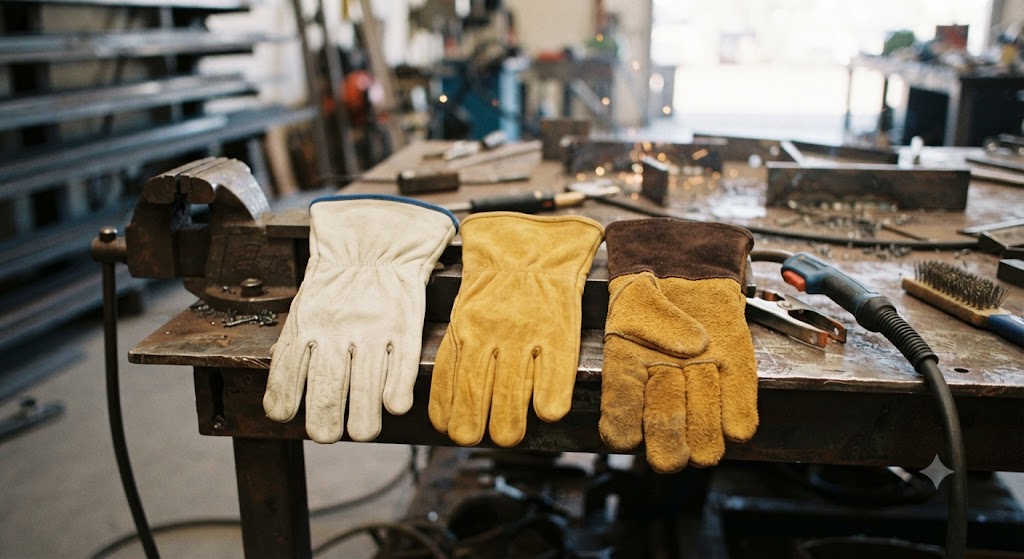
You can learn a lot about what a welder actually does by looking at the leather on their gloves. A TIG welder’s hands are usually in thin, soft goatskin or deerskin that moves with their fingers like a second skin. A pipeline stick welder runs heavy elkskin that absorbs heat punishment for hours. These are not arbitrary preferences. Each leather has a specific combination of thickness, softness, heat resistance, and durability that maps directly to particular welding processes, and using the wrong leather for your process means either burning through gloves too fast or losing the dexterity that your weld quality depends on.
The three leathers compared here (goatskin, deerskin, and elkskin) cover the full range from precision TIG work to production stick welding. No single leather is best for everything. Here is what each does well, where each fails, and which gloves in each category are actually on the market.
What Makes Leather Suitable for Welding Gloves?
The American Welding Society (AWS) identifies four primary requirements for welding PPE leather: heat resistance, flexibility, abrasion resistance, and tactile sensitivity. These requirements exist in tension with each other. Thicker, more heat-resistant leathers tend to be stiffer and reduce dexterity. Softer, more flexible leathers offer better tactile feedback but less thermal protection.
The choice of leather is the manufacturer’s primary tool for positioning a glove in that trade-off. Goatskin, deerskin, and elkskin each occupy different positions on the flexibility-to-protection spectrum.
Goatskin Welding Gloves
Goatskin is the most common leather in TIG welding gloves and a large portion of light-duty MIG gloves. It is a tight-grained, relatively thin leather that resists abrasion well for its weight, flexes naturally with hand movement, and offers good tactile feedback through the palm and fingers.
The grain structure of goatskin is denser than deerskin, which makes it more resistant to puncture and cuts at the same thickness. This is why goatskin is often described as the dexterity-with-durability option: it gives you the feel required for precise TIG torch manipulation without falling apart in a week.
The Tillman 1328 is one of the best-known goatskin TIG gloves in production shops. It uses top grain pearl goatskin with a seamless index finger design (important for TIG trigger control), a 4-inch cuff for forearm protection, and DuPont Kevlar thread construction throughout.
Check the Tillman 1328 Goatskin TIG Gloves on Amazon
Named flaw for goatskin: Goatskin’s tighter, harder grain structure makes it stiffer when wet or when exposed to high heat repeatedly. On long stick or heavy MIG sessions where heat soaks into the glove material, goatskin hardens faster than deerskin or elkskin and can crack along flex points. It is not the leather for high-heat, high-volume use over extended shifts.
Who should skip goatskin: Welders doing production stick, heavy MIG, or any sustained high-heat work. Goatskin’s thermal protection ceiling is lower than deerskin and significantly lower than elkskin. It is the right leather for precision TIG work; it is not the right leather for absorbing sustained heat radiation from a stick rod.
Deerskin Welding Gloves
Deerskin is the softest of the three leathers and the one most TIG welders describe as the best fit for long sessions where you need continuous precise finger movement. Deerskin is typically split from the hide in a way that preserves extreme softness and suppleness. It conforms to the hand faster than goatskin and maintains that fit even after heat exposure.
The characteristic TIG welders notice immediately is that deerskin feels like it disappears on the hand. You feel the tungsten, the torch body, the wire feed, in a way that thicker leathers obscure. For multi-pass TIG on stainless or aluminum, where electrode angle and travel speed depend on subtle tactile feedback, that sensitivity matters.
Deerskin is also notably soft when it gets warm, which means it molds to your hand on the first few sessions and stays that way. The Tillman deerskin TIG gloves use pearl and gold split deerskin with a 4-inch cuff and Kevlar thread locking stitch.
Check the Tillman Deerskin TIG Gloves on Amazon
Named flaw for deerskin: Deerskin’s softness is its most significant limitation as well as its main selling point. It wears through faster than goatskin under abrasion. If your TIG work involves regular grinding between passes, heavy spatter exposure, or contact with rough weld surfaces, deerskin shows wear much faster than goatskin. It is also more expensive per pair for equivalent quality.
Who should skip deerskin: Welders who combine TIG with regular grinding or spatter-heavy processes. Deerskin gloves used for MIG or stick welding will be destroyed in short order. They are TIG-specific and should stay that way.
Elkskin Welding Gloves
Elkskin is the heaviest and most heat-resistant of the three leathers. It is thick, soft (relative to cowhide at comparable thickness), and retains its suppleness under heat exposure far better than goatskin. It is the leather for stick welding, heavy MIG, and any process where the glove needs to absorb sustained radiant heat from the arc and workpiece.
The reason elkskin stays soft under heat is the fiber structure of the hide. It does not harden or become brittle with repeated thermal cycling the way thinner leathers do. Pipeline welders have used elkskin stick gloves for decades specifically because a glove that hardens in the first hour of a shift becomes dangerous: you lose grip on the electrode holder and start compensating with hand position.
The Tillman 850 elkskin stick welding glove is among the most established pipeline gloves in North America. It uses top grain and rough side out elkskin with a 14-inch length, welted fingers to protect stitching, foam-lined back for heat absorption, and unlined palm for dexterity. It is Kevlar-stitched throughout.
Check the Tillman 850 Elkskin Stick Welding Gloves on Amazon
Named flaw for elkskin: Elkskin’s thickness means it is not a precision instrument. Tactile feedback through heavy elkskin is genuinely limited. For TIG work, where you need to feel the tungsten and the wire simultaneously, elkskin is too much leather in the way. Experienced stick and MIG welders accept this trade-off gladly; TIG welders should not try to use elkskin for precision passes.
Who should skip elkskin: TIG welders, precision MIG welders, and anyone whose process depends on fine finger dexterity. Elkskin is built for heat protection and durability, not for the tactile feedback that TIG quality depends on.
Which Leather Is Best for TIG Welding Gloves?
Deerskin is the TIG welder’s first choice for feel and fit over long sessions. Goatskin is the better choice if you want TIG dexterity with more durability and abrasion resistance, particularly if your TIG work involves occasional grinding or material handling between passes. Elkskin is not appropriate for TIG.
Most production TIG welders keep both deerskin and goatskin on hand: deerskin for precision passes where feel is everything, goatskin for longer sessions where the glove takes more general abuse.
Leather Comparison at a Glance
| Property | Goatskin | Deerskin | Elkskin |
|---|---|---|---|
| Softness and feel | Good | Excellent | Moderate |
| TIG dexterity | Very good | Best | Poor |
| Heat resistance | Moderate | Moderate | High |
| Abrasion resistance | Good | Fair | Very good |
| Durability (heavy use) | Good | Fair | Excellent |
| Stick/MIG appropriate | Light MIG only | No | Yes |
| TIG appropriate | Yes | Yes (premium) | No |
| Key failure mode | Hardens/cracks hot | Wears fast under abrasion | Too thick for precision |
Bottom Line
The three leathers are tools for three different jobs. Deerskin for the best tactile TIG experience. Goatskin for TIG with more durability and for light MIG. Elkskin for stick welding, pipeline work, and any sustained high-heat process where the glove needs to take the heat so your hands do not.
Buying the wrong leather is not about brand. A premium deerskin glove used for stick welding will be garbage in a week. A heavy elkskin glove used for TIG will produce welds that reflect it. Match the leather to the process and the glove will do exactly what it is supposed to do.
FAQ
Which leather is best for TIG welding gloves? Deerskin offers the best tactile feedback for precision TIG work. Goatskin offers nearly as much dexterity with better abrasion resistance, making it better if your TIG work includes grinding or material handling. Elkskin is too thick for TIG and should not be used for precision arc work.
Is elkskin better than goatskin for heat resistance? Yes, significantly. Elkskin is thicker and maintains its suppleness under repeated heat exposure better than goatskin. For stick welding and heavy MIG where the glove absorbs sustained radiant heat, elkskin outlasts goatskin substantially.
Why do TIG welders prefer deerskin or goatskin? TIG welding requires continuous precise control of the torch angle, travel speed, and wire feed simultaneously. Deerskin and goatskin are thin enough that the welder feels the torch and the weld pool feedback through the glove. Thicker leathers like elkskin or heavy cowhide reduce that feedback to a point where precision TIG quality suffers.
Does deerskin hold up for MIG welding? No. Deerskin’s softness means it wears through quickly under the spatter, slag, and abrasion common in MIG welding. Use goatskin or a heavier leather for MIG, and save deerskin for TIG.
What is the difference between split leather and top grain leather in welding gloves? Top grain leather uses the outer layer of the hide, which has a tighter, more uniform fiber structure and better abrasion resistance. Split leather comes from the inner layers of the hide and is generally softer and more pliable but less abrasion-resistant. Many deerskin TIG gloves use split leather specifically because the extra softness improves dexterity, accepting the faster wear rate as a trade-off.
How do I know when to replace welding gloves? Replace gloves when you see through-holes in the palm or fingers, significant leather cracking along flex points, degraded stitching that could allow the seam to open under heat, or any area where the leather has thinned enough that you feel heat through it directly during welding.
References
- https://www.aws.org/technical/facts/FACT-30.pdf (AWS Safety and Health Facts: Hand and Body Protection)
- https://jtillman.com/products/tillman-gloves/tig-gloves/
- https://www.osha.gov/personal-protective-equipment
URL slug: goatskin-vs-deerskin-vs-elkskin-welding-gloves Excerpt: Deerskin for TIG feel. Goatskin for TIG durability. Elkskin for stick heat resistance. Here is how the three most common welding glove leathers compare, where each one fails, and which glove to buy for your process.