Jackson BH3 vs TrueSight II: Which Jackson Safety Helmet Wins?
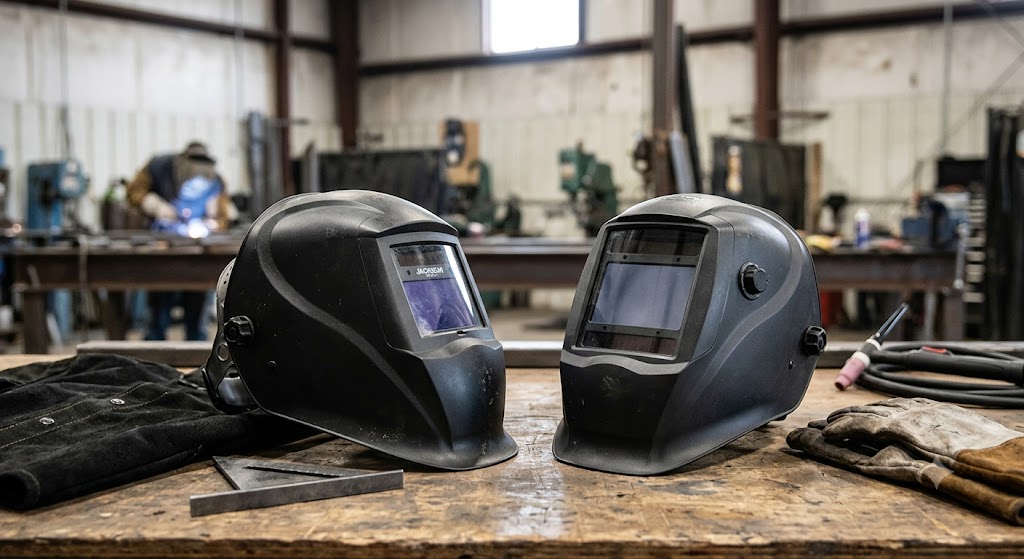
You’re setting up for a full day of stainless TIG. The arc strikes at around 60 amps, the puddle is small, and if your lens throws a green cast or the image swims even slightly, your bead quality suffers. Both the Jackson Safety BH3 and TrueSight II carry the same 1/1/1/1 optical clarity rating. That’s the headline. What separates them is everything else: viewing area, weight, power, and how they sit on your head across an eight-hour shift.
Jackson Safety welding helmets are auto-darkening hoods made by the SureWerx brand, designed around Balder Technology, the company’s proprietary true-color lens system that filters the arc light without the green or yellow tint found in most budget lenses. Both helmets reviewed here carry that Balder Technology and the top EN379 optical rating of 1/1/1/1.
If you want the largest viewing area Jackson makes and a lightweight shell that won’t bruise your neck by afternoon, the TrueSight II is the stronger choice. If you need a premium helmet with an established record in demanding industrial environments and are less concerned about total weight, the BH3 delivers.
The Jackson Safety BH3: Built for Industrial Environments
The BH3 (model 37191, WH70 shell) is Jackson Safety’s professional-grade helmet, designed for heavy use in fabrication shops and industrial settings. It carries the highest EN379 optical rating available, 1/1/1/1, across diffusion, angle deviation, luminous transmittance, and solar UV transmittance. The Balder Technology ADF produces accurate, natural color in the weld puddle rather than the yellow-green tint that causes eye strain over long sessions.
The viewing area on the BH3 is 96 x 68.5mm, which translates to roughly 3.78 inches by 2.7 inches, a substantial window that keeps most of your work zone visible without lifting the hood. The lens operates on solar plus battery power and offers digital shade control from 5 to 13 with grinding mode included. The WH70 shell is built from Zytel ST 801 AVG, a high-performance engineering resin that holds up to heat and impact in industrial environments.
Jackson Safety BH3 Welding Helmet
Named flaw: The BH3 is not a lightweight helmet. At approximately 399g without the ADF installed (and heavier with it), full production days in overhead or out-of-position welding will make themselves known in your neck and shoulders. Welders who spend long hours in awkward positions consistently flag the weight as a real-world limitation.
The Jackson Safety TrueSight II: Maximum Viewing Area, Minimum Weight
The TrueSight II (model 46118 and 46159) is Jackson Safety’s flagship for welders who want the largest viewing area the brand makes combined with an ultra-lightweight shell. At 13 square inches of viewing area (4 inches by 3.25 inches), it offers meaningfully more visibility than the BH3. The HydraFlex shell weighs just 6 ounces, which is among the lightest in its class.
Like the BH3, the TrueSight II uses Balder Technology and carries a 1/1/1/1 optical clarity rating. It adds three welding modes, weld, torch, and grind, with digital controls and a built-in magnification lens holder. Power comes from solar cells plus two AAA batteries. The 370 Speed Dial ratcheting headgear from Jackson Safety is one of the better headgear systems in this segment, offering precise micro-adjustments without the loose play found in cheaper ratchets. The warranty is five years on the lens, which is industry-leading.
Jackson Safety TrueSight II Welding Helmet
Named flaw: The TrueSight II runs on AAA batteries as its primary power alongside solar. While the battery life is rated in the hundreds of hours, if you work in low-light indoor environments where the solar cell can’t top up, you are dependent on those batteries. Some users have also noted that the headgear attachment points can loosen with heavy daily use over an extended period.
Head-to-Head: Viewing Area
TrueSight II wins decisively. Thirteen square inches versus the BH3’s 96 x 68.5mm translates to a noticeably wider field of view in practice. This matters most when welding in tight corners, working on tube assemblies, or anywhere you need to track multiple points of the weld without repositioning. The BH3’s window is generous by most standards, but the TrueSight II’s is larger.
Head-to-Head: Optical Clarity
This is a tie. Both helmets carry the full 1/1/1/1 EN379 rating and both use Balder Technology. Side-by-side, experienced TIG welders typically cannot distinguish a quality difference in the clarity of the lens. The 1/1/1/1 rating is the ceiling, and both helmets reach it.
Head-to-Head: Weight and All-Day Comfort
TrueSight II wins significantly. The 6-ounce HydraFlex shell compared to the BH3’s Zytel construction is a real-world difference that accumulates over a full shift. Welders coming from heavier helmets almost universally report less neck fatigue when switching to the TrueSight II. The 370 Speed Dial headgear also distributes the load more evenly than the standard headgear systems on many competing helmets.
Does the BH3 Use Batteries?
Yes. The BH3 ADF uses both solar power and battery backup. The solar cells handle most of the operating load in normal shop conditions, with batteries providing power when ambient light is insufficient. This is the same hybrid approach used by most professional-grade auto-darkening helmets.
Comparison Table
| Feature | Jackson BH3 (37191) | Jackson TrueSight II (46118/46159) |
|---|---|---|
| Optical Clarity | 1/1/1/1 (EN379) | 1/1/1/1 (EN379) |
| Lens Technology | Balder Technology | Balder Technology |
| Viewing Area | ~96 x 68.5mm | 4” x 3.25” (13 sq in) |
| Shell Weight | ~399g without ADF | 6 oz (HydraFlex shell) |
| Power | Solar + battery | Solar + 2x AAA battery |
| Welding Modes | Weld, Grind | Weld, Torch, Grind |
| Shade Range | 5-13 | 5-13 |
| Warranty | 3 years | 5 years |
| Headgear | 370 ratchet | 370 Speed Dial ratchet |
FAQ
What is the difference between the BH3 and TrueSight II? The TrueSight II has a larger 13 sq in viewing area and weighs significantly less thanks to its HydraFlex shell. The BH3 uses a more robust industrial shell and has an established track record in heavy-use shop environments. Both carry identical 1/1/1/1 optical clarity ratings and Balder Technology lenses.
Which has the larger viewing area? The TrueSight II, at 4 inches by 3.25 inches (13 square inches), offers more viewing area than the BH3’s 96 x 68.5mm window.
Does the BH3 use batteries? Yes. The BH3 uses a hybrid solar-plus-battery system. The solar cell is the primary power source in typical shop lighting, with battery backup for low-light conditions.
Which helmet is better for TIG welding? Both are excellent for TIG work given their 1/1/1/1 clarity. For precision TIG with long sessions, the TrueSight II’s larger viewing area and lighter weight give it a practical edge for daily use.
Is the TrueSight II worth the premium over the BH3? For welders who log full production days, the weight advantage of the TrueSight II pays off in reduced fatigue. If you weld occasionally or primarily in a fixed position, the BH3 remains a capable and durable choice.
What is Balder Technology? Balder Technology is Jackson Safety’s proprietary auto-darkening filter system designed to produce true, natural color representation of the weld puddle and surrounding area, eliminating the green or yellow tint common in standard ADF lenses.
References
- Jackson Safety BH3 Product Page: jacksonsafety.com
- Jackson Safety TrueSight II (46118) Spec Page
- ANSI Z87.1 Eye and Face Protection Standard
- OSHA Eye and Face Protection: 1910.133
Slug: jackson-bh3-vs-truesight-2 Excerpt: Both the Jackson BH3 and TrueSight II carry the top 1/1/1/1 optical clarity rating and Balder Technology lenses. The TrueSight II wins on viewing area and weight. The BH3 wins on shell durability. Here’s how to choose.