Jackson W40 Insight vs TrueSight II: Which Jackson Helmet Is Worth the Investment?
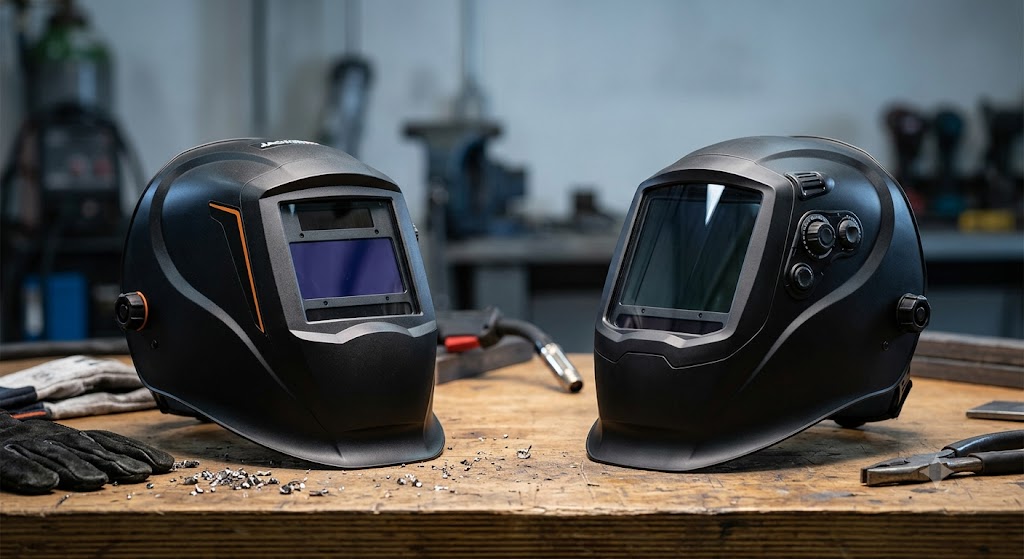
They’re both Jackson Safety. Both use the HLX shell. Both meet ANSI Z87.1 and CSA Z94.3. If you’re standing at the supply house comparing them, the shells look similar enough that it’s easy to wonder whether the price difference is just Jackson charging more for a name inside their own lineup.
It’s not. The TrueSight II is a fundamentally different ADF cartridge, and the difference becomes apparent the moment you look through both lenses back-to-back on an active weld. The Insight does everything a capable auto-darkening helmet should do. The TrueSight II does it with a view that makes you question why you put up with anything less.
Auto-darkening filters darken in response to arc radiation, protecting your eyes from UV and infrared energy. The optical quality of the ADF, measured in clarity class, is what separates a functional helmet from a great one. Jackson’s two-tier lineup draws that line cleanly between the Insight and the TrueSight II.
The Jackson W40 Insight (46129)
The Insight is built around Jackson’s HSL shell with the ultra-lightweight HLX design philosophy. The 46129 model weighs approximately 6 ounces for the shell alone, a meaningful number when you’re wearing it all day. The viewing area measures 3.93” x 2.36”, offering a clear, unobstructed field for most standard welding positions without needing to lift the hood.
The variable ADF runs shades 9 to 13, with easy-to-use digital controls and sensitivity and delay adjustments. It meets ANSI Z87.1 2010 standards and is CSA compliant. The headgear is a standard ratchet design that holds adjustment reliably through a shift.
The honest flaw: the Insight’s ADF uses a standard variable ADF without Balder Technology. What that means in practice is that the lens produces a slightly cooler, less color-accurate rendering of the weld pool than the TrueSight II. For welders who have used only standard ADFs, the Insight looks perfectly fine. For welders who have seen Balder Technology, going back to the Insight is noticeable.
The W40 Insight 46129 is sold through welding supply distributors but is not currently listed as a standalone product on Amazon US. If you need to purchase it, check authorized distributors like Cyberweld or direct from jacksonsafety.com.
The Jackson TrueSight II, 46118)
The TrueSight II is Jackson’s top auto-darkening helmet, and it earns that position through Balder Technology, a patented true-color optical system that produces a significantly warmer, more color-accurate rendering of the weld pool and base metal.
The specs back up the reputation: 4.0” x 3.25” viewing area (13 square inches, the largest available in Jackson’s ADF lineup), 1/1/1/1 optical clarity, four independent arc sensors, variable shades 5 to 13, and three operating modes including weld, torch, and grind. The Hydraflex shell weighs 6 ounces, matching the Insight’s shell weight despite the larger viewing area. The 370 Speed Dial ratcheting headgear provides precise micro-adjustments for fit. Jackson backs it with a five-year warranty, which is among the longest in the category.
The shade range starting at 5 (compared to the Insight’s 9) means the TrueSight II covers low-amperage TIG work where the Insight cannot reach. For welders doing both TIG and higher-amperage processes, that expanded range matters.
The built-in magnification lens holder accepts Jackson’s optional cheater lens inserts in seven focal powers, making the TrueSight II the more practical choice for older welders or anyone who needs optical correction while welding.
Is the TrueSight II Worth the Upgrade?
For TIG welders, yes without hesitation. The 5 to 13 shade range, four sensors, and Balder Technology combine to give you a clearer, more color-accurate view of a TIG puddle at low amperage than any ADF without comparable true-color technology. The weld pool on stainless steel or aluminum looks different through the TrueSight II than through a standard ADF. That difference directly affects your ability to read the puddle and adjust your technique in real time.
For MIG and stick welders, the upgrade is more honest: you’ll see the difference, you’ll prefer the TrueSight II view, but the Insight does the job. The real justification for the step up is the expanded shade range, the four-sensor layout for out-of-position work, and the five-year warranty that protects the investment over a longer ownership period.
Who should skip the TrueSight II: hobbyists or occasional welders doing basic MIG or stick in flat and horizontal positions who want a solid, reliable helmet without spending what the TrueSight II costs. The Insight is the right choice for that application.
Which Has the Larger Viewing Area?
The TrueSight II, by a meaningful margin. The TrueSight II’s 4.0” x 3.25” window (13 square inches) versus the Insight’s 3.93” x 2.36” (approximately 9.3 square inches) gives you noticeably more vertical real estate. That extra vertical space is particularly useful for TIG welding where your eye tracks down the taper of the tungsten to the puddle, for pipe welding where the joint runs at an angle, and for any work where you’re reading the leading edge and trailing edge of the bead simultaneously.
Which Is Better for TIG Welding?
The TrueSight II. The combination of shade range 5 to 13, Balder Technology’s true-color rendering, four arc sensors, and the torch mode specifically designed for TIG applications makes it the better helmet for this process.
The Insight’s shade floor of 9 excludes the shade 5 to 8 range that’s appropriate for low-amperage TIG work under roughly 60 amps. If you’re doing delicate TIG work on thin stainless or aluminum, the Insight simply can’t get dark enough at the low end to give you the right protection and contrast.
Head-to-Head Comparison
| Feature | Jackson W40 Insight 46129 | Jackson TrueSight II |
|---|---|---|
| Viewing area | 3.93” x 2.36” (~9.3 sq in) | 4.0” x 3.25” (13 sq in) |
| Lens technology | Standard variable ADF | Balder Technology |
| Arc sensors | Not specified | 4 independent sensors |
| Shade range | 9 to 13 | 5 to 13 |
| Modes | Weld, Grind | Weld, Torch, Grind |
| Optical clarity | 1/1/1/1 | 1/1/1/1 |
| Shell weight | ~6 oz | ~6 oz (Hydraflex) |
| Warranty | Standard | 5 years |
| ANSI Z87.1 | Yes | Yes |
| Amazon availability | Not available | Check on Amazon |
FAQ
Is the TrueSight II worth the upgrade over the W40 Insight? For TIG welders, yes. Balder Technology delivers a noticeably warmer and more color-accurate view of the weld pool, the shade range extends down to 5 for low-amperage work, and the five-year warranty protects the investment. For MIG and stick welders doing primarily flat and horizontal work, the Insight performs well at a lower investment.
Which has the larger viewing area? The TrueSight II at 4.0” x 3.25” (13 square inches) versus the Insight’s 3.93” x 2.36”. The TrueSight II’s larger vertical dimension is especially noticeable for TIG and pipe welding.
Which is better for TIG welding? The TrueSight II. Balder Technology, the 5 to 13 shade range covering low-amperage TIG, and the dedicated torch mode make it the correct choice for TIG applications.
Can I buy the Jackson W40 Insight 46129 on Amazon? The W40 Insight 46129 is not currently listed as a standalone product on Amazon US. It’s available through authorized welding supply distributors, including jacksonsafety.com and specialty welding retailers.
What is Balder Technology? Balder Technology is Jackson Safety’s patented true-color optical system built into the TrueSight II ADF cartridge. It produces a more accurate color rendering of the weld pool and base metal compared to standard ADF lenses, reducing eyestrain and improving puddle readability during welding.
Are both helmets ANSI Z87.1 rated? Yes. Both the W40 Insight and TrueSight II meet ANSI Z87.1 2010 standards and CSA Z94.3, confirmed in the product specifications on jacksonsafety.com.
What is the warranty on the TrueSight II? Jackson backs the TrueSight II with a five-year warranty, one of the longest in the auto-darkening helmet category.
Does the TrueSight II have a magnification lens holder? Yes. The TrueSight II includes a built-in magnification lens holder compatible with optional cheater lenses in seven focal powers, sold separately by Jackson Safety.
References
- Jackson W40 Insight 46129 spec page (jacksonsafety.com)
- Jackson TrueSight II 46159 spec page (jacksonsafety.com)
- Jackson TrueSight II Check on Amazon Amazon listing (amazon.com)
- OSHA eye and face protection standard
- American Welding Society welding safety resources