Lincoln Electric K2985 vs Black Stallion Welding Jacket Compared
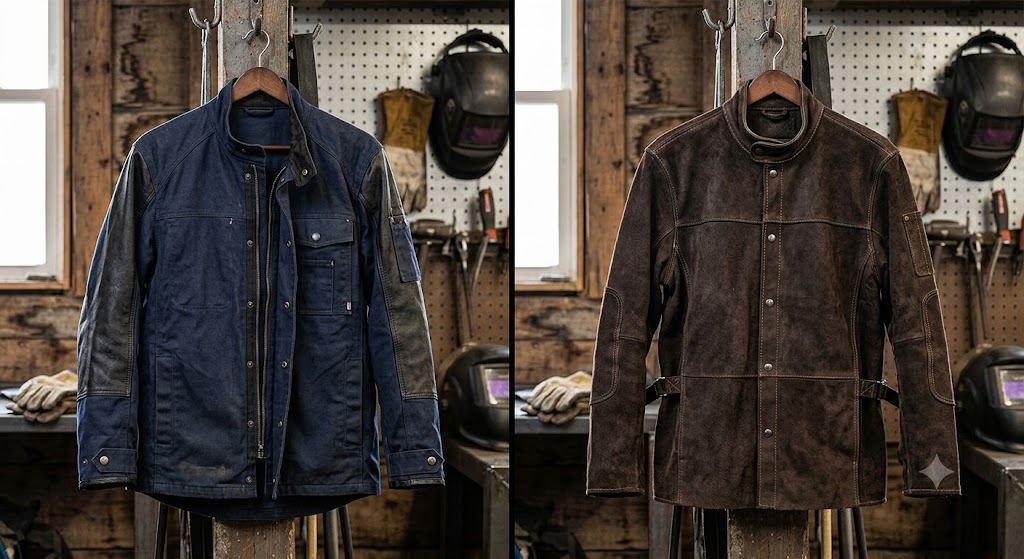
The FR cotton welding jacket debate comes down to what kind of heat you’re working near. If you spend your days running MIG at 150 amps or doing TIG on sheet metal, a 9 oz FR cotton jacket keeps you cool enough to stay focused and protected enough to be safe. Pick the wrong one and you either get a jacket that fits badly, wears out in six months, or makes you sweat through an eight-hour shift in a warm shop.
The Lincoln Electric K2985 and the Black Stallion BSX BX9C go after the same buyer: the welder who wants FR cotton over leather because they’re doing lighter work and they care about breathability. Both are 9 oz FR cotton. Both are black. Both cost less than a leather jacket. The differences come down to cut, coverage, and construction quality.
FR cotton jackets like these are governed by ASTM D6413, the standard test for flame resistance of textiles. Both the K2985 and BSX BX9C meet this standard, meaning the fabric is chemically treated to resist ignition and self-extinguish when the flame source is removed.
Lincoln Electric K2985: What It Does Well
The K2985 is a traditional cut: straight body, snap-front closure, snap sleeves for adjustability at the wrist. At 30 inches from collar seam to hem, it covers your waist and the top of your hip when you’re upright. Stand up straight, you’re protected. The 9 oz FR cotton is rated to retain flame resistance for 100 home washings or 50 commercial washings, which is a practical guarantee for a shop environment.
The inside left pocket is a useful addition for keeping a pen or a small notepad out of the line of sparks. The seams are sewn with 100% polyester, which resists heat slightly better than cotton thread under direct spark contact.
Where the K2985 falls short: the snap front has a tendency to gap at the chest when you’re reaching across your body or bending at the waist. In a flat welding position that’s fine. In vertical or overhead, that gap can let a spark find the shirt underneath. The 30-inch length also means if you’re tall, the jacket rides up when you reach overhead and leaves an inch or two of lower back exposed. If you’re above 6 feet, size up and check the length before you buy.
The K2985 is sized M to 3XL. It’s best suited for MIG and TIG at lower amperages in a shop environment where you’re welding in comfortable positions and not working overhead for extended runs.
Black Stallion BSX BX9C: What It Does Well
The BX9C is a contoured cut with a raised welder’s collar, leather-reinforced snaps, and dual scribe pockets on the sleeves. That contoured fit is the most important distinction between these two jackets. The BSX BX9C is shaped to fit closer at the torso without being restrictive, which means less excess fabric bunching at the front when you’re leaning into a weld.
The welder’s collar on the BX9C is not just marketing. It stands up higher at the back of the neck than the K2985’s collar, which closes the gap between your helmet and your jacket when you tilt your head down. Anyone who has had a spark find the back of their neck during overhead stick knows exactly why this matters.
Leather-reinforced snaps are a durability upgrade that sounds minor until you’ve had snap-front closures fail on cheap jackets after six months of daily use. The reinforcement spreads the stress at each snap attachment point and extends the life of the closure meaningfully.
The dual scribe pockets on the sleeves are a thoughtful detail for fabricators who mark constantly - a soap stone or marker stays accessible without having to reach into a chest pocket.
The honest flaw with the BX9C: the contoured cut that makes it fit better also makes it less forgiving if your measurements don’t match the size chart. Wide-shouldered welders sometimes find the armhole on the BX9C restrictive when making large overhead movements. If you have a wide back or broad shoulders, try before you buy or size up.
The BX9C is better suited than the K2985 for welders who alternate between positions, do some overhead work, or work in a shop where the neck-gap problem has bitten them before.
FR Cotton vs Leather: When Each Applies
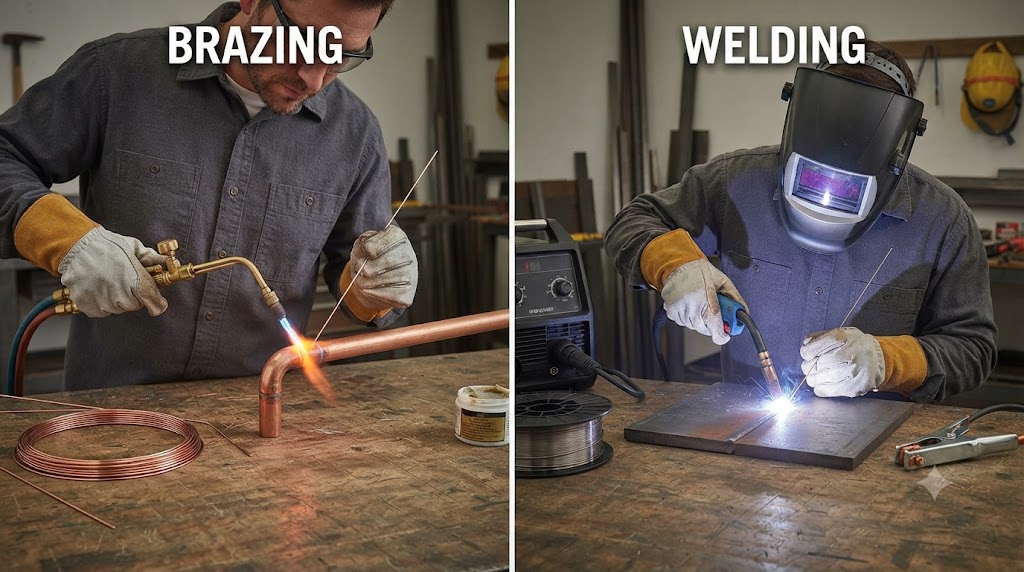
Both jackets are built for light to moderate amperage work. FR cotton has two advantages over leather: it breathes, and it doesn’t conduct heat the way leather can when it gets close to a hot workpiece. In a warm shop, leather jackets can make a full-day shift genuinely uncomfortable.
Leather jackets like split cowhide offer better protection against heavy spatter and slag, particularly for out-of-position Stick welding or flux-cored on structural steel. The surface area of protection is higher and the material is more resistant to burn-through from a direct spatter hit.
For low-amperage TIG on stainless or aluminum, MIG on sheet metal, or light Stick on mild steel, either of these FR cotton jackets is the more practical choice. For heavy structural Stick, flux-cored in any position, or any environment where large spatter or slag is routine, step up to leather.
Head-to-Head Comparison
| Feature | Lincoln K2985 | Black Stallion BX9C |
|---|---|---|
| Material | 9 oz FR cotton (ASTM D6413) | 9 oz FR cotton (ASTM D6413) |
| Cut | Traditional straight body | Contoured |
| Collar | Standard | Raised welder’s collar |
| Closure | Snap front | Snap front, leather-reinforced |
| Length | 30 inches | Extended front (32 in front) |
| Pockets | 1 inside left | Dual sleeve scribe pockets + inside |
| Best for | Flat/horizontal MIG and TIG | Mixed-position welding, fabricators |
| Flaw | Gaps at chest when reaching | Restrictive armhole for wide builds |
Verdict
If you’re in a fixed position shop doing MIG and light TIG, the Lincoln K2985 is a workmanlike jacket at a fair price. Machine washable, well-proven FR treatment, straightforward construction.
If you move around the shop, do overhead work, or have had the neck-gap problem before, the Black Stallion BX9C is the better jacket. The welder’s collar, leather-reinforced snaps, and contoured fit are meaningful upgrades for the modest additional cost.
Neither jacket is the right choice for heavy Stick or flux-cored structural work. Step up to leather for those applications.
FAQ
Which is better for low amperage welding? Both are rated for low amperage applications. For TIG on thin material and light MIG work, either jacket provides adequate protection. The BX9C’s closer fit reduces excess fabric near the arc, which is a minor but real advantage for precision TIG work.
Which is more breathable? They use the same weight FR cotton, so breathability is similar. The BX9C’s contoured cut reduces the amount of fabric sitting against your torso, which can feel marginally cooler because there’s less insulation. For hot shop environments, both are significantly more breathable than leather.
Which offers more spark protection? The BX9C’s raised welder’s collar and leather-reinforced snaps provide better protection at the neck and front closure, where sparks commonly find gaps. For general spark protection across the body, both provide equivalent FR cotton coverage.
Is FR cotton enough for stick welding? For light to medium amperage Stick on mild steel in flat or horizontal position, yes. For vertical, overhead, or high-amperage Stick where large spatter blobs are common, leather is more appropriate. FR cotton can be burned through by a direct hit from a large spatter glob in a way that a leather jacket resists better.
How long does the FR treatment last on these jackets? The Lincoln K2985 is rated for 100 home washings or 50 commercial washings before the FR treatment may degrade. The BX9C uses chemically treated FR cotton with similar durability. Neither should be dry-cleaned or treated with fabric softener, as both can compromise the FR properties.
What sizes are available? The Lincoln K2985 is available in M through 3XL. The Black Stallion BX9C is available in small through 4XL in most color options, providing better coverage for smaller and larger frames.
References
- https://www.lincolnelectric.com (K2985 product page)
- https://www.revco-industries.com (Black Stallion/BSX product information)
- https://www.astm.org/d6413_d6413m-12r19.html (ASTM D6413 standard for textile flame resistance)
Slug: lincoln-electric-k2985-vs-black-stallion-welding-jacket-compared Excerpt: Both are 9 oz FR cotton. Both are built for light to moderate welding. The differences come down to fit, collar design, and whether you need the BX9C’s reinforced details for mixed-position work.