Lincoln Viking 3350 vs Optrel Crystal 2.0 Compared
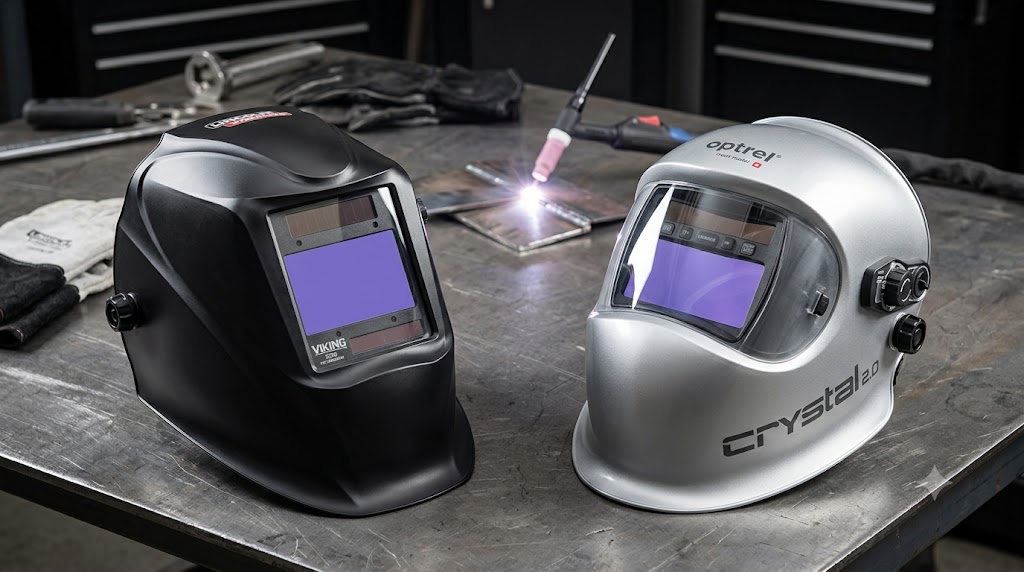
Two welders. Same shop. One reaches for the Lincoln because it has the biggest lens he’s ever used on an auto-darkening helmet. The other reaches for the Optrel because he says it’s like looking through a window instead of a filter. They’re both right, and neither one is about to switch.
The Viking 3350 and the Crystal 2.0 represent two distinct philosophies in premium welding helmet design. Lincoln went wide: a 12.5 square inch viewing area, 4C lens technology tuned for natural color rendering, and a shell that distributes weight well enough to wear all day. Optrel went clear: a 31% light transmittance in the bright state, shade 2.0 protection level, and a lens that lets you see the workpiece with a clarity that changes how you set up your tacks.
If you weld MIG and Stick primarily and want the largest field of view in your price range, the Viking 3350 is the better fit. If you do precision TIG and the ability to see the weld pool in bright state matters more than square inches, the Crystal 2.0 is the one that will change how you work.
Lens Clarity: What the Numbers Mean in Practice
Both helmets carry 1/1/1/1 optical clarity ratings per EN 379 - the top rating across diffusion, angle of view, luminous transmittance variation, and angular dependence. On paper they’re equal. In practice, they feel different.
The Viking 3350’s 4C lens technology is tuned to widen the color spectrum visible through the dark filter, reducing the greenish-gray cast that cheaper lenses impose. Colors read closer to daylight. If you’ve used budget helmets where your weld puddle looks like you’re watching it through a tinted car window, the 4C lens is a genuine improvement.
The Crystal 2.0 uses Optrel’s Crystal Lens Technology 2.0, which achieves 31% light transmittance in the bright state and a protection level of shade 2.0 rather than the shade 3 or 3.5 that most competitors offer. That extra transmission means you’re seeing the workpiece almost as clearly as you would through a lightly tinted safety glass. When you’re positioning a TIG torch on thin stainless, or chasing a root pass in a tight joint, that difference in bright-state visibility is not subtle.
The flip side: the Crystal 2.0’s dark-state shade range runs from 8 to 12, whereas the Viking 3350 covers shade 5 to 13. For high-amperage applications like arc gouging or heavy structural Stick work, the Viking’s shade 13 ceiling matters. The Crystal 2.0 was not designed for that work.
Viewing Area: 12.5 vs 8.5 Square Inches
The Viking 3350 has a 3.74 x 3.34 inch lens, which works out to 12.5 square inches. Optrel quotes the Crystal 2.0 viewing area at 50mm x 100mm - approximately 7.75 square inches (4.25 x 2.0 inches in imperial terms, per Optrel’s own spec sheet).
That’s a meaningful difference. The Viking gives you more peripheral visibility, which matters for tracking long welds, watching your puddle edge-to-edge, and shifting position without losing sight of the bead. For production MIG welding on larger assemblies, the Viking’s bigger window is a real advantage.
For TIG welding, especially on small components, the Crystal 2.0’s smaller but extraordinarily clear lens often feels like more because you can actually see fine detail in bright state before you strike the arc. You’re not losing information to lens tint before the work even begins.
Shade Range and Process Compatibility
The Viking 3350 covers shade 5 to 13, handles Stick, TIG, pulsed TIG, MIG, pulsed MIG, flux-cored, gouging, and grinding. It has four arc sensors, a switching speed of 1/25,000 of a second, and a solar-assisted battery power system. This is a helmet that will follow you across every process in a fabrication shop.
The Crystal 2.0 tops out at shade 12 with Autopilot automatic shade adjustment, three sensors, and a cutting mode. It’s optimized for TIG, light MIG, and precision fabrication. The auto-shade function adjusts the dark state based on arc brightness, which removes one variable when you’re moving between amperage ranges on the same shift. The trade-off is the ceiling - take this to a heavy Stick application and you’re near the top of its range.
Headgear and All-Day Wear
The Viking 3350 ships with Lincoln’s X6 headgear, which is genuinely well-engineered. Weight distribution across six contact points reduces the pressure concentration that makes cheaper headgear painful by midday. The helmet shell itself is lightweight plastic, and Lincoln has tuned the balance point so the forward weight of the lens doesn’t pull the front down when you tilt your head.
The Crystal 2.0’s shell is lighter at 17.2 oz with filter installed, and Optrel’s headgear is a ratchet design with decent adjustability. For an all-day shift welding large structures in fixed positions, both helmets are comfortable. For a fabricator moving between positions constantly - flat, vertical, overhead - the Viking’s X6 headgear has a slight edge because of how it manages weight shift.
One honest flaw with the Viking 3350: the external grind button is low-profile and functional, but the sensitivity knob has a tactile feel that some welders find imprecise - small adjustments can be difficult with gloves on in a hurry. If you’re constantly fine-tuning sensitivity between jobs, you’ll notice it.
One honest flaw with the Crystal 2.0: the viewing area is smaller than competitors at this price point, and the shade ceiling of 12 rules it out for any high-amperage Stick or gouging work. It’s a specialist’s tool, not a generalist’s.
Which Is Better for TIG?
The Crystal 2.0. There’s no equivocation here. The shade 2.0 light state and 31% transmittance let you track your torch position and see your puddle with clarity that a shade 3 bright state simply can’t match. Optrel built this helmet for TIG welders, and it shows in every spec decision they made.
For TIG below 30 amps on thin material, the Crystal 2.0’s pre-arc clarity changes how you set up each weld. The Viking 3350 is excellent for TIG as well, but if TIG is your primary process and you’re doing precision work, the Crystal 2.0 justifies its premium.
Comparison Table
| Feature | Lincoln Viking 3350 | Optrel Crystal 2.0 |
|---|---|---|
| Viewing area | 12.5 sq in (3.74 x 3.34 in) | ~7.75 sq in (50 x 100 mm) |
| Light state | Shade 3.5 (DIN) | Shade 2.0 (31% transmittance) |
| Dark state range | Shade 5-13 | Shade 8-12 |
| Arc sensors | 4 | 3 |
| Switching speed | 1/25,000 sec | 0.1 ms |
| Auto shade | No | Yes (Autopilot) |
| Optical clarity | 1/1/1/1 | 1/1/1/1 |
| Best for | MIG, Stick, all-around | Precision TIG, light MIG |
Verdict
Buy the Viking 3350 if you work across multiple processes and want the biggest, clearest all-around lens at this price. The 4C optics are genuinely excellent, the X6 headgear is one of the best in this category, and shade 13 keeps you covered for the heaviest work a fab shop produces.
Buy the Crystal 2.0 if you’re a TIG welder who wants to see the workpiece the way it actually looks before you strike an arc. The brightness and clarity of the light state are unlike anything else at this price, and Autopilot simplifies the shade adjustment routine.
FAQ
Which has better lens clarity, the Viking 3350 or the Crystal 2.0? Both carry 1/1/1/1 optical clarity ratings. The Crystal 2.0 has the superior bright-state transmission at 31% (shade 2.0), which gives it a significant advantage in pre-arc visibility. The Viking 3350’s 4C lens technology provides better-than-average color rendering in the dark state.
Is the Crystal 2.0 worth the higher price? For precision TIG welders, yes. The bright-state clarity is a genuine capability upgrade that changes how you set up tacks and root passes. For welders who primarily run MIG or Stick, or who need shade 13 for heavy amperages, the Viking 3350 delivers equal or better value.
Which is better for TIG welding? The Crystal 2.0 for precision TIG, especially under 150 amps where the light-state visibility matters most. The Viking 3350 handles TIG well and covers a wider amperage range, but the Crystal’s shade 2.0 bright state is unmatched for fine positioning work.
Can the Crystal 2.0 handle Stick welding? Light to medium amperage Stick work, yes. Its shade range tops out at 12, which is adequate for most Stick applications but not for high-amperage or arc gouging. The Viking 3350 is the better choice for heavy Stick.
Does the Viking 3350 have automatic shade adjustment? No. Shade is manually set on the Viking 3350 via the sensitivity and shade controls on the filter. The Optrel Crystal 2.0’s Autopilot function adjusts shade automatically based on arc brightness.
What is the Crystal 2.0’s product number? The black version is 1006.901. The silver version is 1006.900.
How long is the warranty on each helmet? Lincoln Electric offers a 5-year hassle-free warranty on the Viking 3350. Optrel provides a 2-year warranty on the Crystal 2.0 with a 1-year extension available through online product registration within the first 6 months.
References
- https://www.lincolnelectric.com (Viking 3350 product page and specifications)
- https://optrel.us/product/crystal-black-2-0/
- https://optrel.us/product/crystal-2-0/
- https://ch-delivery.lincolnelectric.com/api/public/content/e5a581704e424b66b500c89cb35ce90f?v=2024dc65
- https://assets.lincolnelectric.com/assets/EU/OperatorManuals/IM2044rev0-Viking3350-ENG.pdf
Slug: lincoln-viking-3350-vs-optrel-crystal-2-0-compared Excerpt: The Viking 3350 gives you more viewing area and a wider shade range. The Crystal 2.0 gives you a bright state that looks like a window. Here’s which one earns its price for your type of welding.