MIG vs TIG vs Stick Welding: How the Processes Actually Differ
Every new welder hits the same fork in the road: MIG, TIG, or stick? They all join metal with an electric arc, but they feel completely different in the hand, and each one is genuinely better at some jobs than the others. Pick by what you actually weld, not by what looks coolest online. This guide breaks down how MIG, TIG, and stick really differ, in how they work, how hard they are to learn, how fast they go, and what each one is best at.
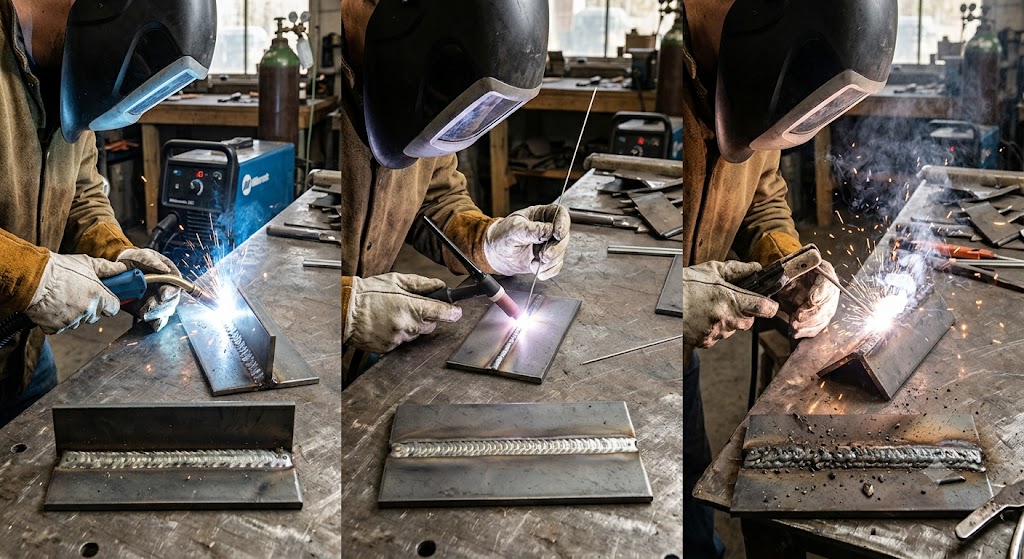
MIG feeds a wire and is the easiest to learn and fastest for general work. TIG uses a hand-fed rod and a non-melting tungsten for the cleanest, most precise welds. Stick uses a flux-coated rod and is the most rugged and portable. Here is how they compare.
How each process works
Start with the basic mechanics, because everything else follows from them:
- MIG (GMAW): a machine feeds a continuous solid wire that melts into the joint, with a shielding gas protecting the pool.
- TIG (GTAW): a non-melting tungsten electrode makes the arc, argon shields the weld, and you dip filler by hand.
- Stick (SMAW): a flux-coated rod melts into the joint and the burning flux shields the weld and leaves slag.
Continuous wire, hand-fed rod, or consumable coated rod, that core difference shapes how each process behaves.
Direct answer: the quick comparison
If you just want the headlines:
- Easiest to learn: MIG. Pull the trigger and go; the machine feeds the wire for you.
- Cleanest and most precise: TIG. Total control over heat and filler, but the steepest skill curve.
- Most rugged and portable: Stick. Works outdoors, on dirty metal, with simple gear.
- Fastest for general work: MIG, thanks to continuous wire feed.
- Best for thin metal and aluminum: TIG, for its fine heat control.
- Best outdoors and on rusty steel: Stick (or flux core).
Each wins a different category, which is why many shops keep more than one.
Skill and ease of learning
The learning curve is where these three differ most for beginners. MIG is the friendliest by far: the machine feeds the wire automatically, so you mostly steer the gun at a steady pace, and decent welds come quickly. That is why MIG is the usual first process. Stick is a bit harder because you have to strike and hold an arc manually and manage the rod as it burns down, but the fundamentals come with practice, and stick forgives dirty metal. TIG is the hardest to learn because you are doing several things at once: holding the torch steady, feeding filler with the other hand, and often controlling amperage with a foot pedal, all while keeping the tungsten from touching the pool. TIG rewards patience with beautiful welds, but it asks the most coordination.
Speed, strength, and materials
Beyond ease of use, the practical differences come down to speed, materials, and setting. MIG is fast because the wire feeds continuously, so it is great for general fabrication and longer welds, and it handles thin to medium steel well. TIG is slower because you feed filler by hand, but it gives the cleanest, most precise welds and is the top pick for thin sheet, stainless, and aluminum, where heat control is everything. Stick is the rugged all-rounder: it is slower than MIG and leaves slag to clean, but it welds outdoors, tolerates rust and dirt, and needs only simple, portable gear, which makes it the field-repair and heavy-structural favorite. As for strength, a sound weld from any of the three can be strong; the right choice is about matching the process to the material and conditions, not chasing a single strongest option.
Which one should you choose?
Match the process to your work. If you are learning or doing general fabrication, home projects, or auto bodywork, MIG is the natural start for its speed and easy learning. If you weld thin material, stainless, or aluminum, or you want show-quality welds and are willing to practice, TIG is worth the effort. If you work outdoors, repair heavy or dirty steel, or need a simple portable setup, stick (or self-shielded flux core) is the tool. Plenty of welders end up using all three over time, choosing whichever fits the metal and the setting in front of them. There is no single best process, only the best process for the job.
The bottom line
MIG, TIG, and stick all weld with an arc, but they differ in the one thing that matters most: how filler and shielding are delivered. MIG’s continuous wire and gas make it the easiest and fastest, ideal for learning and general work. TIG’s non-melting tungsten and hand-fed rod make it the most precise, the choice for thin metal, stainless, and aluminum, though it demands a steep learning curve. Stick’s flux-coated rod makes it the most rugged and portable, unbeatable outdoors and on dirty steel. Rather than asking which is best overall, ask what you weld and where, and the right process picks itself.
FAQ
Which process is easiest to learn first? MIG. The machine feeds the wire automatically, so you mainly steer the gun at a steady pace, and reasonable welds come quickly. That makes MIG the usual first process for beginners. Stick is a moderate step up because you manage the arc and rod by hand, and TIG is the hardest because it demands coordinating torch, filler, and often a foot pedal at once.
Which process is strongest? There is no single strongest process; a sound weld from MIG, TIG, or stick can be strong. Weld strength depends on matching the process to the material, using correct technique, and getting good fusion and penetration, not on the process name. The better question is which process best fits your metal and conditions, since that is what produces a strong, sound weld.
Which process is best for thin sheet metal? TIG. Its fine, real-time heat control, often through a foot pedal, lets you put just enough heat into thin material without burning through, and its hand-fed filler adds metal precisely. That is why TIG is the top choice for thin sheet, stainless, and aluminum, where too much heat quickly ruins the part.
Which process is best for outdoor work? Stick, or self-shielded flux core. Both make their shielding at the arc from burning flux, so wind cannot blow it away, unlike standard MIG’s bottled gas. Stick also tolerates rusty and dirty steel and uses simple, portable gear, which is why it dominates outdoor field repair and heavy structural welding.
Is TIG better than MIG? Neither is simply better; they suit different jobs. TIG makes cleaner, more precise welds and handles thin metal, stainless, and aluminum well, but it is slower and harder to learn. MIG is faster and much easier, ideal for general fabrication and longer welds. The best choice depends on your material, the finish you need, and your skill level.
Can one welder do all three processes? Yes. Many welders learn all three over time, and multi-process machines can run MIG, TIG, and stick from one unit. Since each process is best at different jobs, being able to switch lets a welder match the process to the metal and setting, whether that is fast fabrication, precise thin-metal work, or rugged outdoor repair.
References
- Miller Electric guides comparing MIG, TIG, and stick welding processes (manufacturer), millerwelds.com.
- Lincoln Electric welding process resources (manufacturer), lincolnelectric.com.
- The Welding Institute (TWI) references on arc welding process fundamentals (industry), twi-global.com.