miller digital elite vs esab sentinel compared
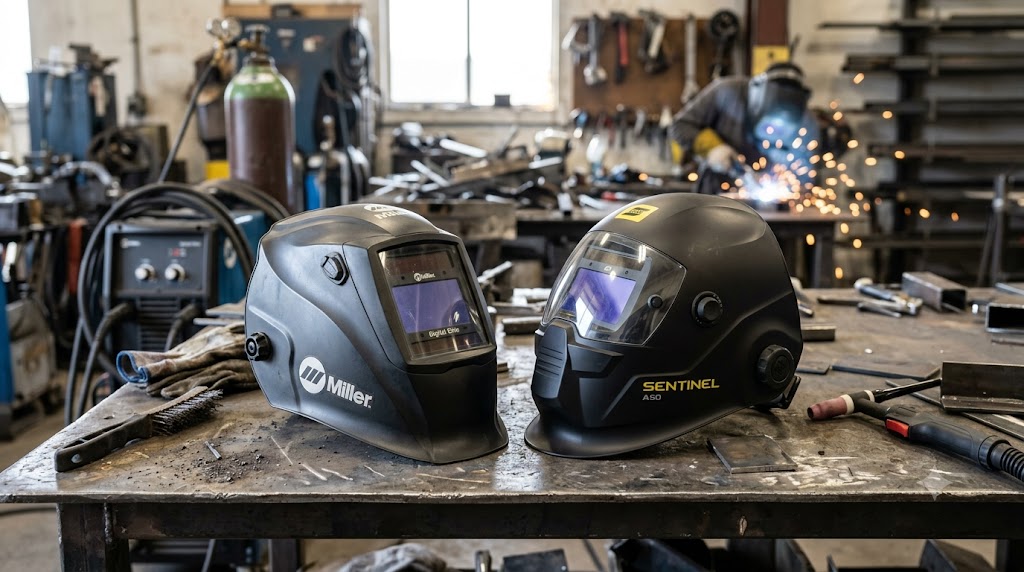
Two helmets can both look clear when you hold them under shop lights. The difference shows up when you are tucked around a bracket, the arc is half-blocked, and you need the lens to keep up without making your neck fight the headgear. That is the real Miller Digital Elite vs ESAB Sentinel choice.
The Miller Digital Elite is a premium auto-darkening welding helmet line built around ClearLight lens technology, four arc sensors, digital controls, and Miller’s X-Mode. The ESAB Sentinel family, especially the A50 and A60, is known for a low-profile shell, true-color optics, and HALO-style five-point headgear.
Direct answer: I would choose the Miller Digital Elite for daily shop use where X-Mode, button controls, and sensor behavior matter most. I would choose the ESAB Sentinel A60 if comfort, low-profile shell shape, and the clearest ESAB viewing experience matter more. The A50 is still a good hood, but the A60 is the better Sentinel comparison against newer Miller helmets.
Quick verdict: Miller for workhorse control, ESAB for comfort
My pick for hard daily use is the Miller Digital Elite, especially the newer ClearLight 4x versions. Miller’s official page lists four operating modes (weld, cut, grind, and X-Mode), half-shade settings, four independent arc sensors, digital controls with large push buttons, and quick-release cover lenses.
The ESAB Sentinel A60 fights back with a bigger, clearer modern lens than the old A50. ESAB says the A60 has a 4.65 by 2.80 inch viewing area, 1/1/1/1 optical rating, OpTCS broad-spectrum light control, and true-color view. ESAB also gives the Sentinel line the headgear advantage for many welders.
The honest flaw on Miller is headgear feel. Some welders love the balance, while others never stop fiddling with the fit. The honest flaw on ESAB is the control setup and long-term abuse concern, especially around touchscreen-style interfaces on the A50 in gritty shop life.
Optics: which has the clearer lens?
For pure spec-sheet clarity, the ESAB Sentinel A60 has the cleaner headline because ESAB states a 1/1/1/1 optical quality rating. The A60 also uses ESAB’s OpTCS True Color Lens Technology and has a larger view than the A50.
Miller’s newer ClearLight 4x helmets are no slouch. Miller describes ClearLight 4x as advanced high-definition optics for a clearer, brighter, more realistic view before, during, and after the weld. The Digital Elite gives you a 9.22 square inch viewing area in current spec listings, while the Digital Infinity steps up to 13.4 square inches if you want more window.
My take: if you are comparing Miller Digital Elite ClearLight 4x to ESAB Sentinel A60, clarity is close enough that fit and controls should decide it. If you are comparing older Digital Elite ClearLight 2.0 to the A60, the ESAB’s 1/1/1/1 rating and larger modern view are harder to ignore.
Headgear: ESAB wins comfort for most people
The ESAB Sentinel’s HALO-style headgear is the reason many welders try it on and immediately understand the hype. ESAB describes the related HALO headgear as a five-point-contact system that helps shift helmet weight around the head.
Forum discussions line up with that. Welders often praise the ESAB for comfort and balance, while still debating the lens covers and controls. One WeldingWeb comparison described the ESAB as having the best headgear and the most comfortable overall feel among several premium helmets.
Miller is not uncomfortable, but it is more personal. The Digital Elite can balance well, and the lighter-feeling shell helps in long sessions. Still, if headgear pressure points usually ruin helmets for you, try the ESAB first.
Controls: Miller’s buttons are safer for rough shop life
Miller’s large push-button digital controls are less flashy than ESAB’s touchscreen-style A50 interface, and that is exactly why I trust them more for dirty work. Gloved hands, grinding dust, and bench abuse are not kind to delicate control surfaces.
The ESAB A50’s color touchscreen is slick when clean. The concern is durability and usability after real shop wear. Welder discussions often praise the A50’s comfort and clarity while raising doubts about how the touchscreen will hold up.
The ESAB A60 moves the line forward with updated features and external grind access, but my workhorse verdict stays the same: Miller’s controls feel more practical if the helmet is going to get tossed on a bench every day.
X-Mode is Miller’s best argument
X-Mode is the feature that keeps Miller in this fight even when ESAB wins the comfort test. Miller says X-Mode electromagnetically senses the weld, which helps reduce sunlight interference and keeps detection going when optical sensors are blocked.
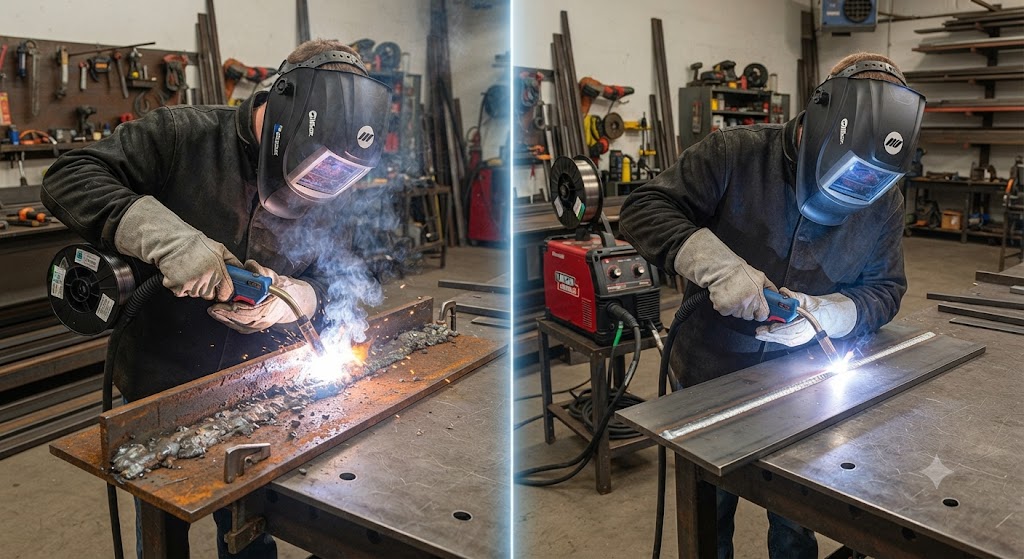
That matters for out-of-position welding. If your hand, torch, pipe, bracket, or fixture blocks the sensors, a normal optical-only helmet can get confused. Four sensors help, but X-Mode gives Miller another way to know you are welding.
If you mostly weld flat at a clean bench, X-Mode may not change your life. If you weld outdoors, around equipment, or in awkward positions, it is one of the best reasons to choose Digital Elite over Sentinel.
A50 vs A60 vs Miller Digital Elite
The ESAB Sentinel A50 is still easy to like. The verified () matches the ESAB 0700000800 Sentinel A50 listing, with a 3.93 by 2.36 inch viewing lens, real-color technology, external grind control, and HALO headgear.
The A60 is the better modern ESAB choice if you are shopping fresh. ESAB says it has a 40 percent larger viewing area than the A50, a 1/1/1/1 optical rating, and OpTCS true-color technology. The flaw is that the A60 may be more helmet than occasional welders need.
For Miller, I verified a current Digital Elite Amazon listing at (). I also verified the newer Miller Digital Infinity ClearLight 4x () by search, but the Infinity is the larger-view sibling, not the Digital Elite itself.
Which one is better for daily shop use?
For daily shop use, I would buy the Miller Digital Elite. The reason is not that it is dramatically clearer than the ESAB. It is the mix of X-Mode, four sensors, large physical controls, quick lens changes, and a shell that feels built for routine abuse.
For fabrication work where you wear the hood for long stretches and comfort is the pain point, the ESAB Sentinel A60 is the better emotional choice. It sits well, looks sharp, and gives you a broad true-color view.
If you are rough on gear, choose Miller. If you baby your hood and comfort decides whether you keep welding or keep adjusting straps, choose ESAB.
Safety and standards still matter
Both brands build serious helmets, but you still need the right shade and eye protection for the work. OSHA’s welding eye-protection guidance ties shade number to radiation intensity, and AWS reminds welders that arcs generate UV, visible, and IR radiation.
Miller also notes that ANSI Z87.1 compliance matters because a helmet must provide passive protection even if the lens is off or malfunctioning. That does not mean you should weld with a dead ADF. It means standards are the floor, not the whole decision.
Replace scratched cover lenses, test the ADF, and wear safety glasses under the hood. A premium helmet with a pitted outer cover can make a good lens look bad.
Final verdict
Buy the Miller Digital Elite if your helmet is a daily tool. X-Mode, four sensors, practical controls, and fast cover-lens changes make it the safer workhorse pick for mixed welding positions.
Buy the ESAB Sentinel A60 if comfort and view feel are what keep you productive. It has the clearer spec-sheet optics, the better headgear reputation, and the sleeker shell.
Skip the ESAB A50 unless you specifically want that older Sentinel feel or find a verified listing that makes sense for your needs. It is still a good hood, but the A60 is the Sentinel I would compare to modern Miller helmets.
FAQ
Which has clearer optics, Miller or ESAB?
The ESAB Sentinel A60 has the cleaner optical rating on paper at 1/1/1/1. Miller ClearLight 4x is still very clear, so fit, controls, and X-Mode may matter more in real use.
Which has the more comfortable headgear?
Most welders will prefer ESAB’s HALO-style headgear. It spreads weight well and is a major reason the Sentinel line has such a strong comfort reputation.
Which is better for daily shop use?
I would choose the Miller Digital Elite for daily shop use. The physical controls, X-Mode, four sensors, and quick cover-lens setup make it feel more practical for hard routine work.
Is the ESAB Sentinel A60 better than the A50?
Yes, if you want the newer lens experience. ESAB says the A60 has a larger viewing area than the A50, a 1/1/1/1 optical rating, and OpTCS True Color Lens Technology.
Is Miller Digital Infinity better than Digital Elite?
The Digital Infinity gives you a larger viewing area than the Digital Elite. The Digital Elite is the better pick if you want a slightly more compact premium workhorse, while the Infinity is for welders who want the bigger window.
Does Miller X-Mode really matter?
It matters most outdoors, around reflective light, and in awkward positions where optical sensors can be blocked. If you mostly weld flat on a bench, it is less of a deciding factor.
Which one should beginners buy?
A beginner with the money to buy once should choose based on fit. If the ESAB feels better on your head, buy the Sentinel A60. If you want simpler rugged controls and X-Mode, buy the Miller Digital Elite.
What were verified?
I verified Check on Amazon for the ESAB Sentinel A50, Check on Amazon for a Miller Digital Elite listing, and Check on Amazon for a Miller Digital Infinity ClearLight 4x listing.
References
- https://www.millerwelds.com/en-US/safety-products/helmets/digital-elite-m00471/digital-elite-black-qr-clearlight-4x-296765
- https://www.millerwelds.com/en-US/safety-products/helmets/digital-infinity-m30025/digital-infinity-black-clearlight-4x-296786
- https://www.millerwelds.com/en-US/welding-solutions/product-details/welding-helmet-clarity-ratings-what-it-means-and-how-clearlight-compares
- https://esab.com/us/nam_en/products-solutions/product/ppe-safety/head-and-face/sentinel-a60/
- https://esab.com/us/nam_en/about/news-folder/new-sentinel-a60-automatic-helmet-offers-larger-clearer-true-color-view-while-welding/
- Check on Amazon
- https://www.weldingweb.com/threads/tried-on-a-few-welding-helmets.715055/
- https://www.osha.gov/sites/default/files/publications/OSHAFACTSHEET-EYEPROTECTION-DURING-WELDING.pdf
- https://www.aws.org/magazines-and-media/welding-digest/2025/november/wd-nov-2025 - complete-welding-lens-shade-chart - safety-guide-for-eye-protection/