Miller Digital Infinity vs Lincoln Viking 3350: Premium Helmet Showdown
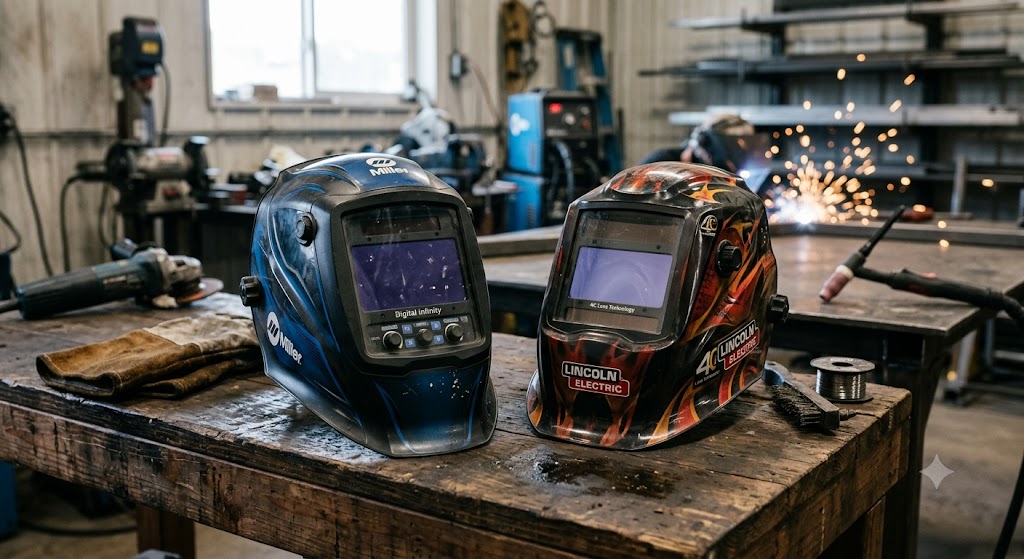
At this level of the market, you stop asking whether a helmet is good and start asking which tradeoff you can live with. The Miller Digital Infinity and Lincoln Electric Viking 3350 are both flagship welding helmets. Both carry 1/1/1/1 optical clarity ratings. Both are built to be worn all day. The real differences come down to viewing area, weight distribution, headgear comfort under sustained load, and which brand’s lens technology reads truer to your eye.
Flagship auto-darkening welding helmets are professional-grade hoods designed for welders who spend most of their working hours in a helmet and cannot afford lens fatigue, missed arcs, or discomfort to affect their output. At this price point, you are paying for optics, ergonomics, and sensor reliability rather than basic functionality.
For most professional welders running production TIG, MIG, or flux-core in a fixed shop environment, the Lincoln Viking 3350 is the stronger all-around value at its price. Its 12.5 square inch viewing area, 4C lens technology, and X6 headgear system have an established record in industrial environments. The Miller Digital Infinity earns its place for welders who specifically need the largest viewing area available (13.4 square inches) and for shops already standardized on Miller equipment.
The Miller Digital Infinity (ClearLight 4X)
The Miller Digital Infinity’s headline is its viewing area: 13.4 square inches, the largest among production auto-darkening helmets at the time of this writing. That is not a marginal difference. Moving from a standard 9-square-inch helmet to 13.4 is like removing a frame from around your monitor. Structural welders, pipe welders, and anyone who tracks long seams across large surfaces will feel that difference immediately.
The ClearLight 4X lens is Miller’s current top-tier optics package, designed to reduce eye strain over long sessions by producing a cleaner, less fatiguing image. The helmet carries a 1/1/1/1 optical clarity rating, four independent arc sensors, and a shade range of 5 to 13. A built-in LED work light is included on the ClearLight 4X version, which is genuinely useful in low-light corners of a shop where you’re trying to see your tack points before you strike an arc.
Miller Digital Infinity ClearLight 4X Welding Helmet
Named flaw: The Miller Digital Infinity is heavier than it looks. Over a full production day, particularly in overhead or out-of-position welding, that weight accumulates. Welders who have switched from lighter competing helmets consistently note that the Digital Infinity’s bulk becomes a factor after four or five hours. The headgear manages it reasonably, but it does not disappear the way lighter helmets do.
The Lincoln Electric Viking 3350 (K3034-4)
The Viking 3350 has been Lincoln Electric’s flagship welding helmet for years and has accumulated a track record in industrial, structural, and production environments that is hard to dismiss. The viewing area is 12.5 square inches, slightly smaller than the Digital Infinity’s 13.4 but still among the largest available and meaningfully larger than most competing helmets.
Lincoln’s 4C lens technology is the engineering contribution that most Viking owners cite first. 4C stands for Clarity, Color, Contrast, and Consistency, and in practice it produces a natural, accurate view of the weld puddle that most experienced welders describe as less fatiguing over long sessions than standard ADF lenses. The optical clarity rating is 1/1/1/1. Shade range is variable from 5 to 13, the same as the Digital Infinity.
The X6 headgear is where the Viking 3350 earns particular loyalty. Six independent adjustment points allow welders to dial in a precise fit that distributes the helmet’s weight across the skull rather than concentrating it at the forehead. On long production shifts, this matters more than most spec sheets suggest. A low-profile external grind button lets you switch to grind mode without removing the helmet or reaching inside to toggle a control.
Lincoln Electric Viking 3350 Welding Helmet K3034-4
Named flaw: The X6 headgear adjustment points can loosen over extended daily use, particularly the rear adjustment. Welders who wear the Viking 3350 in high-vibration environments or who set and reset their headgear multiple times per shift sometimes find the ratchet requires periodic retightening to maintain a secure fit. It does not fail, but it requires more attention than the self-locking systems on some competing helmets.
Which Has the Bigger Viewing Area?
The Miller Digital Infinity wins on raw numbers: 13.4 square inches versus the Viking 3350’s 12.5. In everyday welding, the 0.9 square inch difference is less pronounced than the 13.4 vs 9.3 comparison you see in other categories, but it is real. For welders who work on large structural assemblies or who specifically prioritize maximum field of view, the Digital Infinity is the correct choice. For most production welders, the Viking 3350’s 12.5 square inches is more than sufficient.
Which Is Heavier?
The Miller Digital Infinity is the heavier helmet. While exact weights vary by configuration, multiple side-by-side comparisons from welders and reviewers consistently place the Digital Infinity as noticeably heavier than the Viking 3350. The Lincoln X6 headgear does a better job of managing the Viking 3350’s weight through its six adjustment points, making the Lincoln feel lighter in practice than raw weight numbers suggest.
Which Brand Has Better Headgear Comfort?
The Lincoln Viking 3350 wins on headgear comfort for most welders. The X6 system’s six adjustment points give a more precise, stable fit than the Digital Infinity’s headgear. Over a full production shift, the Viking 3350’s weight management through the X6 is one of the most consistently praised aspects of the helmet from welders who have worn both. The Digital Infinity’s headgear is functional and adjustable, but it does not match the distributed-load design of the X6 for all-day wear.
Head-to-Head: Optical Quality
Both helmets carry the 1/1/1/1 EN379 optical clarity rating, which is the ceiling for this specification. In practice, opinions split between the two lens technologies based on individual preference. Miller’s ClearLight 4X users tend to describe the lens as very bright and slightly cooler in tone. Lincoln 4C users tend to describe their view as more neutral and natural. Neither is objectively better: this is a personal preference that matters more to welders with sensitive eyes or those running many hours of TIG on fine materials.
Comparison Table
| Feature | Miller Digital Infinity (ClearLight 4X) | Lincoln Viking 3350 (K3034-4) |
|---|---|---|
| Viewing Area | 13.4 sq in | 12.5 sq in |
| Lens Technology | ClearLight 4X | 4C Technology |
| Optical Clarity | 1/1/1/1 (EN379) | 1/1/1/1 (EN379) |
| Arc Sensors | 4 | 4 |
| Shade Range | 5-13 | 5-13 |
| Headgear | Standard ratchet | X6 (6-point adjustment) |
| Grind Button | Internal controls | External low-profile button |
| Built-in LED Light | Yes (ClearLight 4X) | No |
| Weight | Heavier | Lighter in practice (X6 distribution) |
| Best For | Maximum viewing area | All-day production comfort |
FAQ
Which has the bigger viewing area? The Miller Digital Infinity, at 13.4 square inches versus the Viking 3350’s 12.5 square inches.
Which is heavier? The Miller Digital Infinity is the heavier helmet. The Lincoln Viking 3350 with X6 headgear manages its weight more effectively across a full shift through six-point distribution.
Which brand has better headgear comfort? Lincoln’s X6 headgear on the Viking 3350 is widely regarded as the more comfortable system for all-day production use. Its six independent adjustment points provide a more stable, distributed fit than the Digital Infinity’s headgear system.
Does the Miller Digital Infinity have a solar cell? The Digital Infinity ClearLight 4X version runs on battery power with arc sensor activation rather than a solar-hybrid system. Check the specific listing for your model’s power configuration.
Is the Lincoln Viking 3350 good for TIG welding? Yes. The 4C lens technology and 1/1/1/1 clarity rating make the Viking 3350 an excellent TIG helmet. Its shade range starts at 5, covering low-amperage TIG applications.
What is 4C technology on the Lincoln Viking 3350? Lincoln Electric’s 4C technology stands for Clarity, Color, Contrast, and Consistency. It describes the optical engineering of the ADF lens, which is designed to produce a natural, fatigue-reducing view of the weld puddle without green or yellow tinting.
Which helmet should I buy if I’m already on Miller equipment? Either helmet can be used with any brand’s welding equipment. Helmets are not paired to a manufacturer’s machines. If brand consistency matters to you, the Digital Infinity integrates visually into a Miller shop, but that is an aesthetic preference rather than a technical one.
What is the warranty on the Viking 3350? Lincoln Electric offers a 3-year lens warranty on the Viking 3350 K3034-4. Details are available at lincolnelectric.com.
References
- Miller Digital Infinity Product Information: millerwelds.com
- Lincoln Electric Viking 3350 K3034-4 Product Page: lincolnelectric.com
- OSHA Eye and Face Protection: 1910.133
- ANSI Z87.1 Eye and Face Protection Standard
- American Welding Society Safety Standards: aws.org
Slug: miller-digital-infinity-vs-lincoln-viking-3350 Excerpt: The Miller Digital Infinity and Lincoln Viking 3350 are both flagship welding helmets with 1/1/1/1 optical clarity. The Infinity wins on viewing area at 13.4 sq in. The Viking 3350 wins on all-day headgear comfort with its X6 system. Here’s the full comparison.