Miller Digital Performance vs Digital Elite: Which One Do You Actually Need?
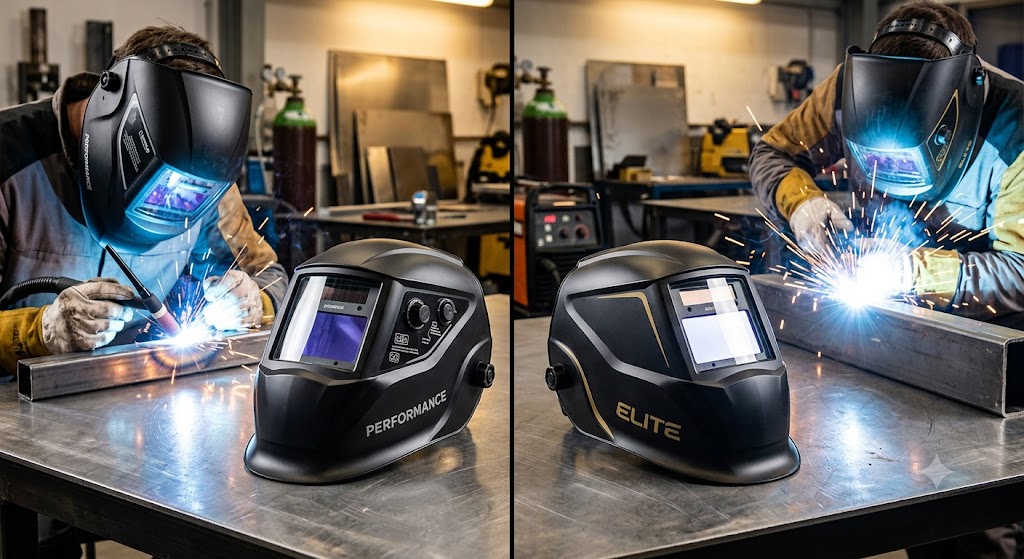
Miller has positioned the Digital Performance and Digital Elite adjacent to each other in their lineup, and the marketing language overlaps enough to make the buying decision genuinely confusing. Both helmets run ClearLight technology, both have X-Mode, both look similar on spec sheets. But spend a day welding in both and you will feel the differences immediately. This comparison breaks it down without the marketing softening.
The Short Answer
If you weld professionally or semi-professionally and arc visibility is something you care about, the Digital Elite is the choice. The Digital Performance exists as a capable step-down option for welders who weld regularly but do not need every feature the Elite offers. It is a good helmet. The Elite is a better one.
Viewing Area: The Most Tangible Difference
The Digital Performance has approximately 7.2 square inches of viewing area in the standard configuration. The Digital Elite has approximately 9.14 square inches. That is a meaningful difference in how much of the weld joint you can see without repositioning your head.
For flat-position MIG work, both are adequate. For out-of-position, overhead, pipe, or precision TIG work where you need to track a narrow joint over a long run, the Elite’s extra viewing area reduces the constant micro-adjustments that build fatigue over a shift. This is probably the most concrete day-to-day difference between the two helmets.
Lens Technology: ClearLight 2.0 vs ClearLight 4x
The Digital Performance has been offered with ClearLight 2.0 technology on many models. Some newer Digital Performance variants - particularly the Carbon Edge Digital Performance configuration - have been updated to ClearLight 4x. Miller’s current lineup specifics can shift between model years, so verify which lens generation is in the specific model you are considering at purchase time.
ClearLight 4x (in the Digital Elite and top-spec Performance variants) provides four times the optical clarity of the ANSI minimum standard for 1/1/1/1-rated lenses. ClearLight 2.0 provides two times the minimum standard. In practical terms:
- Through ClearLight 4x, the arc is brighter, truer in color, with less of the greenish tint common in budget lenses
- Through ClearLight 2.0, clarity is noticeably better than entry-level helmets but not quite the same as 4x
- For TIG welding where puddle definition matters most, ClearLight 4x is genuinely superior
- For MIG welding where amperage is higher and the arc is more forgiving, many welders find ClearLight 2.0 completely adequate
X-Mode: Present in Both
X-Mode is Miller’s electromagnetic arc detection technology. Both the Digital Performance and Digital Elite have X-Mode. This is a full feature in the Performance, not a reduced version. It works identically in both helmets - electromagnetic detection of weld current, outdoor-capable, resistant to ambient light interference.
This is one area where the Performance does not give up anything to the Elite.
Sensor Count: Verify Before You Buy
The Digital Elite consistently has four arc sensors in its standard configuration. The Digital Performance lineup has varied by specific SKU - some configurations have four sensors, some have two. Check the product specification sheet for the exact model you are evaluating.
Four sensors matter most for welders who frequently weld overhead, in tight positions, or with a torch approach angle that could shadow sensors. Two sensors work fine for straight-ahead flat and horizontal welding. If you weld in varied positions regularly, confirm the Performance variant you are considering has four sensors.
Weight: Similar but Not Identical
The Digital Elite is approximately 17.5 oz. Digital Performance weights vary slightly by configuration but are generally in a comparable range. Neither helmet is particularly heavy relative to the Digital Infinity (23 oz). Weight is not a meaningful differentiator between the Performance and Elite.
Controls and Interface
Both helmets use Miller’s internal digital control system with push-button controls on the inside of the ADF cartridge. The user interface logic is the same. Welders who are comfortable with one will immediately understand the other. The Digital Elite’s display may show slightly more status information depending on generation, but functionally both are operated the same way.
Parts and Consumables: Largely Shared
Both helmets use the same CR2450 battery (part 217043). The headgear (770246) is shared across most Miller series including both the Performance and Elite. Hard hat adapters and comfort accessories are the same.
Cover lenses may differ in part number between Performance and Elite depending on the shell and ADF cartridge generation. Always verify the specific cover lens part number for your exact model through Miller’s parts lookup at millerwelds.com rather than assuming cross-compatibility.
Price Reality
The Digital Elite typically runs roughly 100-150 more than the Digital Performance at comparable retail prices. The question is whether the larger viewing area and confirmed ClearLight 4x lens justify that difference for your work.
For a welder who puts in 20+ hours of arc time per week on varied joint configurations, yes. For a hobbyist or student who welds a few hours per week on flat-position practice joints, the Performance is likely adequate and the savings are real.
Head-to-Head Summary
| Feature | Digital Performance | Digital Elite |
|---|---|---|
| Viewing area | ~7.2 sq. in. | ~9.14 sq. in. |
| Lens clarity | ClearLight 2.0 (most models) | ClearLight 4x |
| X-Mode | Yes | Yes |
| Sensors | 2 or 4 (verify by SKU) | 4 |
| Battery | CR2450 (217043) | CR2450 (217043) |
| Headgear | 770246 | 770246 |
| Weight | ~17-18 oz (varies) | ~17.5 oz |
| Best for | Regular use, mixed processes | Professional daily use, TIG |
The Verdict
Buy the Digital Performance if: you are a regular welder but not a daily professional, you primarily do flat and horizontal work, and the price difference matters.
Buy the Digital Elite if: you weld professionally, you do any TIG work where puddle visibility matters, you frequently work out of position, or you simply want the better optics and wider field of view for the work you do.
The Digital Infinity is a third option for anyone who wants the absolute maximum viewing area - 13.4 square inches - and ClearLight 4x, at the cost of more weight and a higher price.
Frequently Asked Questions
Is the Digital Performance good enough for TIG welding? It is functional for TIG, particularly in ClearLight 4x variants. For precision low-amperage TIG work where puddle clarity is critical, the Digital Elite’s confirmed ClearLight 4x lens is the more reliable choice.
Do both helmets have X-Mode? Yes. X-Mode is a full feature in both the Digital Performance and Digital Elite, with identical functionality in both helmets.
What is the biggest practical difference between the two helmets? Viewing area. The Elite’s 9.14 square inches versus the Performance’s 7.2 square inches is the difference most welders notice most quickly when switching between them.
Are the cover lenses interchangeable between the Digital Performance and Digital Elite? Not necessarily. Verify the specific cover lens part number for your exact model SKU before ordering. While many Miller parts cross over between series, lens dimensions can differ.
Does the Digital Performance have four sensors? This varies by specific SKU. Check the product specification sheet for the exact model you are considering. The Digital Elite consistently has four sensors in standard configurations.
Is the Digital Performance a new helmet or an older design? Miller has refreshed the Digital Performance multiple times. Current models use ClearLight 4x in the premium variants. Older models used ClearLight 2.0. Check the lens technology specification when evaluating a specific purchase.
Keywords: miller digital performance vs digital elite, miller digital performance review, miller digital elite vs performance, which miller welding helmet, ClearLight 2.0 vs 4x