Optrel Crystal 2.0 vs Speedglas Compared
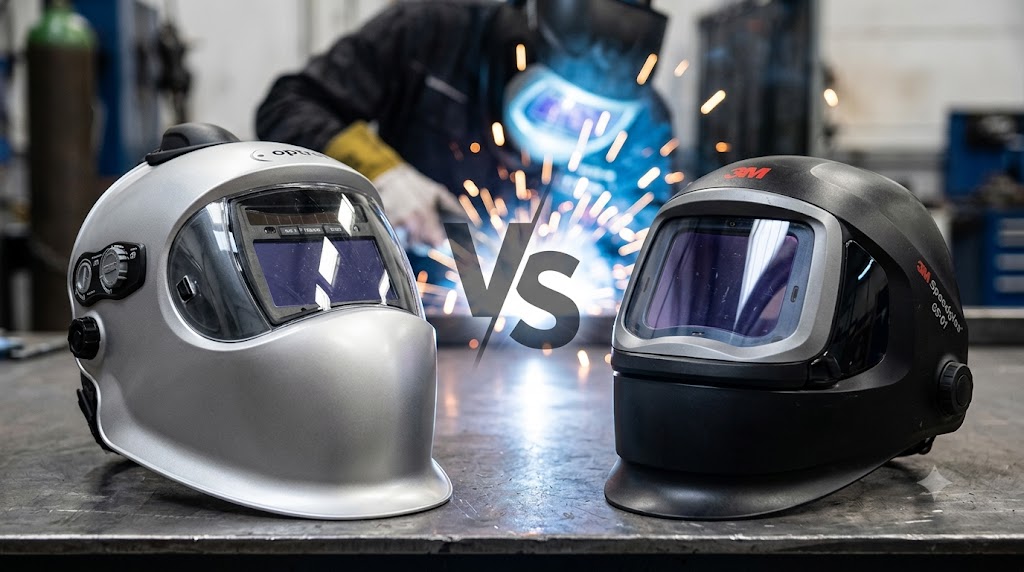
The first time you flip down an Optrel Crystal 2.0, the light state catches you off guard. It is not the amber-tinted dim that most auto-darkening helmets give you between welds. It reads closer to looking through window glass. Whether that clarity is worth the premium over 3M Speedglas depends on how you work, what process you run, and how much the view between arc strikes actually affects your day.
The Optrel Crystal 2.0 (model 1006.901) is a Swiss-made auto-darkening welding helmet with Crystal Lens Technology, a light state of 2.0 that delivers exceptional pre- and post-weld visibility, Shadetronic autopilot shade adjustment from 4 to 12, and a Twilight feature that gradually transitions the lens back to the light state to reduce eye strain. It weighs approximately 2.2 pounds and is sold on Amazon.
The 3M Speedglas 9100XXi is a proven auto-darkening filter paired with the Speedglas 9100 helmet, featuring Natural Color Technology for more realistic color perception during the weld, a 2.8-inch by 4.2-inch viewing area, selectable shades 5 and 8 to 13, a light state of shade 3, and a switching time of 0.1 milliseconds at 23 degrees Celsius. It is available on Amazon.
Direct answer: for TIG welders who care most about what they see between arc strikes and during setup, the Optrel Crystal 2.0 has an edge no other helmet matches in its class. For MIG, stick, and mixed production environments where durability, proven performance, and respiratory integration matter, 3M Speedglas is the standard for good reasons.
The Crystal 2.0’s light state is its defining feature
Most auto-darkening helmets sit at a light state of shade 3 or 3.5. A shade 2.0 light state means dramatically more light reaches your eyes between welds, during setup, and while inspecting the work. Optrel describes this as 31 percent light transmission in the bright state, which is close to lightly tinted safety glasses rather than the dim-green view most welders accept as normal.
For TIG welders who spend as much time setting up and repositioning as they do striking an arc, that clarity is not cosmetic. You see your work more naturally, read joint fit-up with less strain, and reduce the awkward flip-up habit that a darker idle state forces on many welders.
The honest flaw on the Crystal 2.0: its shade range tops out at shade 12, not 13. For most MIG, TIG, and stick work, shade 12 is sufficient. For high-amperage applications pushing beyond 300 amps regularly, you may want to verify that shade 12 meets your specific process needs before committing.
Speedglas optics: Natural Color Technology and proven reliability
The Speedglas 9100XXi filter introduced what 3M calls Natural Color Technology, designed to deliver more realistic colors during the weld without the green or blue tint that older Speedglas filters carried. The viewing area is 2.8 inches by 4.2 inches, which gives reasonable horizontal width for most MIG and stick positions.
The 9100XXi has two memory modes accessible via the silver front panel without removing gloves, which matters when you are alternating between weld settings mid-project. Switching speed is 0.1 milliseconds at normal temperature, which is fast enough for every process in the helmet’s range.
The honest flaw on the Speedglas 9100XXi: the viewing area, while adequate for most work, is narrower than some competitors at the same price tier. And the 9100 series battery life is rated at approximately 1,800 hours for the XXi filter using two CR2032 cells, which is shorter than some solar-assisted helmets.
TIG welding: where Optrel makes its strongest argument
For TIG welding, the choice between these two helmets comes into sharp focus. TIG demands that you see the puddle clearly, hold the torch at exact angles, and manage the filler rod precisely, often at low amperages where a less-reactive lens can feel sluggish.
The Optrel Crystal 2.0’s Shadetronic autopilot automatically adjusts the shade based on arc brightness, which means you are not manually selecting shade for every amperage change. The Twilight feature gradually brings the lens back to the idle state rather than snapping it open, which many TIG welders say reduces the jarring transition that breaks their concentration between passes.
The Speedglas 9100XXi performs well on TIG, and the Natural Color Technology improves puddle visibility versus older Speedglas filters. But the idle view at shade 3 still reads darker than the Crystal 2.0’s shade 2.0, and you will feel that difference during extended TIG sessions.
Durability and real-world use
The 3M Speedglas 9100 platform has been a professional standard for years, with a track record in fabrication shops, shipyards, and construction environments. Welders who need PAPR respiratory integration use the Speedglas 9100 because the Adflo PAPR system connects directly to the helmet. That system compatibility is a genuine structural advantage in industrial environments where respiratory protection is mandatory.
The Optrel Crystal 2.0 carries a three-year warranty after registration (Optrel’s 2 plus 1 warranty program). The Swiss manufacturing and component quality are reflected in the price. The Patented Sensor Slide lets you reduce the detection angle from 120 to 60 degrees, which prevents the ADF from false-triggering when a coworker welds nearby, a practical feature in shared shop spaces.
Comparison table
| Feature | Optrel Crystal 2.0 (1006.901) | 3M Speedglas 9100XXi |
|---|---|---|
| Light state | Shade 2.0 | Shade 3 |
| Shade range | 4 to 12 (auto via Shadetronic) | 5, 8 to 13 |
| Viewing area | Manufacturer-specified | 2.8” x 4.2” (72 x 107 mm) |
| Lens tech | Crystal Lens Technology (CLT) | Natural Color Technology |
| Switching speed | Not published | 0.1 ms at 23°C |
| Twilight feature | Yes | No |
| PAPR compatible | No | Yes (Adflo) |
| Warranty | 3 years (registered) | 1 year |
| Amazon | Check on Amazon | Check on Amazon |
Is Optrel worth the higher investment?
For welders whose primary process is TIG, particularly precision TIG on aluminum or stainless, the Crystal 2.0 is difficult to argue against. The light state 2.0, Twilight transition, and autopilot shade adjustment remove small friction points that accumulate over a long day of detailed work.
For shops doing primarily MIG and stick, or environments where helmets take genuine abuse from grinding, drops, and rough bench treatment, the Speedglas 9100 platform’s durability reputation and PAPR integration may tip the decision.
Neither helmet is a bad choice. They are different tools aimed at slightly different welders.
Final verdict
Buy the Optrel Crystal 2.0 if you are a TIG welder who values the clearest possible view between and during arc strikes, works on precision joints, and wants the light state 2.0 experience that no other helmet currently matches.
Buy the 3M Speedglas 9100XXi if you need a proven, durable platform with respiratory integration options, strong brand support, and solid performance across MIG, stick, and TIG without the premium for the ultra-clear idle view.
Skip the Crystal 2.0 if your process regularly pushes above shade 12 requirements, or if your helmet is going to live in a rough shared shop environment where the investment return is limited.
FAQ
Which has clearer optics, Optrel or Speedglas?
For the view between welds, the Optrel Crystal 2.0 is distinctly clearer because of its shade 2.0 light state compared to the Speedglas shade 3 idle. During the weld itself, the 9100XXi’s Natural Color Technology provides a more realistic view than older Speedglas filters, but the Crystal 2.0’s CLT still ranks among the best available at any price.
Which is better for TIG welding?
The Optrel Crystal 2.0 is the stronger TIG helmet. The shade 2.0 idle, Shadetronic autopilot, and Twilight transition make repeated TIG passes less fatiguing and easier to manage. The Speedglas performs well on TIG but does not match the Crystal 2.0’s idle-state clarity.
Is Optrel worth the higher price?
For dedicated TIG welders and fabricators who spend long hours in a hood, yes. The optical experience is genuinely different and the three-year warranty and Swiss build quality justify the investment. For occasional welders or MIG-focused shops, the Speedglas 9100XXi delivers a high-quality experience at a lower entry point.
Does the Optrel Crystal 2.0 work for MIG welding?
Yes. The Shadetronic autopilot covers shade 4 to 12, which is appropriate for most MIG applications. The external grind mode and sensitivity control function the same as other professional auto-darkening helmets. It is not limited to TIG use.
What is the Twilight feature on the Optrel Crystal 2.0?
Twilight gradually transitions the lens back to the light state after welding, rather than snapping open immediately. This reduces the jarring brightness change that can break concentration between passes and helps reduce eye fatigue during long sessions.
Can the Speedglas 9100XXi be used with a respirator?
Yes. The 3M Speedglas 9100 helmet is designed to integrate with 3M’s Adflo Powered Air Purifying Respirator system, which is a significant structural advantage for welders working in confined spaces or high-fume environments where respiratory protection is required.
What shade does the Optrel Crystal 2.0 max out at?
The Crystal 2.0’s auto-darkening range goes up to shade 12. For most MIG, TIG, and stick processes this is sufficient. High-amperage applications above 300 amps regularly may require verification that shade 12 meets the applicable eye protection standard for that specific output level.
References
- https://optrel.us/product/crystal-black-2-0/
- https://www.3m.com/3M/en_US/speedglas-welding-helmets-us/speedglas-9100xxi/
- Check on Amazon
- Check on Amazon
- https://multimedia.3m.com/mws/media/1508376O/3m-speedglas-welding-filter-9100v-9100x-9100xx-9100xxi-technical-specifications.pdf
- https://www.osha.gov/sites/default/files/publications/OSHAFACTSHEET-EYEPROTECTION-DURING-WELDING.pdf
- https://www.aws.org/magazines-and-media/welding-digest/2025/november/wd-nov-2025—complete-welding-lens-shade-chart—safety-guide-for-eye-protection/