Optrel Panoramaxx vs Sphere X CLT: Which Swiss Helmet Wins for TIG Welders?
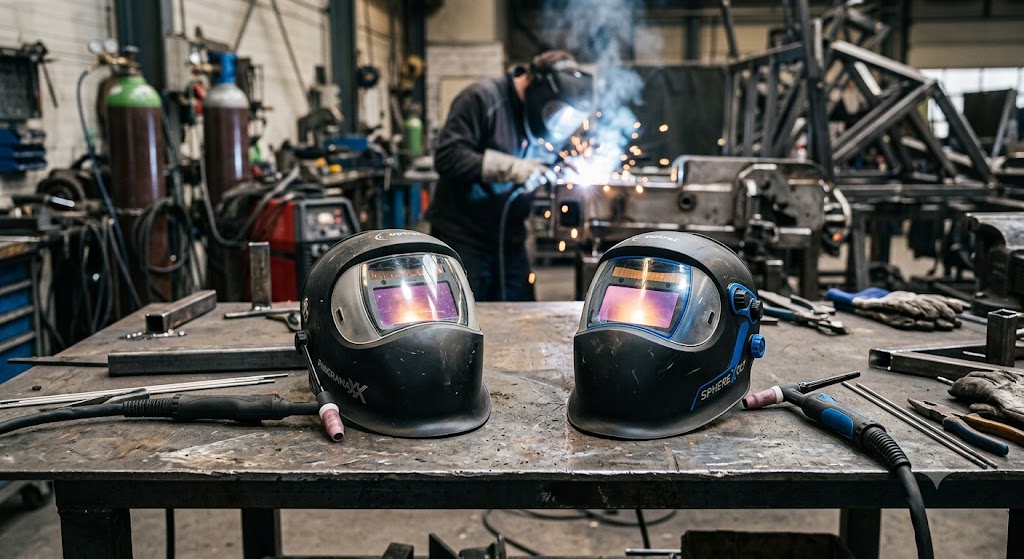
The Panoramaxx changed what a welding helmet could look like. When it came out, that panoramic field of view felt like someone had finally decided welders deserved to see more than a narrow slit of light while working. It became a benchmark in premium auto-darkening helmets, and it still holds up. The Sphere X CLT is Optrel’s answer to the question of what comes next, with a 30% larger field of view than the Crystal 2.0 and a second-generation CLT lens that takes the optical experience further.
For TIG welders doing bench work on stainless, aluminum, or thin sheet, this comparison matters more than it might seem. The ability to read the weld pool, see the filler rod placement, and track the heat input across a seam depends substantially on how your helmet interprets the light coming through it. Both of these helmets are Swiss-made, IsoFit-equipped, and aimed at welders for whom a blurry, greenish view through the lens is simply not acceptable.
Crystal Lens Technology, or CLT, is Optrel’s optical system that produces a true-color, high-contrast view of the weld pool with minimal color shift. The basic premise is that you should be able to see the pool the way it actually looks under the arc, not through the greenish or brownish filter that standard ADF lenses impose. CLT 2.0 is the current generation, found in both the Panoramaxx CLT and the Sphere X CLT.
Is the Sphere X CLT an Upgrade Over the Panoramaxx?
In technical terms, yes. The Sphere X CLT is Optrel’s current flagship and was designed as the successor to the Crystal 2.0, which itself succeeded the Panoramaxx. The Sphere X CLT expands the field of view by 30% compared to the Crystal 2.0 while adding IsoFit X headgear, five arc sensors (versus the Panoramaxx’s sensor layout), a shade floor of 2 for grind mode (the brightest grinding vision Optrel has put in a welding helmet), and external controls for switching between weld and grind mode without lifting the hood.
The Panoramaxx CLT, model 1010.200) remains an excellent helmet. It uses CLT 2.0, covers shades 4 to 12, and provides the panoramic field of view that made the original Panoramaxx a reference point in the category. The IsoFit headgear on the Panoramaxx is a generation behind the IsoFit X on the Sphere X CLT, but it’s still one of the better headgear systems in welding.
The honest assessment: if you already own a Panoramaxx CLT in good condition, the Sphere X CLT is an upgrade you’ll feel but not a replacement you have to make. If you’re buying new today, the Sphere X CLT is the more capable helmet and the one Optrel is actively developing forward.
Which Is Lighter for TIG Bench Work?
The Panoramaxx CLT weighs 550 grams (about 1.21 lb). The Sphere X CLT’s weight is not listed in the available spec data, but Optrel has not compromised weight in the Sphere X line: the series was built around all-day comfort for precision bench welding, and the IsoFit X headgear is designed to distribute weight more evenly across the crown than the original IsoFit.
For TIG bench work specifically, the IsoFit X system’s advantage isn’t just weight distribution, it’s positional stability. When you’re working at a bench with your head at a fixed angle for extended periods, the Sphere X CLT’s multi-point crown contact and Position Locker hold the helmet in place without requiring constant micro-adjustment. The Panoramaxx’s IsoFit headgear provides excellent fit as well, but the IsoFit X is a refinement that bench welders will appreciate over a long session.
Both helmets perform well for TIG bench work. The Sphere X CLT has the headgear advantage; the Panoramaxx has the known weight spec.
Viewing Area and Sensor Count
The Panoramaxx CLT’s panoramic field of view made it famous. The lens design provides what Optrel describes as a six times larger field of vision than standard welding helmets, a claim based on the panoramic lens geometry rather than a direct linear measurement comparison.
The Sphere X CLT expands on the Crystal 2.0 predecessor with a 30% larger field of view. Since the Crystal 2.0 is the Panoramaxx CLT’s successor and the Sphere X CLT is the Crystal 2.0’s successor, the progression is clear: each generation has expanded the viewing area while adding optical improvements.
The Sphere X CLT also carries five arc sensors compared to the Panoramaxx CLT’s sensor layout. Five sensors provide more detection angle coverage for out-of-position welding and low-amperage TIG where the arc’s electromagnetic signature is smaller and easier to miss with fewer sensors.
Shade Range and Operating Modes
The Panoramaxx CLT covers shades 4 to 12, with CLT 2.0 and sensitivity adjustments. The Sphere X CLT covers variable shade 2/5 to 12 with ShadeTronic (automatic shade selection based on arc conditions) and FadeTronic (gradual fade-back to light state rather than an abrupt snap back). Manual mode is available on both.
The ShadeTronic function on the Sphere X CLT is worth understanding before buying: it reads the arc conditions and automatically selects the appropriate shade, removing manual dial adjustments between processes. For welders who switch between TIG at low amperage and MIG or stick at higher amperage in the same session, that automatic adjustment reduces the chance of an incorrect shade setting.
The Sphere X CLT’s grind mode reaches a shade of 2, the brightest grinding vision Optrel has put in any helmet. For a TIG welder who also grinds between passes, keeping the hood down during grinding at shade 2 is a safety and workflow improvement over helmets with shade 3 or 4 grind modes.
What Is the Difference in Value Between These Two Helmets?
Both helmets sit at the premium end of the auto-darkening market. The Sphere X CLT carries a higher investment than the Panoramaxx CLT. In feature terms, you are paying for: a larger field of view, five sensors versus fewer, IsoFit X headgear, ShadeTronic and FadeTronic automation, a brighter grind mode, external controls, and Optrel’s current-generation engineering rather than a previous generation.
For a professional TIG welder who wears a helmet daily, the Sphere X CLT is the correct choice. For a welder who occasionally does TIG and is stepping up from a mid-tier helmet, the Panoramaxx CLT remains an excellent entry point into CLT optics at a somewhat lower price point.
Neither helmet is available through standard mass retail channels. Both are sold through authorized Optrel distributors and on Amazon (Panoramaxx CLT at; Sphere X CLT at.
Optrel Panoramaxx CLT on Amazon
Head-to-Head Comparison
| Feature | Panoramaxx CLT | Sphere X CLT |
|---|---|---|
| Lens technology | CLT 2.0 | CLT 2.0 |
| Field of view | Panoramic (6x vs standard) | 30% larger than Crystal 2.0 |
| Arc sensors | Not specified | 5 |
| Shade range | 4 to 12 | 2/5 to 12 |
| Grind mode shade | Not specified | 2 (brightest available) |
| ShadeTronic | No | Yes |
| FadeTronic | No | Yes |
| Headgear | IsoFit | IsoFit X |
| External controls | No | Yes |
| Weight | 550g (1.21 lb) | Not specified |
| Origin | Swiss Made | Swiss Made |
| Amazon availability |
FAQ
Is the Sphere X CLT an upgrade over the Panoramaxx CLT? Yes. The Sphere X CLT is the current-generation flagship, offering a larger field of view, five arc sensors, IsoFit X headgear, ShadeTronic, FadeTronic, brighter grind mode, and external controls. The Panoramaxx CLT remains a capable helmet, but the Sphere X CLT is a meaningful step forward in every functional category.
Which is lighter for TIG bench work? The Panoramaxx CLT has a published weight of 550 grams (1.21 lb). The Sphere X CLT’s exact weight is not listed in available specifications, but Optrel designed the Sphere X line for all-day bench welding comfort. The IsoFit X headgear on the Sphere X CLT provides better weight distribution and positional stability than the original IsoFit.
What is the difference in value between these helmets? The Sphere X CLT carries a higher investment reflecting its additional sensors, larger view, and current-generation features. The Panoramaxx CLT is the more accessible entry into CLT optics for welders stepping up from mid-tier helmets.
What is CLT and why does it matter for TIG welding? CLT (Crystal Lens Technology) produces a true-color, high-contrast view with minimal color shift. For TIG welding, where reading the weld pool color and behavior is central to heat control and penetration, a lens that renders the pool accurately reduces eyestrain and improves puddle readability compared to standard ADF lenses with greenish or brownish tints.
What is ShadeTronic on the Sphere X CLT? ShadeTronic automatically selects the appropriate shade based on arc conditions, removing the need to manually adjust the shade dial between processes or amperage settings. It’s particularly useful for welders who switch between processes in the same session.
Can I use the Panoramaxx CLT for plasma cutting? Yes, within its shade range of 4 to 12. Verify that your plasma cutting current falls within the helmet’s appropriate shade range before using it for plasma work.
Are both helmets Swiss Made? Yes. Both the Panoramaxx CLT and Sphere X CLT are manufactured in Switzerland and carry Optrel’s Swiss Made designation.
Which is better for TIG welding on stainless steel? The Sphere X CLT. The combination of CLT 2.0, five sensors, the Sphere X’s enhanced field of view, and ShadeTronic for consistent shade selection at low amperage makes it the better tool for precision stainless TIG work.
References
- https://optrel.us/product/sphere-x-clt/ (Optrel Sphere X CLT official product page)
- https://optrel.us/blog-comparing-spherex-series/ (Optrel SphereX series comparison)
- Check on Amazon (Panoramaxx CLT Amazon listing)
- Check on Amazon (Sphere X CLT Amazon listing)
- https://www.osha.gov/laws-regs/regulations/standardnumber/1910/1910.133 (OSHA eye and face protection standard)
- https://aws.org/certification (American Welding Society welding safety resources)
URL slug: optrel-panoramaxx-vs-sphere-x-clt Excerpt: The Sphere X CLT expands on the Panoramaxx with a larger field of view, five arc sensors, ShadeTronic automation, and IsoFit X headgear. The Panoramaxx CLT remains excellent for welders entering the CLT tier. Here is how to choose between them.