PAPR Welding Helmet vs Standard Welding Helmet: Do You Actually Need One?
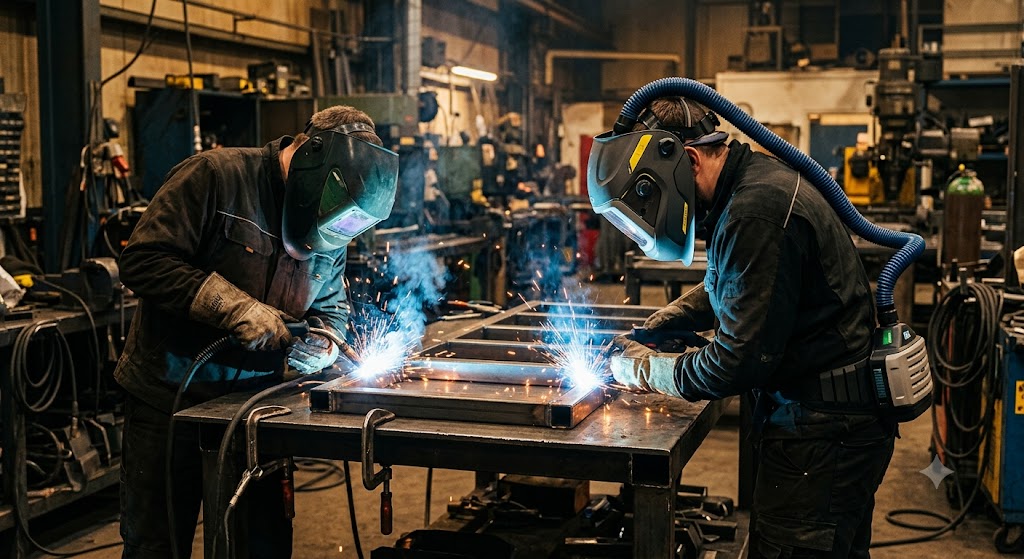
There is a moment most welders recognize, usually during a long stainless run in a tight corner, when you look up and the air around your head is brown. You have been breathing that. A standard auto-darkening helmet is excellent at protecting your eyes. It does nothing for your lungs. That is the gap a PAPR welding helmet fills, and it is worth being precise about whether you actually need to fill it before spending the money.
Powered air-purifying respirators (PAPRs) for welding are not new, but they have become significantly more accessible in the past few years. Where a 3M Adflo system with a Speedglas shell once represented a serious capital purchase for a production shop, YESWELDER and a handful of other brands now sell integrated PAPR helmets at a fraction of that cost. The result is a wider range of welders asking a question that used to only come up in industrial safety meetings: is a PAPR helmet worth it for my situation?
The honest answer is that most hobbyists and light fabricators do not need one. For welders doing extended stainless steel, chromoly, galvanized, or aluminum work, especially in enclosed or poorly ventilated spaces, a PAPR is not a luxury. It is the appropriate level of protection.
What Is a PAPR Welding Helmet?
A PAPR helmet combines a standard auto-darkening welding shell with a powered air-purifying respirator system. A motor-driven blower unit pulls ambient air through a filter, removes particulates and fumes, and delivers a continuous flow of filtered air inside the helmet shell around your face. Because the filtered airflow keeps the interior at a slight positive pressure, unfiltered air is less likely to leak around the seal.
The key distinction from a standard helmet: a PAPR actively filters and moves air. A standard helmet simply covers your face and protects your eyes. Respiratory protection from a standard helmet is zero.
Most PAPR welding helmets use HEPA-grade or P100-equivalent filters that capture fine metal oxide particles, manganese, hexavalent chromium, and other fume particulates at very high efficiency. NIOSH assigns protection factor ratings to PAPR designs; loose-fitting PAPR helmets (the most common welding type) carry an assigned protection factor of 25, meaning they reduce exposure to 1/25th of ambient concentration.
What Is the Difference Between a PAPR and a Standard Helmet?
A standard auto-darkening helmet does one job: it protects your eyes and face from arc radiation, sparks, and spatter. It does it very well. It does nothing for the fumes that weld processes generate directly in front of your face and inside the lens shade zone.
The difference comes down to what kills a welder over time. Arc flash to the eyes is a short-term risk that standard helmets handle completely. Manganese exposure from MIG and flux-core, hexavalent chromium from stainless, ozone from aluminum TIG, these accumulate over years and are not visible in the moment. OSHA 1910.1000 and NIOSH research have documented the long-term pulmonary and neurological risks from sustained welding fume exposure without respiratory protection.
A PAPR helmet addresses both hazards simultaneously. A standard helmet addresses only one.
The Standard Auto-Darkening Helmet: What You Give Up Without a PAPR
A high-quality standard helmet delivers excellent optics, fast switching speeds (measured in fractions of a millisecond), and a comfortable fit for extended use. Modern standard helmets offer large viewing areas, solar-hybrid power, and sensitivity and delay controls for different processes.
What they do not offer is any respiratory protection. In well-ventilated outdoor environments or large open shops with good airflow, this is manageable for many welding processes. In any confined space, on stainless steel, on galvanized metal, on coated materials, or during sustained production MIG and flux-core work, the fume exposure from a standard helmet alone sits above OSHA permissible exposure limits (PELs) for several specific compounds.
Named flaw: A standard helmet’s limitation in respiratory protection is not about product quality, it is a category limitation. No standard welding helmet, regardless of price, provides fume protection. Welders who work extended hours in enclosed spaces with a standard helmet are relying entirely on ambient ventilation, which is frequently insufficient.
Who should skip upgrading: Hobbyists doing occasional outdoor mild steel MIG and stick welding with good natural ventilation have low enough fume exposure that a standard helmet is adequate for their actual exposure hours. A quality respirator worn under the helmet is an effective lower-cost alternative in many cases, though comfort on long sessions suffers.
The YESWELDER PAPR Helmet
The YESWELDER PAPR is the accessible entry point into integrated PAPR helmet protection. It combines an auto-darkening lens with a blower-and-filter system built into the helmet assembly. Three airflow control levels let you adjust the fan speed based on activity and ambient fume level. The system filters dust, fog, smoke, and welding particulates.
For welders who do moderate production work, work occasionally with stainless or coated materials, or work in shop spaces with imperfect ventilation, the YESWELDER PAPR is a meaningful step up from a standard helmet at a price point that does not require budget approval from management.
Check the YESWELDER PAPR Welding Helmet on Amazon
Named flaw: Independent reviewers have noted that the YESWELDER PAPR’s blower system is less powerful than industrial-grade PAPR units at higher airflow settings. In very high-fume environments (heavy production flux-core, extensive stainless grinding), the filter replacement cycle is short and the airflow may not fully clear heavy fume concentrations. It is the right product for moderate exposure, not for the most demanding industrial applications.
Who should skip it: Welders doing the heaviest industrial fume work, sustained production MIG on stainless, hexavalent chromium exposure in shipbuilding, or pressure vessel work with exotic alloys should look at the 3M Adflo system or other industrial-certified PAPR equipment rather than a consumer-tier integrated helmet.
The 3M Adflo: When You Need Industrial-Grade PAPR
The 3M Adflo PAPR system paired with a Speedglas welding shell is the standard that PAPR performance in welding is measured against. The Adflo uses a belt-mounted blower unit with a breathing tube connecting to the Speedglas helmet shell. The separation of the blower weight from the helmet dramatically reduces neck fatigue compared to integrated helmet PAPR designs.
The Adflo is NIOSH-approved and meets ANSI Z87.1-2015 standards. The assigned protection factor of the loose-fitting Speedglas/Adflo combination under typical welding conditions is designed for genuine industrial fume environments, including hexavalent chromium exposure from stainless steel.
Check the 3M Adflo PAPR with Speedglas on Amazon
Named flaw: The Adflo system is heavy overall when you account for the belt unit, battery, and breathing tube, even though the helmet itself is lighter than integrated PAPR designs. The tube connecting blower to helmet can catch on fixtures and workpieces in confined spaces. Setup and breakdown time is longer than putting on a standard helmet. These are real operational trade-offs for real industrial protection.
Who should skip it: The Adflo is purpose-built for production industrial environments. For a small shop welder doing a few hours of stainless TIG per week, the YESWELDER PAPR or a quality half-face respirator worn under a standard helmet delivers adequate protection at a fraction of the cost and complexity.
Is a PAPR Welding Helmet Worth the Extra Cost?
For the right welder, absolutely. The cost calculation is not just about the upfront price of the helmet. It is about the cumulative fume exposure over a career and the health consequences that NIOSH and OSHA have thoroughly documented. Manganism from manganese exposure, pulmonary fibrosis, occupational asthma, and increased lung disease risk are all tied to chronic welding fume inhalation without respiratory protection.
For a production welder doing 2,000 hours a year of MIG and flux-core, the question is not whether a PAPR is worth it. The question is which PAPR is appropriate for their specific exposure.
For a hobbyist doing 50 hours a year of outdoor mild steel welding with good ventilation, a PAPR is a significant over-investment in protection for actual exposure levels. A quality half-face respirator with P100 filters worn under a standard helmet is the more practical solution.
Who Actually Needs a PAPR Helmet?
Priority candidates for PAPR protection:
- Welders working indoors on stainless steel, galvanized, or coated metals
- Production welders doing sustained MIG or flux-core in enclosed or semi-enclosed spaces
- Anyone regularly welding chromoly, high-alloy steels, or exotic materials
- Welders in shops without adequate local exhaust ventilation
- Anyone with existing respiratory conditions
Welders who can reasonably use a standard helmet plus separate respirator:
- Outdoor welders with good natural airflow on mild steel
- Hobbyists with limited annual weld hours
- Welders in large, well-ventilated shops with fume extraction at the source
Side-by-Side Comparison
| Feature | Standard Auto-Darkening Helmet | PAPR Welding Helmet |
|---|---|---|
| Eye/face protection | Yes | Yes |
| Respiratory protection | None | Yes (particulate filter) |
| Fume filtration | None | HEPA/P100-grade (model dependent) |
| NIOSH-rated options | No | Yes (3M Adflo) |
| Weight | Lower | Higher |
| Setup time | Immediate | Longer |
| Maintenance | Minimal | Filter replacement required |
| Best use case | Most welding in ventilated spaces | Extended fume exposure environments |
FAQ
Is a PAPR welding helmet worth the extra cost? For production welders doing sustained work on stainless, galvanized, or coated materials in enclosed spaces, yes. The health cost of chronic fume exposure without respiratory protection is well-documented by NIOSH and OSHA. For hobbyists doing occasional outdoor mild steel welding with good ventilation, a separate respirator worn under a standard helmet is a more practical and cost-effective option.
What is the difference between a PAPR and a standard welding helmet? A standard helmet protects your eyes and face from arc radiation and spatter. A PAPR helmet adds a powered air-purifying system that filters fumes and particulates from the air before you breathe it. A standard helmet provides zero respiratory protection.
Who actually needs a PAPR helmet? Production welders working on stainless, galvanized, or coated metals in enclosed spaces, welders without adequate source extraction ventilation, anyone with existing respiratory conditions, and anyone regularly working with exotic alloys or chromoly.
How long do PAPR filters last? Filter life depends on fume concentration and usage hours. In moderate production environments, filters typically last several weeks to a few months. Heavy flux-core or stainless work can exhaust filters faster. Check the manufacturer’s replacement guidelines and watch for reduced airflow as an indicator.
Can I use a regular respirator instead of a PAPR helmet? Yes, for many welding situations. A half-face respirator with P100 filters worn under a standard auto-darkening helmet provides meaningful particulate protection at lower cost and complexity. The trade-off is comfort on long sessions, as the respirator presses against your face and can cause heat and pressure fatigue. A PAPR provides a more comfortable airflow solution for extended wear.
Does a PAPR protect against welding fumes completely? No filter system provides 100% protection. NIOSH-rated PAPR systems like the 3M Adflo carry an assigned protection factor of 25 for loose-fitting designs, meaning they reduce inhaled concentration to 1/25th of ambient under test conditions. Source extraction ventilation at the weld point is still the first and most effective line of defense; a PAPR supplements it.
What OSHA standards apply to welding fume protection? OSHA 29 CFR 1910.1000 sets permissible exposure limits (PELs) for specific fume components including manganese, hexavalent chromium, and iron oxide. OSHA 1910.134 governs respiratory protection programs. NIOSH RELs are generally more conservative than OSHA PELs and are considered more protective.
References
- https://www.osha.gov/welding-cutting-brazing
- https://www.cdc.gov/niosh/topics/welding/default.html
- https://www.osha.gov/laws-regs/regulations/standardnumber/1910/1910.1000
- https://www.3m.com/3M/en_US/p/d/v000057494/
- https://yeswelder.com/
URL slug: papr-welding-helmet-vs-standard-welding-helmet Excerpt: A standard welding helmet protects your eyes. A PAPR helmet protects your lungs too. Here is who actually needs the upgrade, which PAPR helmets are worth considering, and when a separate respirator plus a standard helmet is the more practical answer.