Tillman vs Steiner Welding Gloves: Which TIG Glove Is Worth Your Money?
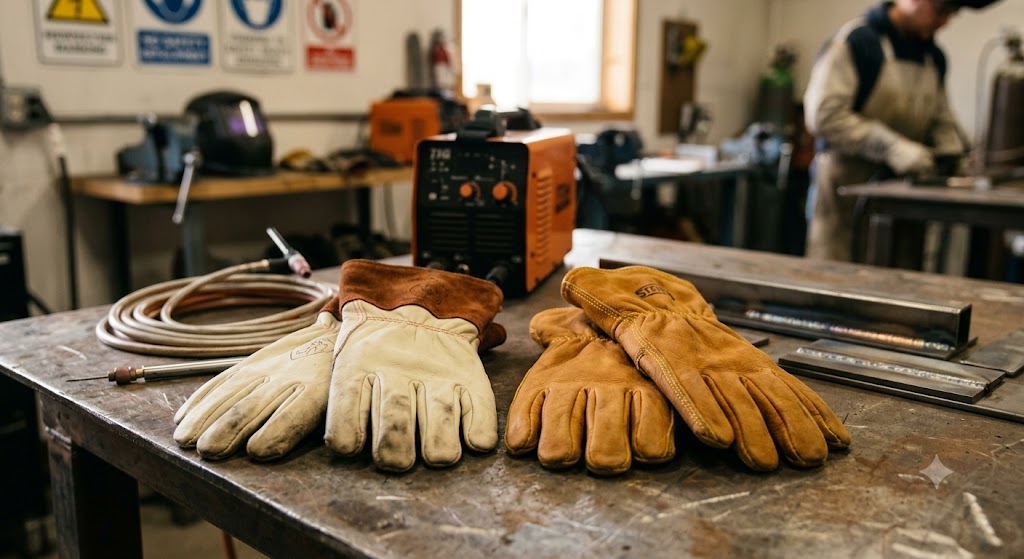
You’re three hours into a TIG session, running tight beads on stainless, and your glove index finger has gone stiff. That half-second of lost feel shows up in the puddle. The difference between a glove that keeps its softness across a full shift and one that fights you comes down to leather quality, seam placement, and whether the palm stays unlined where it counts. Tillman and Steiner both claim the top of that ladder. Here’s how they actually compare.
TIG welding gloves are lightweight, unlined or minimally lined gloves designed specifically for the dexterity and arc sensitivity that gas tungsten arc welding demands. Unlike MIG or stick gloves, a TIG glove prioritizes tactile feedback over raw heat protection, so the leather selection and construction method matter enormously.
For most TIG welders comparing these two brands, Steiner’s MegaTIG 0230 has the edge in heat management thanks to its ThermoCore foam back, while Tillman’s 44 wins on pure dexterity for welders who want the least material between their fingers and the torch. If you run long production days with your hand resting near the cup, go Steiner. If you prioritize feel above everything else, go Tillman.
What Makes Tillman’s TIG Gloves Different
Tillman built its reputation on the 24C series and then refined that formula with the 44 Onyx line. The 44 uses top grain kidskin throughout, including the cuff, which most competitors cut from cheaper split cowhide to save money. Kidskin sits softer and thinner than goatskin, giving your trigger finger an almost bare-hand sensitivity when feathering the amperage pedal.
The construction uses a straight thumb pattern, which aligns naturally with the grip you hold on a TIG torch. All seams are stitched with DuPont Kevlar thread, so heat resistance is built into the seam structure rather than added as a coating. The 4-inch cuff keeps spatter off your wrist without locking your range of motion.
Tillman 44 Onyx Kidskin TIG Gloves
Named flaw: The kidskin cuff stitching can begin to fray after extended heavy use, and the thinner leather means these gloves are not built for anyone mixing TIG with occasional MIG or stick work. They are a single-process glove.
What Makes Steiner’s MegaTIG Different
Steiner’s 0230 MegaTIG goes in a different direction. The palm is premium grain kidskin, fully unlined, so you keep the dexterity and feel where it matters most. The back, however, gets ThermoCore foam insulation, which is a meaningful upgrade for welders who rest the back of their hand against hot work or weld near the cup for extended periods.
The SensiTIG seamless index finger is the detail that separates this glove from most competitors. Eliminating the seam on the finger you use most to guide the torch removes the one friction point that causes discomfort over long welds. The cuff is 4-inch split cowhide, which provides a slightly stiffer base than Tillman’s all-kidskin cuff but holds its shape better over time.
Named flaw: The ThermoCore foam back adds noticeable bulk compared to a fully unlined glove. If you weld in tight corners or frequently rotate your wrist in confined spaces, that added thickness can catch on work surfaces in a way the Tillman 44 never does.
Head-to-Head: Dexterity
For pure, uncompromised dexterity, Tillman wins. The all-kidskin construction with no foam anywhere gives you the thinnest glove in this comparison. Steiner’s unlined palm keeps it competitive, but the foam back does affect how the glove conforms when your hand wraps around the torch body in a full grip. On small-diameter pipe or intricate aluminum work where feel is everything, most welders reach for the Tillman 44.
Head-to-Head: Heat Protection
Steiner wins this one without debate. The ThermoCore foam back is the deciding factor. If you run high-amperage TIG on thick steel or stainless and your hand gets close to the work, the Steiner 0230 keeps you welding longer before heat becomes a distraction. Tillman’s 44 is built for lower-heat, high-precision work where the focus is the weld, not the protection level.
Head-to-Head: Durability
Both gloves use Kevlar-sewn seams, which removes the weakest point in most TIG gloves. The Steiner’s split cowhide cuff holds up better to abrasion than Tillman’s kidskin cuff, so over six months of daily shop use, the Steiner tends to maintain its structural integrity longer. Tillman’s leather stays softer longer but shows wear on the cuff edges first.
Which Is Better for TIG Welding: Tillman or Steiner?
It depends on your work. For jewelers, pipe welders, and anyone running fine stainless or aluminum where feel is the entire game, Tillman 44 is the call. For production TIG welders logging eight-hour days, welding near the cup, or working on thicker material at higher amperage, the Steiner MegaTIG gives you protection that adds up by end of shift.
They are both excellent gloves. You are not making a wrong choice with either one. You are choosing which tradeoff matters more on your specific job.
Comparison Table
| Feature | Tillman 44 Onyx | Steiner 0230 MegaTIG |
|---|---|---|
| Palm Leather | Top grain kidskin | Premium grain kidskin |
| Cuff Leather | Top grain kidskin | 4” split cowhide |
| Back Insulation | None (fully unlined) | ThermoCore foam |
| Index Finger | Standard seamed | SensiTIG seamless |
| Seam Thread | DuPont Kevlar | Standard |
| Cuff Length | 4 inch | 4 inch |
| Best For | Maximum dexterity | Heat management + dexterity |
FAQ
Which brand is better for TIG welding, Tillman or Steiner? For pure dexterity and feel, Tillman’s 44 Onyx is slightly ahead. For longer sessions with heat exposure, Steiner’s MegaTIG 0230 has the advantage due to its foam-insulated back. Both carry 1/1/1/1-equivalent construction quality; the choice comes down to your specific process.
Are Tillman gloves cut resistant? Tillman TIG gloves are not marketed as cut-resistant PPE. The kidskin leather provides some abrasion resistance and the Kevlar thread adds seam strength, but these gloves are not rated to any cut-resistance standard. For cut hazards, Tillman makes separate product lines.
Which is more affordable? Both gloves sit in the same general tier for TIG-specific gloves. Tillman tends to have a slight edge in value at the entry size, while Steiner’s MegaTIG commands a small premium for the ThermoCore construction.
What leather does Steiner use for the MegaTIG? The MegaTIG 0230 uses premium grain kidskin on the palm and fingers, with a 4-inch split cowhide cuff for structure and durability.
Can I use Tillman 44 gloves for MIG welding? Not recommended. The thin kidskin is not built to handle the spatter and higher heat of MIG welding. Use them only for TIG work to preserve the leather.
Does the Steiner MegaTIG use a seamless index finger on all sizes? Yes. The SensiTIG seamless index finger is a standard feature across all sizes of the 0230 line, not just select sizes.
How should I break in kidskin TIG gloves? Wear them through a few short practice sessions before relying on them for precision work. Kidskin softens quickly with body heat and moisture. Avoid soaking them or using leather conditioners with silicone, which can make them slippery on the torch handle.
References
- John Tillman Co. Product Page: 44 Onyx TIG Glove
- Steiner Industries: MegaTIG 0230 Product Page
- OSHA Hand Protection Standards: 1910.138
Slug: tillman-vs-steiner-welding-gloves Excerpt: Tillman and Steiner both make top-tier TIG gloves, but they solve the problem differently. Tillman’s 44 Onyx prioritizes feel with all-kidskin construction, while Steiner’s MegaTIG 0230 adds ThermoCore foam for heat management. Here’s which one belongs on your hands.