Welding Chaps vs Apron: Which One Actually Protects You?
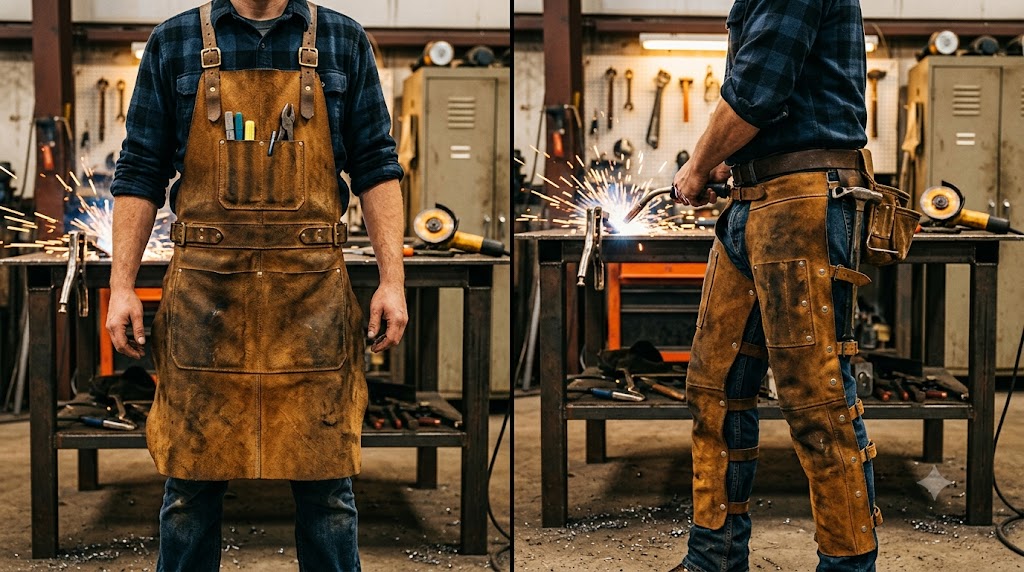
Picture this: you are midway through a horizontal fillet, the spatter pattern is moving back toward your legs, and the only thing standing between a hot bead and your shins is whatever you put on before you struck the arc. If that is a bib apron, you are covered from the belly down to about mid-shin, front only. If that is a set of split-leg leather chaps, every inch from your waist to your ankle is covered, and the leather is strapped tight to your leg so nothing slides or gaps when you move.
Both pieces of gear do a real job. They serve different tasks, suit different welders, and have genuine tradeoffs. Here is how to decide which one belongs in your shop.
Leather welding chaps are split-leg leg coverings that attach at the waist and strap down each leg, providing 360-degree coverage from hip to ankle. A welding bib apron covers the front of your torso and legs from chest to approximately mid-shin, leaving your sides, back of legs, and lower calves exposed. Both are made primarily from split cowhide or full-grain leather and are designed to resist spark, spatter, slag, and incidental heat contact.
The direct answer: for welders who move around, weld in multiple positions, or work overhead, chaps provide meaningfully better protection. For bench welding, light MIG or TIG work in a fixed position, or tasks where you want fast on-and-off and minimal heat retention, an apron is practical and adequate.
Chaps vs Apron: Coverage Comparison
The coverage difference is not subtle. A standard bib apron covers your front from collarbone to mid-shin. It leaves your back legs fully exposed, your sides open to side-splatter, and the gap at your lower ankle and boot top unprotected. When you turn to reposition a piece, reach across the table, or work with your body at any angle to the weld, coverage varies.
Chaps wrap around each leg individually. The Tillman 3840, for example, is a 24” x 40” split-leg design with a heavy waist strap and side-release buckles at three points down each leg. When you strap it correctly, there is no material that shifts when you bend or move. The leg coverage follows you.
That said, an apron has one specific advantage: speed. You can pull an apron on over your head in fifteen seconds and get back to work. Full chaps require you to step into them and buckle each leg. For short tack-up tasks where you are in and out of the gear repeatedly, the apron’s convenience is real.
When Chaps Are the Right Call
Choose chaps when:
- You weld overhead, where spatter falls directly onto your legs and gravity works against any piece of gear that does not fully wrap the limb
- You work in multiple positions during a session, including kneeling, crouching, or working around pipe and structural
- You weld with stick or heavy MIG processes that produce high spatter volume
- Your shop has you walking between machines or carrying material, where your legs face incidental heat from all directions
OSHA 29 CFR 1910.252(b)(3) requires appropriate protective clothing for welding operations based on the nature and location of the work. For overhead welding specifically, industry guidance consistently identifies full leg coverage as the appropriate protection level. An apron, which leaves the back and sides of the legs uncovered, does not meet that standard for overhead tasks.
When an Apron Is Enough
Choose an apron when:
- You do bench or table welding in a fixed front-facing position
- Your work is light TIG or MIG with low spatter output
- You need to move in and out of protective gear frequently throughout a shift
- Heat retention is a concern and you want the cooler option
For TIG welding especially, where spatter is minimal and the primary hazard is UV radiation and incidental heat from the torch, a bib apron provides sufficient leg and torso coverage for front-facing work. The Black Stallion 42A 42” bib apron is a widely available split cowhide option well-suited to this kind of task:
Named flaw: the bib apron format leaves the back of the legs, the sides, and the boot top exposed. For any work where spatter reaches you from the side or rear, it is not sufficient protection on its own.
The Tillman 3840: Split-Leg Chaps That Work
The Tillman 3840 is a 24” x 40” premium side split cowhide split-leg waist apron, which is Tillman’s terminology for full-length chaps. It uses a heavy-duty waist strap and Kevlar-stitched seams throughout. The 40-inch length covers most welders from the waist to the ankle. It is one of the most referenced leather welding chaps in professional shops.
Named flaw: the Tillman 3840 is a single universal size. It fits a wide range of welders due to the adjustable waist and leg straps, but very tall welders may find the 40-inch length stops short of full ankle coverage. If you are over six feet tall, verify the fit before relying on it for ankle protection near the boot top.
Comparison Table: Welding Chaps vs Bib Apron
| Feature | Split-Leg Chaps | Bib Apron |
|---|---|---|
| Front leg coverage | Full (waist to ankle) | Full (chest to mid-shin) |
| Back leg coverage | Full | None |
| Side coverage | Full | None |
| Torso/chest coverage | No (waist only) | Yes |
| Overhead welding | Suitable | Not sufficient |
| On/off speed | Slower (multiple buckles) | Fast |
| Heat retention | Higher | Lower |
| Best process fit | Stick, heavy MIG, overhead | TIG, bench MIG |
| OSHA compliance for overhead | Yes | No |
What OSHA Says
OSHA 29 CFR 1910.252(b)(3) does not prescribe specific garment types. It requires that protective clothing be “appropriate” for the size, nature, and location of the work. For overhead welding, where spatter falls onto the welder’s legs from above, chaps with full leg wrap are appropriate and an apron alone is not. The OSHA eTool for shipyard hot work, at 29 CFR 1915.157, reinforces that leather or FR garments provide protection when they cover the exposed hazard zone completely.
An employer who provides only a bib apron for a welder doing sustained overhead stick work is not meeting the OSHA standard of appropriateness, regardless of the apron’s material quality.
Verdict
If you weld in one position at a bench and mostly run TIG or light MIG, an apron is enough and is faster to use. If you move around, weld overhead, run stick or heavy MIG, or want reliable coverage regardless of your body position, chaps are the right call. The Tillman 3840 chaps are the working welder’s default. The Black Stallion 42A bib apron is a solid choice for bench-only welders who want to keep their setup simple.
FAQ
Should welders wear chaps or an apron? It depends on the work. For overhead welding, heavy MIG, or stick processes with high spatter volume, chaps provide better coverage because they wrap the full leg including the back and sides. For bench TIG or light MIG in a fixed position, a bib apron is practical and sufficient.
What is the difference between welding chaps and a leather apron? Chaps are split-leg garments that strap to each leg individually, covering front, back, and sides from waist to ankle. An apron covers the front of the body from chest to mid-shin but leaves the back and sides of the legs exposed. Chaps provide more comprehensive leg protection; aprons are faster to put on and cooler to wear.
Are leather chaps necessary for overhead welding? Yes. Overhead welding creates a spatter pattern that falls directly downward onto the welder’s legs. A bib apron, which is only front coverage, does not protect the back of the legs from falling spatter. Leather chaps with full-leg wrap are the appropriate PPE for sustained overhead welding work.
What is the best leather for welding protection? Split cowhide is the standard for welding chaps and aprons. It is thick, heat-resistant, and flexible enough to work in. Full-grain leather offers slightly better surface durability, but split cowhide is the industry default for welding PPE and performs well for all standard shop tasks.
Can I use a welding apron for stick welding? You can, but it is not ideal. Stick welding produces significant spatter that reaches the sides and back of your legs, especially as you reposition. A bib apron leaves those areas uncovered. If your stick work is strictly front-facing and stationary, an apron provides some protection, but chaps are the better choice for any sustained stick welding.
Do welding chaps come in different lengths? Yes. Full-length chaps like the Tillman 3840 run approximately 38 to 40 inches from waist to hem and are designed to cover from hip to ankle. Shorter “half chap” or knee-length designs exist and are discussed in a separate guide. Full-length is appropriate for overhead and structural work; shorter options suit lighter tasks only.
How do you clean leather welding chaps? Wipe down with a damp cloth after use to remove spatter debris and flux residue. Condition periodically with a leather conditioner to prevent the cowhide from drying and cracking. Do not machine wash or submerge in water. Dried and cracked leather loses flexibility and can split at stress points.
References
- https://www.osha.gov/laws-regs/regulations/standardnumber/1910/1910.252 (OSHA 29 CFR 1910.252, Welding General Requirements)
- https://www.osha.gov/etools/shipyard/shipbreaking/ppe/ppe-selection/hot-work (OSHA Hot Work PPE eTool)
- https://jtillman.com/product/3840/ (Tillman 3840 product specs)
URL slug: welding-chaps-vs-apron Excerpt: The real difference between welding chaps and a bib apron comes down to what stays covered when you move. Here’s how to match your protection to your actual work, with OSHA context and specific product picks.