Welding Helmet vs Cutting Goggles: The Right Eye Protection for the Right Process
The first time someone hands you a pair of cutting goggles and says they are fine for welding, they are probably telling you what they were told once. The confusion is understandable: both involve intense heat, bright light, and the word “welding” nearby. But the actual requirement is not flexible. Cutting goggles are appropriate for some processes and categorically dangerous for others, and the line between them is drawn by the type of radiation the process generates, not by how bright the flame looks.
This is one area where general shop wisdom gets people hurt. Oxy-fuel cutting and gas welding produce a primarily visible and infrared light hazard that appropriately shade-rated goggles handle correctly. Arc welding (MIG, TIG, stick, flux-core) produces ultraviolet radiation at levels that goggles with standard welding lenses do not adequately block, and UV exposure at that intensity causes arc eye, a photokeratitis injury that feels exactly like having hot sand in your eyes for 24 hours. The damage is real, it is painful, and it is entirely preventable.
The answer is not that goggles are inferior equipment. It is that the right tool depends entirely on which process you are running.
What Is the Difference?
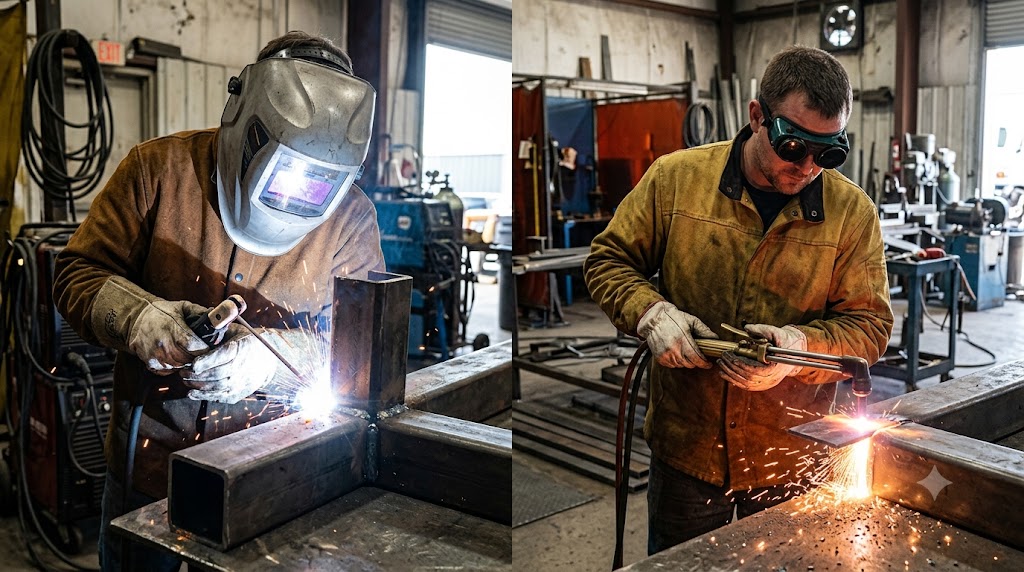
A welding helmet provides a large face shield combined with an auto-darkening or passive lens rated for arc welding processes. The lens shade on a welding helmet is selected based on the process and amperage, and the optical design accounts for the UV and infrared spectrum produced by electric arc welding.
Cutting goggles are a form-fitting frame worn against the face with filter lenses rated for the specific shade level required by gas cutting or welding processes. They cover only the eyes and the area immediately around them, leaving the rest of the face exposed. They are lightweight, quick to put on, and appropriate for the optical hazard of oxy-fuel processes.
ANSI Z87.1 governs the optical and impact protection requirements for both. The critical distinction is lens shade selection and the radiation spectrum each lens is designed to filter.
What Is the Applicable Lens Shade for Each Process?
OSHA Table E-1 in 1910.133 and OSHA 1915.153 (shipyards) both publish recommended shade numbers by process and current range. The following are the key figures:
Oxy-fuel cutting:
- Light cutting (under 1 inch plate): shade 3 to 4
- Medium cutting (1 to 6 inches): shade 4 to 5
- Heavy cutting (over 6 inches): shade 5 to 6
Gas welding:
- Light: shade 4 to 5
- Medium: shade 5 to 6
- Heavy: shade 6 to 8
Arc welding processes (SMAW, MIG, TIG, FCAW):
- Stick (SMAW) at 60 to 160 amps: shade 10
- Stick at 160 to 250 amps: shade 12
- MIG (non-ferrous) at 60 to 160 amps: shade 11
- MIG (ferrous) at 160 to 250 amps: shade 12
- TIG at 50 to 150 amps: shade 12
Cutting goggles are rated for the shade 3 to 6 range used in oxy-fuel processes. Arc welding requires shade 10 to 13, which is handled by welding helmet lenses, not by standard cutting goggle lenses. Using a shade 5 cutting goggle for stick welding at 150 amps exposes your eyes to roughly 50,000 times more UV radiation than the lens was designed to filter. Arc eye is the immediate consequence.
Are Cutting Goggles as Safe as a Welding Helmet?
For oxy-fuel cutting and gas welding, properly shade-rated cutting goggles are the appropriate protection and meet ANSI Z87.1 and OSHA requirements for those specific processes. They are not a compromise. They are the correct tool.
For arc welding, cutting goggles are not an acceptable substitute for a welding helmet under any circumstance. The issue is not build quality or brand, it is that the lens shade range of cutting goggles does not cover arc processes. No amount of extra UV coating on a shade 5 lens makes it appropriate for a 150-amp TIG arc.
The confusion arises because oxy-fuel torches look bright and feel dangerous in a way that telegraphs the need for eye protection. The arc is visibly more intense, so people sometimes assume that a tool that handles the visible light must handle the arc. It does not. UV radiation from arc welding is invisible. You cannot see it through the goggle lens. Your eyes absorb it before you feel anything.
When Is It Acceptable to Use Goggles Instead of a Helmet?
Goggles are appropriate and preferred for:
- Oxy-acetylene cutting at all thicknesses (with appropriate shade selection per OSHA 1910.133 Table E-1)
- Oxy-fuel gas welding
- Torch brazing and soldering
- Plasma cutting in some configurations when the operator is not directly exposed to the arc column (verify with manufacturer’s shade recommendations)
- Grinding where face shield requirements apply (non-darkening safety goggles for eye protection under a face shield)
Goggles are never appropriate for:
- SMAW (stick)
- GMAW (MIG)
- GTAW (TIG)
- FCAW (flux-core)
- PAW (plasma arc welding)
- SAW (submerged arc welding)
- Any electric arc process
The key phrase is “electric arc process.” If electricity is jumping a gap to create the weld, you need a welding helmet with an arc-appropriate shade lens.
Do Goggles Protect Against Arc Flash the Same Way?
No. This is not a close comparison. Arc flash from welding produces UV radiation at wavelengths (primarily 180 to 380 nm) and intensities that cutting goggle filter lenses are not designed to block. The assigned shade of a cutting goggle is calibrated for thermal radiation from combustion processes, not electrical arc radiation.
The result of using cutting goggles for arc welding is photokeratitis (arc eye), a painful but temporary corneal burn, on short exposures, and potential permanent retinal damage on sustained exposure. The injury does not occur immediately. The UV damage typically takes 6 to 12 hours to become symptomatic, which is why welders who make this mistake often do not connect the cause to the effect until the middle of the night.
Welding Helmet vs Cutting Goggles: Side-by-Side
| Factor | Welding Helmet | Cutting Goggles |
|---|---|---|
| Arc welding UV protection | Yes (shade 9 to 13) | No (shade 3 to 6 only) |
| Oxy-fuel cutting protection | Yes (oversized, but effective) | Yes (preferred tool) |
| Face coverage | Full face and neck | Eyes only |
| Weight and bulk | Higher | Lower |
| OSHA compliant for arc welding | Yes | No |
| OSHA compliant for oxy-fuel cutting | Yes | Yes |
| Auto-darkening available | Yes | Limited specialty options |
Choosing the Right Shade
If you run both oxy-fuel cutting and arc welding in your shop, the answer is both. A welding helmet for arc processes. Cutting goggles for oxy-fuel. The right protection is process-specific, not universal.
For welders who only run arc processes, a quality auto-darkening helmet with a shade range of 9 to 13 and a fixed shade 3 or 4 for grinding mode covers all arc welding and general grinding. For dedicated oxy-fuel cutting and gas welding shops, goggles with the appropriate shade for the cut thickness and ANSI Z87.1 marking are the correct, lightweight, practical tool.
Bottom Line
Cutting goggles are excellent protection for what they are designed for: oxy-fuel processes in the shade 3 to 6 range. They are entirely inappropriate for arc welding, where the UV radiation spectrum exceeds what their lenses filter by a significant margin.
A welding helmet for arc welding is not optional, it is the minimum appropriate protection per OSHA 1910.133. If you cut oxy-fuel and weld arc in the same shop, keep both. If someone offers you goggles for stick or MIG welding, the correct answer is no.
FAQ
Are welding goggles as safe as a helmet for arc welding? No. Welding goggles with standard shade lenses (shade 3 to 6) are not designed for arc welding processes that require shade 10 to 13. Using goggles for arc welding exposes your eyes to UV radiation levels that cause photokeratitis (arc eye) and potential permanent retinal damage.
When is it acceptable to use goggles instead of a helmet? Goggles are the appropriate tool for oxy-fuel cutting, gas welding, torch brazing, and soldering. They meet OSHA 1910.133 Table E-1 requirements for those processes. They are never acceptable for electric arc welding processes.
Do goggles protect against arc flash the same way a helmet does? No. Cutting goggle lenses are rated for thermal radiation from combustion processes, not UV radiation from electric arcs. Arc flash from welding produces UV at wavelengths and intensities that goggle filter lenses are not calibrated to block.
What shade lens do I need for oxy-fuel cutting? OSHA 1910.133 Table E-1 recommends shade 3 to 4 for light cutting (under 1 inch), shade 4 to 5 for medium cutting, and shade 5 to 6 for heavy cutting. These are the ranges where cutting goggles are the appropriate and sufficient tool.
What shade lens do I need for MIG welding? OSHA recommends shade 11 for non-ferrous MIG at 60 to 160 amps and shade 12 for ferrous MIG at 160 to 250 amps. This requires a welding helmet, not cutting goggles.
What is arc eye? Arc eye (photokeratitis) is a UV burn of the cornea caused by exposure to arc radiation without adequate eye protection. Symptoms (pain, sensitivity to light, the sensation of sand in the eyes) typically appear 6 to 12 hours after exposure. It is temporary in most cases but extremely painful. Repeated exposure increases the risk of permanent damage.
Can I use the same helmet for both oxy-fuel and arc welding? Yes. A welding helmet with an auto-darkening lens that covers shade 3 to 13 can handle both arc welding and oxy-fuel cutting. Set it to the shade appropriate for the process you are running. The helmet provides more face and neck coverage than goggles, which is an advantage in either case.
References
- https://www.osha.gov/laws-regs/regulations/standardnumber/1910/1910.133 (Table E-1 shade numbers by process)
- https://www.osha.gov/laws-regs/regulations/standardnumber/1915/1915.153 (shipyard eye and face protection)
- https://www.cdc.gov/niosh/topics/eye/default.html
- https://www.aws.org/technical/facts/FACT-03.pdf (AWS Safety and Health Facts: Eye and Face Protection)
- https://www.osha.gov/welding-cutting-brazing