Welding Respirator vs Standard Dust Mask Compared
Welding fumes are one of the most underestimated hazards in the trade. You cannot always see them, the effects build slowly, and it is easy to convince yourself that the cheap dust mask in the drawer is doing the job. It usually is not. Understanding the difference between a standard dust mask and a proper welding respirator, and matching the protection to the fume, is genuinely important for your long-term health. This guide lays it out clearly.
Is a Dust Mask Enough Protection for Welding Fumes?
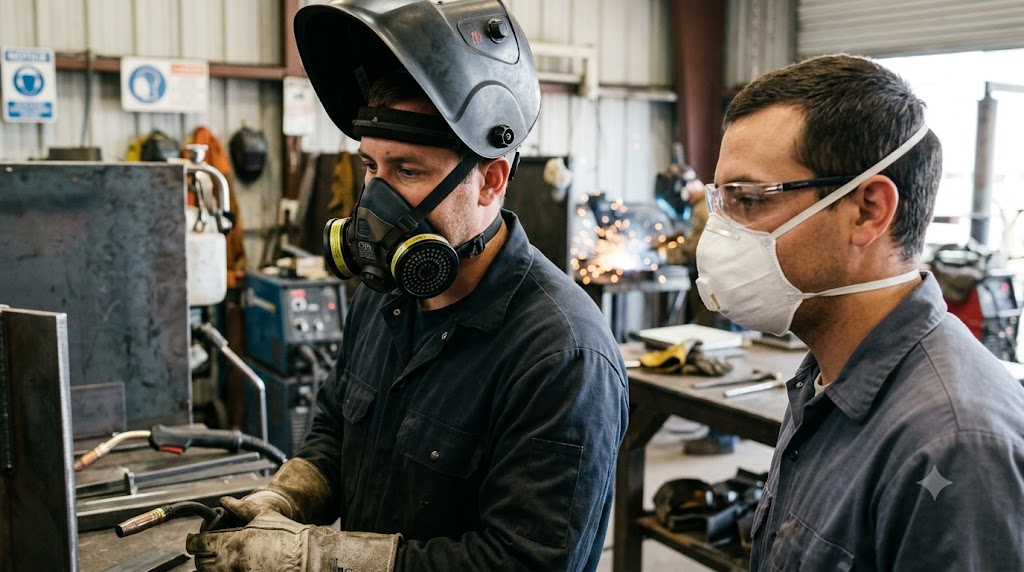
In most cases, no, a basic dust mask is not adequate protection for welding fumes. Here is why. Welding fumes are not simple dust. They are made of extremely fine metal particulates, metal oxides created when the arc vaporizes metal and it condenses in the air, along with gases produced by the process. These particles are far finer than sawdust or general nuisance dust, and some are toxic, including manganese, hexavalent chromium (from stainless), zinc (from galvanized), and others depending on the base metal and coatings.
A basic paper dust mask, especially one that is not NIOSH-rated, provides little meaningful protection against these fine metal fume particles and none against gases. It may block coarse dust but lets the dangerous fine fume through, and it usually seals poorly against the face, allowing fume to leak in around the edges. Relying on a basic dust mask for welding gives a false sense of protection.
What Is the Difference Between N95 and P100 for Metal Fumes?
NIOSH rates particulate respirators by two things: filtration efficiency and oil resistance. The number is the efficiency, and the letter is the oil resistance.
N95 filters at least 95 percent of airborne particles and is not oil resistant (the N stands for “not oil resistant”). An N95 rated respirator, properly fitted, filters fine particulates far better than a basic dust mask and provides real protection against many welding fume particulates. It is a meaningful step up and adequate for lighter welding fume exposure on mild steel in well-ventilated conditions.
P100 filters at least 99.97 percent of airborne particles and is oil resistant (P for “oil proof”). The P100 is the highest particulate protection level, capturing essentially all fine fume particulates. For heavier welding, for toxic fumes from stainless (hexavalent chromium) or galvanized (zinc), or for sustained exposure, a P100 is the appropriate choice. The higher filtration and oil resistance make it the safer pick for serious welding fume protection.
The practical guidance: N95 is a minimum meaningful level for light mild-steel welding in good ventilation; P100 is the better and safer choice for regular welding and essential for toxic fume sources.
Do Welders Need Organic Vapor Cartridges Too?
Sometimes, yes. Particulate filters (N95, P100) capture solid particles but do not capture gases and vapors. Certain welding situations produce gases and vapors that particulate filters do not stop:
- Welding on coated, painted, or contaminated metal can release organic vapors and other gases.
- Some processes and materials produce gases like ozone and nitrogen oxides.
For these situations, a combination cartridge that includes both a P100 particulate filter and an organic vapor (and sometimes acid gas) element provides broader protection. Many quality half-mask respirators accept combination cartridges for exactly this reason. If you weld on coated or painted materials, or work where gases are a concern, consider a combination cartridge rather than particulate-only.
Important: no air-purifying respirator protects in oxygen-deficient environments or against very high gas concentrations. For confined spaces or extreme exposure, supplied-air respirators and proper confined-space procedures are required. Air-purifying respirators are for adequately ventilated environments.
Fit Matters as Much as the Filter
A respirator only protects if it seals to your face. A P100 that leaks around the edges is not delivering P100 protection. Facial hair, poor fit, and improper wearing all compromise the seal. For a tight-fitting respirator to work, you need a good seal against clean-shaven skin at the sealing surface. Welders with beards who need respiratory protection should consider a loose-fitting powered air-purifying respirator (PAPR) system, which does not depend on a face seal, rather than a tight-fitting half mask.
What to Choose
- Light mild-steel welding, good ventilation: N95 rated respirator as a minimum meaningful level.
- Regular welding, better protection: P100 particulate respirator.
- Stainless, galvanized, or toxic fumes: P100 at minimum, essential protection.
- Coated, painted, or gas-producing work: combination P100 plus organic vapor cartridge.
- Beards or seal problems: a PAPR system that does not rely on a face seal.
- Confined spaces or extreme exposure: supplied-air respirator and proper procedures.
Browse P100 welding respirators on Amazon
The Bottom Line
A basic dust mask is not adequate for welding fumes, which contain fine and often toxic metal particulates that basic masks let through. Step up to at least an N95 for light mild-steel work in good ventilation, and to a P100 for regular welding and any toxic fume sources like stainless or galvanized metal. Add an organic vapor cartridge for coated, painted, or gas-producing work. And remember that fit is everything: a leaking respirator does not protect, so ensure a proper seal or use a PAPR if a seal is not achievable. Your lungs are worth the upgrade.
Frequently Asked Questions
Is a dust mask enough protection for welding fumes? Usually no. Welding fumes are extremely fine metal particulates and gases, far finer than nuisance dust and often toxic. Basic dust masks let the dangerous fine fume through and seal poorly, providing a false sense of protection. Use at least an N95, preferably a P100.
What is the difference between N95 and P100 for metal fumes? N95 filters at least 95 percent of particles and is not oil resistant, adequate for light mild-steel welding in good ventilation. P100 filters at least 99.97 percent and is oil resistant, the safer choice for regular welding and essential for toxic fumes from stainless or galvanized metal.
Do welders need organic vapor cartridges too? Sometimes. Particulate filters do not capture gases and vapors. Welding on coated, painted, or contaminated metal, or processes producing gases, calls for a combination cartridge with both P100 particulate and organic vapor elements.
Does a respirator work if I have a beard? Not a tight-fitting one. Facial hair breaks the face seal a half-mask respirator needs. Welders with beards should use a loose-fitting powered air-purifying respirator (PAPR), which does not depend on a face seal.
Can a respirator protect me in a confined space? No air-purifying respirator protects in oxygen-deficient environments or against very high gas concentrations. Confined spaces require supplied-air respirators and proper confined-space procedures. Air-purifying respirators are only for adequately ventilated environments.
References
https://www.osha.gov https://www.cdc.gov/niosh https://www.lincolnelectric.com
SEO Title: Welding Respirator vs Standard Dust Mask Compared