YESWELDER vs ANDELI Welding Helmet: Budget Brands Compared
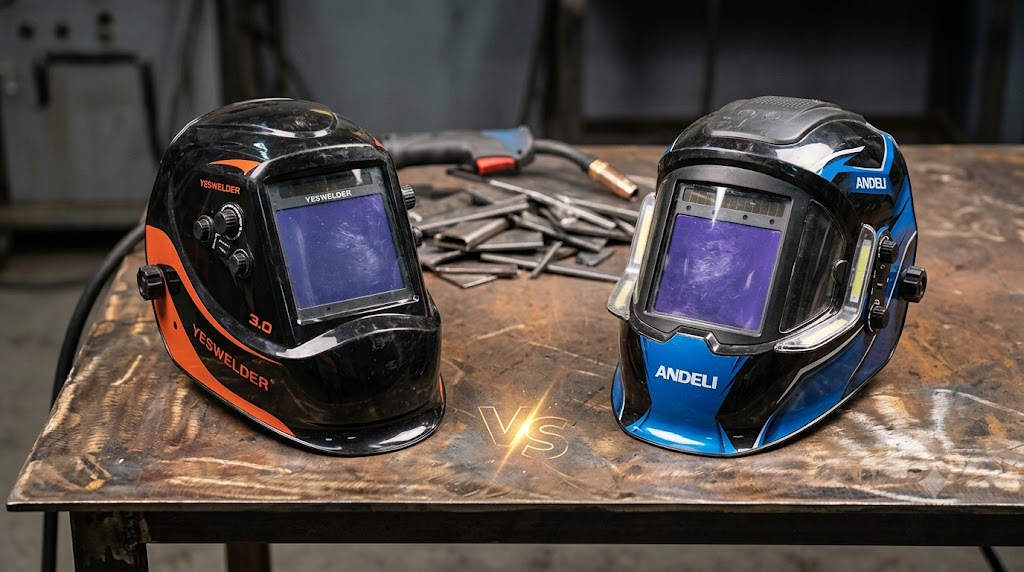
Pick up either box at a welding show and they both feel like reasonable helmets. YESWELDER has been a fixture in the budget auto-darkening market long enough to have built a real reputation. ANDELI showed up later with a panoramic design, LED lights built into the shell, and a six-sensor layout that sounds like it belongs on a helmet costing three times as much. The question is whether those specs translate to reliable protection and a clear view of the puddle, or whether they’re marketing arithmetic.
Both brands sell directly through Amazon and carry true-color, auto-darkening filters. Both are aimed squarely at hobbyists, home shop fabricators, and light-production welders who want something better than a passive lens without spending what a Miller or Lincoln costs. The difference is what each brand decided to prioritize, and one of those priorities matters more than it looks on a spec sheet.
An auto-darkening filter, or ADF, is the electro-optical cartridge inside the helmet that reacts to UV and infrared radiation from a welding arc, darkening from a transparent light state to a rated shade in milliseconds. Budget-tier ADFs meet the same foundational ANSI Z87.1 and EN 379 requirements as professional-grade helmets, but the optical coatings, sensor count, and lens homogeneity vary significantly at different price levels.
Which Budget Brand Is More Reliable?
YESWELDER has the longer track record. The L500A has been in production long enough to have tens of thousands of real-world reviews and a verified supply chain for replacement lenses and headgear components. The brand sells direct through its own site, maintains spec pages, and offers warranty support that you can actually reach.
ANDELI is newer to the US market but has moved quickly. The panoramic helmets with LED assist lighting are the brand’s marquee products, and they’ve accumulated solid review counts since launching. The six arc sensors on the panoramic models represent a genuine spec advantage over most helmets at this tier.
Where ANDELI is less proven is in long-term durability, lens replacement availability, and customer support response times for warranty claims. YESWELDER’s support infrastructure is more established. That matters when the ADF stops responding consistently after 18 months and you need a replacement cartridge.
For reliability as a day-one purchase, both brands are reasonable. For a helmet you expect to maintain over two to three years of regular use, YESWELDER has the more dependable support behind it.
Viewing Area and Sensor Layout
This is where ANDELI makes its case loudest. The ANDELI panoramic helmet is built around a 180-degree panoramic design with side windows for peripheral visibility, six arc sensors, and four built-in LED lights rated at up to 400 lumens. The 2026 updated model expands the main viewing area to 3.94” x 3.74” with the same six-sensor layout and upgraded solar charging.
The YESWELDER L500A has a 3.64” x 1.67” viewing window: compact, clear, and functional for most welding positions, but visually narrow compared to ANDELI’s panoramic approach.
The six-sensor ANDELI layout means detection from more angles simultaneously. In overhead, vertical, or boxed-in welding where one or two sensors might be shadowed by your torch arm or the workpiece, additional sensors lower the risk of a slow or missed trigger. The LED lights are a practical addition for dark shop corners or inside enclosures where your view of the joint before striking is limited.
The honest flaw in ANDELI’s panoramic approach: more glass and a larger shell mean more weight. The panoramic shell is noticeably heavier than the L500A, and the headgear on the ANDELI models is less refined. For long sessions, that extra weight loads your neck more than the YESWELDER does.
Are ANDELI Helmets ANSI Rated?
None of the ANDELI helmet listings reviewed for this article explicitly confirm ANSI Z87.1 compliance in their product detail pages. The ANDELI panoramic models reference CE certification and EN standards on some pages, but ANSI Z87.1 certification was not confirmed in the listing text at the time of writing.
The YESWELDER L500A also does not prominently feature ANSI Z87.1 certification in its main listing. Both helmets appear to meet the DIN EN 379 optical clarity standard.
If ANSI Z87.1 is a hard requirement for your shop, jobsite, or employer, verify the specific listing at purchase time. Helmets that meet ANSI Z87.1 will state it explicitly in the product detail page. Do not assume compliance based on optical ratings alone.
Optical Clarity
Both helmets list 1/1/1/1 optical clarity under EN 379. The YESWELDER L500A has been consistent across production runs. The ANDELI panoramic models have received generally positive feedback on lens clarity, with the true-color filter producing a view without the greenish tint common in entry-level helmets.
The LED assist lighting on the ANDELI is a real differentiator for pre-arc visibility. Seeing the joint clearly before you strike matters for fit-up, gap assessment, and wire or filler rod placement. The L500A gives you no assistance in this regard; you’re relying on your shop lighting.
Which Has Better Customer Support?
YESWELDER has a more established US support infrastructure, a longer product history, and a direct-to-consumer site with replacement parts readily available. ANDELI’s support has improved as the brand has grown, but the track record for warranty follow-through over multi-year ownership is less documented.
For a helmet you’re buying as a primary tool for regular use, YESWELDER’s support advantage is worth factoring in. For an occasional-use helmet or a backup hood, the ANDELI’s additional features may outweigh the support gap.
Head-to-Head Comparison
| Feature | YESWELDER L500A | ANDELI | ANDELI |
|---|---|---|---|
| Viewing area | 3.64” x 1.67” | Panoramic with side windows | 3.94” x 3.74” panoramic |
| Arc sensors | 2 | 6 | 6 |
| LED assist lights | None | 4 (up to 400 lumens) | Yes |
| Optical clarity | 1/1/1/1 | 1/1/1/1 | 1/1/1/1 |
| Weight | ~1 lb | Heavier shell | Heavier shell |
| ANSI Z87.1 confirmed | Not confirmed in listing | Not confirmed in listing | Not confirmed in listing |
| Support track record | Established | Newer | Newer |
The Verdict
Buy the ANDELI panoramic helmet if you do overhead welding, work in dark corners, or want the widest possible field of view and sensor coverage at this tier. The six sensors and LED assist lighting are genuine practical advantages that the YESWELDER doesn’t offer. The weight penalty is the real trade-off, and it’s real.
Buy the YESWELDER L500A if you want a lighter helmet with a longer track record, better replacement part availability, and a more mature support network. It’s the better choice for daily wear over long sessions, for welders who prioritize neck comfort, and for anyone who finds the panoramic feature unnecessary for flat and horizontal work.
Neither helmet belongs on a jobsite where ANSI Z87.1 is a code requirement unless you’ve verified compliance in the current listing. Check before you buy.
ANDELI Panoramic Helmeton Amazon
ANDELI Panoramic Helmeton Amazon
FAQ
Which budget brand is more reliable, YESWELDER or ANDELI? YESWELDER has a longer track record, more established support infrastructure, and better replacement part availability. ANDELI is competitive on features and is improving, but it hasn’t built the same multi-year reputation yet.
Are ANDELI helmets ANSI rated? ANSI Z87.1 compliance was not confirmed in the ANDELI listings reviewed for this article. If ANSI compliance is required for your application, verify it directly in the current product listing before purchasing. Do not assume compliance based on optical clarity ratings alone.
Which has better customer support? YESWELDER. The brand has been selling in the US market longer, has a direct-sales website with documented replacement parts, and has more community-documented warranty interactions.
What do the LED lights on the ANDELI helmet actually do? They illuminate the workpiece before and after the arc, helping you see the joint clearly in low-light environments. The 400-lumen output on themodels is strong enough to be useful inside structures, dark corners, or overhead positions where shop lighting doesn’t reach.
Why does ANDELI use six arc sensors? Six sensors distributed around the viewing area give the ADF more detection angles. This reduces the risk of a missed or delayed trigger when one or more sensors are blocked by your torch hand, the workpiece, or the fixture in out-of-position welding.
Is the YESWELDER L500A good for stick welding? Yes. The L500A handles MIG, stick, and basic TIG welding without issue. Its two-sensor layout is adequate for most flat and horizontal stick work.
Which helmet is lighter? The YESWELDER L500A. The ANDELI panoramic shell is larger and heavier due to the side windows, LED housing, and expanded sensor array.
Can I use either helmet for plasma cutting? Yes. Both helmets include a cut mode with a shade range appropriate for plasma cutting. Verify the specific shade range in the listing matches your cutting current before using.
References
- Check on Amazon (YESWELDER L500A listing)
- Check on Amazon (ANDELI panoramic listing)
- Check on Amazon (ANDELI 2026 panoramic listing)
- https://yeswelder.com/products/welding-helmet-l500a (YesWelder L500A official specs)
- https://www.osha.gov/laws-regs/regulations/standardnumber/1910/1910.133 (OSHA eye and face protection)
- https://aws.org/certification (American Welding Society welding safety standards)
URL slug: yeswelder-vs-andeli-welding-helmet Excerpt: ANDELI’s six-sensor panoramic design with LED assist lighting beats YESWELDER on features; YESWELDER wins on long-term reliability and all-day comfort. Here is how to choose between them based on your actual welding work.