YESWELDER vs TOOLIOM Welding Helmet: Which Budget Auto-Darkener Wins?
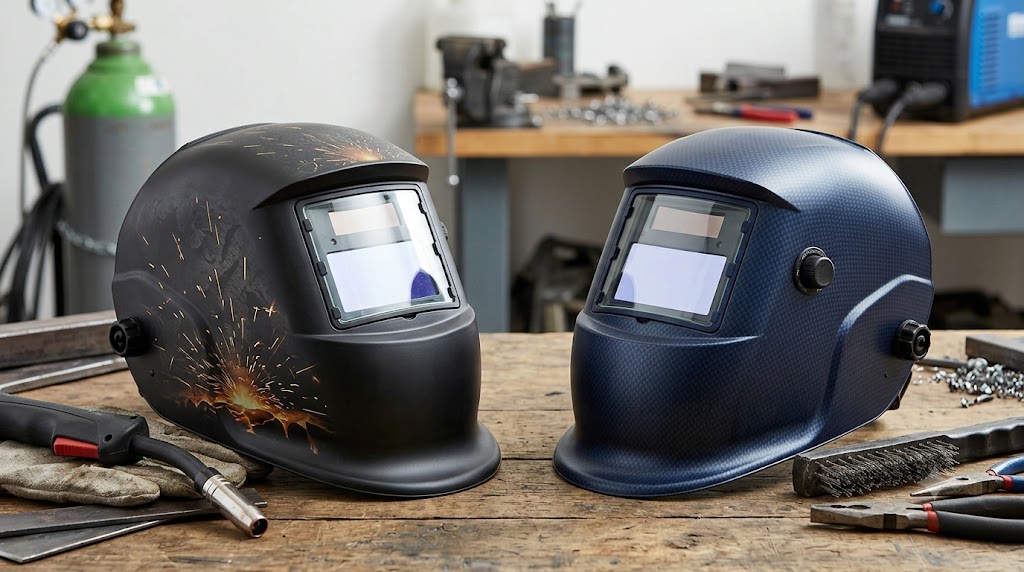
You’ve got a pile of tabs open, two helmets in your cart, and a friend swearing by one while Reddit swears by the other. Both brands sell auto-darkening helmets in roughly the same tier, both promise true-color lenses and four-sensor detection, and both look fine in product photos. The difference shows up when you’re four hours into a fabrication session and your neck starts making itself known, or when a low-amperage TIG arc triggers the lens half a second too late.
This comparison cuts through the spec sheet noise. YESWELDER built its name on the L500A, a slim, lightweight helmet that punches well above its MSRP. TOOLIOM countered with a large-view design that gives you a genuinely bigger window to work through. One is the right pick for your shop; the other might sit on a peg for most of your welding life.
Auto-darkening welding helmets use an electro-optical filter that reacts to UV and infrared radiation from a welding arc. Sensors detect the arc strike, trigger the ADF cartridge to darken from a light state to the set shade, and revert to the light state when the arc stops. The speed, clarity, and number of sensors all determine how well the helmet performs across different processes and positions.
Which One Has the Larger Viewing Area?
TOOLIOM wins this one outright. The TOOLIOM large-view helmet offers a 3.94” x 3.27” window measuring 12.9 square inches, and the updated 14.4 sq in version expands that further to 3.94” x 3.66”. The YESWELDER L500A comes in at 3.64” x 1.67”, which is 6.07 square inches, roughly half the real estate of the larger TOOLIOM.
That gap matters more than it sounds. A bigger window lets you track a weld bead without repositioning your head, see the leading edge of the puddle and the toes of the weld simultaneously, and work in tight joints where you’d otherwise be guessing. If you’re doing a lot of structural plate work, pipe, or any long horizontal runs, the TOOLIOM view reduces the head bobbing that leads to inconsistent travel speed.
The YESWELDER’s narrower window is a real limitation for production-pace work. It’s not a safety issue, it’s a workflow issue, but it adds up across a long day.
Which Has More Reliable Arc Sensors?
Both helmets use arc sensors, but they’re not equivalent. The TOOLIOMandboth run four arc sensors positioned around the viewing area. The YESWELDER L500A uses two sensors.
Four sensors matters most when you’re welding in awkward positions: overhead, inside a box section, or angled away from your centerline. One or two sensors can get blocked by your torch hand, a fixture, or the workpiece itself. With four sensors distributed around the lens, at least one or two have a clear sightline to the arc at almost any angle you’re working from. The L500A’s two-sensor setup is fine for straightforward flat and horizontal work but can misfire or fail to trigger quickly in overhead or out-of-position welding.
That said, the L500A’s 1/30000-second response time is legitimately fast, and most hobbyist and light-fab welders won’t notice sensor coverage as a problem in practice.
Optical Clarity: Reading the Fine Print
Both helmets list 1/1/1/1 optical clarity, which is the top rating under EN 379 covering optical class, diffusion of light scatter, luminous transmittance variation, and angular dependence of luminous transmittance. That rating means both helmets meet the same standard on paper.
In practice, the quality of the ADF cartridge and the coatings on cover lenses affect real-world clarity. Some L500A variants are spec’d at 1/1/1/2 on certain SKUs (check the specific listing). The TOOLIOM 1/1/1/1 true-color lenses have been consistent across their large-view lineup.
For TIG work at low amperage, both helmets handle it reasonably well, but neither matches the optical quality of professional-tier helmets from Miller or Jackson Safety. What you get is a functional, honest auto-darkening experience without the premium name on the shell.
Headgear Comfort and All-Day Wear
The YESWELDER L500A has a genuine edge here. The helmet shell is lighter, the overall balance is better distributed, and the pivot-style headgear holds adjustment without creeping over a long session. The L500A was designed with ergonomics as a selling point, and it shows. If you’re wearing it for five or six hours straight, you’ll notice the difference by midday.
The TOOLIOM helmets are heavier because of the larger shell required to house that expanded viewing area. The additional weight isn’t extreme, but users who do long days of overhead or tight-position work have noted neck fatigue more with the TOOLIOM than with the L500A. The headgear adjustment on the TOOLIOM is functional but less refined, and the ratchet tension can loosen over months of daily use.
If your primary concern is comfort over a full production day, the YESWELDER is the one to reach for.
Shade Range and Mode Coverage
The YESWELDER L500A runs DIN 4 for grinding and DIN 9 to 13 for welding, with a cutting mode that covers DIN 5 to 9. The TOOLIOMoffers similar coverage with weld, grind, and cut modes. The TOOLIOMoffers a shade range of 5 to 9 and 9 to 13, structured for welding and general work.
For most MIG, stick, and flux-core welding you’ll do, both helmets cover the range. Neither is ideal for low-amperage TIG welding at 5 to 30 amps where you’d want a faster reaction time and higher sensor count.
Head-to-Head Comparison
| Feature | YESWELDER L500A | TOOLIOM | TOOLIOM |
|---|---|---|---|
| Viewing area | 3.64” x 1.67” (6.07 sq in) | 3.94” x 3.27” (12.9 sq in) | 3.94” x 3.66” (14.4 sq in) |
| Arc sensors | 2 | 4 | 4 |
| Optical clarity | 1/1/1/1 | 1/1/1/1 | 1/1/1/1 |
| Response time | 1/30000s | Not specified | 1/30000s |
| Weight | ~1 lb | Heavier | ~1.04 lb |
| Shade range | DIN 4 / 9-13 | DIN 3.5-13 | DIN 5-9 / 9-13 |
| Modes | Weld, Cut, Grind | Weld, Grind, Cut | Weld, Cut, Grind |
Which One Should You Buy?
Buy the TOOLIOMif you do production-pace welding where field of view and sensor reliability matter more than all-day weight comfort. The 14.4 sq in window and four sensors make it the better tool for serious shop work, structural work, or anyone who spends more than three hours a day under a hood.
Buy the YESWELDER L500A if you’re a hobbyist, occasional welder, or someone who values a lighter helmet for long sessions over a massive viewing area. It’s a genuinely good helmet for weekend work, home shop fabrication, and light MIG or stick welding. The narrow viewing area is its one honest flaw, and it’s a real one for production work.
Neither helmet belongs in a professional TIG shop running low-amperage stainless. For that, you’re looking at Jackson Safety, Lincoln Viking, or Miller.
TOOLIOM Large View (12.9 sq in) on Amazon
TOOLIOM Large View (14.4 sq in) on Amazon
FAQ
Which has the larger viewing area, YESWELDER or TOOLIOM? TOOLIOM by a wide margin. The TOOLIOMoffers 14.4 square inches of viewing area compared to the YESWELDER L500A’s 6.07 square inches. That’s more than double the window, and it’s noticeable the moment you put both helmets on.
Which has more reliable arc sensors? The TOOLIOM models with four arc sensors are more reliable in out-of-position and overhead welding. The YESWELDER L500A’s two sensors perform well for straightforward flat and horizontal work but can have blind spots when your torch hand blocks the lens.
Which is better for all-day wear? The YESWELDER L500A. It’s lighter, better balanced, and its pivot-style headgear holds more comfortably over extended sessions. The TOOLIOM’s larger shell adds weight that becomes noticeable by the end of a full day.
Can both helmets be used for TIG welding? Both support TIG welding in principle, but neither is ideal for low-amperage TIG under 30 amps where sensor speed and optical clarity are critical. For that application, look at helmets in the professional tier.
Does the YESWELDER L500A have a solar cell? Yes. The L500A uses a combination of solar cell and a replaceable CR2450 battery, so it charges during welding and retains power between sessions.
Is TOOLIOM a reliable brand? TOOLIOM has built a solid reputation in the budget-to-mid tier. Their large-view helmet line has thousands of verified reviews and a consistent track record for sensor responsiveness and lens clarity at the price point.
Which is better for MIG welding? The TOOLIOM is better for production MIG work because of the larger viewing area and four-sensor coverage. The YESWELDER is fine for home shop MIG and will handle most tasks without issue.
What does 1/1/1/1 optical clarity mean? It’s the top rating under EN 379 and covers four optical properties: optical class, diffusion of light scatter, luminous transmittance variation, and angular dependence. A rating of 1 in each category means the lens meets the highest quality threshold in the standard.
References
- Check on Amazon (YESWELDER L500A listing)
- Check on Amazon (TOOLIOM 12.9 sq in listing)
- Check on Amazon (TOOLIOM 14.4 sq in listing)
- https://yeswelder.com/products/welding-helmet-l500a (YesWelder official L500A specs)
- https://tooliom.com/collections/welding-helmets (Tooliom helmet lineup)
- https://www.osha.gov/laws-regs/regulations/standardnumber/1910/1910.133 (OSHA eye and face protection standard)