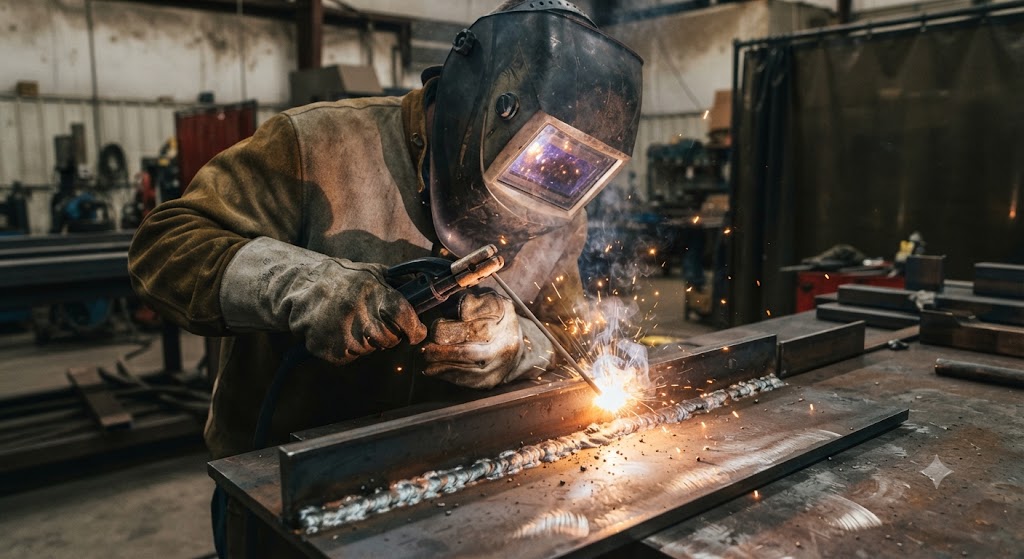
6013 Welding Rod: The Full Guide

Hand a first-time welder a 7018 rod and they will spend the afternoon peeling stuck electrodes off the plate. Hand them a 6013 and something clicks: the arc lights on the first or second try, stays lit, and lays a bead that actually looks like a bead. That forgiving nature is why 6013 is the rod most instructors reach for on day one, and why it lives in nearly every hobbyist’s drawer.
The 6013 welding rod is a mild steel, rutile-coated stick electrode rated at 60,000 PSI that runs in all positions on AC or DC and is prized for easy arc starts, a smooth stable arc, low spatter, and slag that peels off clean. It shines on thin mild steel and sheet metal where its light-to-medium penetration is a feature, not a flaw. Here is where it fits, how to set it, and where it lets you down.
What the name means
Reading E6013 the AWS way: the 60 is 60,000 PSI minimum tensile strength, the 1 means all positions including vertical and overhead, and the 3 points to a rutile-based coating that runs happily on AC, DCEP, or DCEN. That rutile coating is the whole personality of the rod. It gives the soft, stable arc and the tidy bead, in exchange for shallower penetration than a digging rod like 6011 or 6010.
So 6013 is a low-penetration, all-position, easy-running rod. That combination makes it a specialist in thin material and clean metal, and a poor choice for thick structural joints.
Direct answer: what is 6013 good for?
6013 is best for thin mild steel, sheet metal, ductwork, light fabrication, and general repairs where the metal is reasonably clean and you want a good-looking bead without a fight. Its light-to-medium penetration is exactly what you want on thin gauge steel, because a deep-digging rod would blow straight through. It is also the rod beginners learn on, since it starts easily and resists sticking.
Where it is the wrong call: thick plate, high-strength structural work, and dirty, rusty, or painted steel. On thick sections its shallow penetration leaves weak joints, and on contaminated metal it tends to weld over the junk instead of burning through it the way 6011 does. For structural strength you want 7018, and for rusty repair work you want 6011.
Amperage settings
Match amperage to rod diameter, then fine-tune to the metal. Common published ranges for 6013 are:
- 3/32 inch: roughly 40 to 90 amps
- 1/8 inch: roughly 80 to 130 amps
- 5/32 inch: roughly 110 to 160 amps
Start at the lower end and climb until the arc runs steady without stubbing or blowing through. On thin sheet, stay low and keep moving. One quirk worth knowing: recommended ranges vary by brand, so a Hobart 3/32 rod may list a lower range than a Lincoln one. Trust the box on the rod you actually bought, and use these numbers as a starting point.
Technique notes
- Keep a tight arc. 6013 likes a short arc length for a stable, quiet burn.
- Try AC on thin material. Many welders prefer 6013 on AC to avoid arc blow, though it runs fine on DC either polarity.
- Drag it slightly. A modest drag angle around 20 to 30 degrees with steady travel gives the cleanest bead on flat work.
- Do not chase dirty metal with it. If the steel is rusty or painted, switch to 6011 rather than fighting 6013.
Which 6013 to buy
The most useful general size is 1/8 inch for typical light fabrication, with 3/32 inch for thinner sheet and lower-amperage machines.
- Forney 30405 E6013 1/8-inch electrodes are a dependable pick for general-purpose light fabrication and repair on clean mild steel. Forney is a farm-store staple, and this rod delivers the easy arc and flat, wetted bead 6013 is known for. The limitation is the diameter: for very thin sheet you will want to step down to 3/32 inch.
- Hobart 770469 E6013 1/8-inch electrodes are an excellent alternative from an ITW brand, with the same light-to-medium penetration and stable arc on carbon steel in all positions. Hobart’s published amperage range trends a touch lower, which some welders find friendlier on thin material.
How they compare: both are quality all-position 6013 rods, and the practical difference is brand availability and the amperage range printed on the box. Buy whichever you can get locally, or the Hobart if you weld a lot of thin sheet and want the lower starting range.
Who should skip 6013: if your work is structural, thick, or must meet code, go straight to 7018. If you are repairing rusty farm equipment on an AC buzzbox, 6011 will serve you far better. 6013 is the rod for clean, thin, tidy work.
The bottom line
6013 is the friendliest stick rod on the rack. It starts easily, runs smooth, and makes clean beads on thin, clean mild steel, which is exactly why beginners and sheet-metal repairs love it. Just respect its shallow penetration: keep it off thick structural joints and dirty metal, and reach for 7018 or 6011 when the job calls for muscle. A box of 1/8 inch Forney or Hobart 6013 is a smart first rod for any new welder.
FAQ
What is 6013 welding rod good for? Thin mild steel, sheet metal, ductwork, light fabrication, and general repairs on reasonably clean metal. Its light-to-medium penetration and easy arc make it ideal for thin gauge work and for learning.
Is 6013 good for beginners? Yes. It has the easiest arc start of the common rods, resists sticking, runs a stable arc, and peels its slag cleanly, which makes it the rod most people learn on.
What amperage should I use for 6013 1/8 inch? Roughly 80 to 130 amps, starting low and increasing until the arc runs steady. Always defer to the range printed on your specific rod’s box, since brands differ.
Can 6013 run on AC or DC? Both. 6013 runs on AC, DCEP, and DCEN. Many welders prefer AC on thin material to avoid arc blow.
What is the difference between 6013 and 6011? 6013 has a softer arc, shallower penetration, and a cleaner bead, ideal for thin clean steel. 6011 digs deep and welds through rust and paint, making it better for dirty repair work.
Can 6013 weld thick steel? Not well. Its shallow penetration leaves weak joints on thick sections. For thick or structural steel, use 7018, or bevel the joint and use a deeper-penetrating rod.
References
- Hobart Brothers, E6013 stick electrode product documentation and specifications (manufacturer), hobartbrothers.com.
- Forney Industries, E6013 steel electrode product data (manufacturer), forneyind.com.
- Lincoln Electric and Miller Electric stick electrode amperage and selection guidance (manufacturer documentation).