6x6 Welded Wire: Selection, Storage and the Mistakes That Ruin Your Slab
6x6 Welded Wire: Selection, Storage and the Mistakes That Ruin Your Slab
The concrete truck is backing up, and your 6x6 welded wire mesh is sitting in a puddle. You pulled it off the delivery truck two weeks ago, leaned it against the garage wall, and forgot about it. Now the bottom sheet is rusted, the wire is pitted, and you are about to lay it in a slab that is supposed to hold a two-post lift and a truck. That rust is not just cosmetic. Pitted wire has less cross-sectional area than the spec sheet says, and less area means less reinforcement.
6x6 welded wire is a grid of resistance-welded steel wire with 6-inch spacing in both directions. It is the most widely used welded wire reinforcement in residential and light commercial concrete work. The designation tells you the spacing and the wire size, and reading it correctly is the difference between a slab that holds and one that cracks under load.
For a standard residential garage or driveway slab, 6x6 W2.9/W2.9 (6 gauge) is the minimum I would use. For lighter work like a shed floor or walkway, 6x6 W1.4/W1.4 (10 gauge) is adequate. If you are welding the mesh or fabricating frames around it, ER70S-6 under 75/25 argon-CO2 handles the carbon steel.
Reading the 6x6 Welded Wire Designation
The old gauge system and the new W-number system describe the same thing, and you will see both on packaging and in supplier catalogs.
6x6 refers to the spacing: 6 inches between longitudinal wires, 6 inches between transverse wires. The wire size follows. In the old system, this was a gauge number: 10/10, 8/8, 6/6, or 4/4. In the W-system, it is a letter-number combination where W means smooth wire and the number is the cross-sectional area in hundredths of a square inch.
| Old Gauge | W Number | Wire Diameter (approx) | Weight per 100 sq ft |
|---|---|---|---|
| 10/10 | W1.4/W1.4 | 0.135 inch | 21 lbs |
| 8/8 | W2.1/W2.1 | 0.162 inch | 30 lbs |
| 6/6 | W2.9/W2.9 | 0.192 inch | 42 lbs |
| 4/4 | W4.0/W4.0 | 0.225 inch | 58 lbs |
The Wire Reinforcement Institute identifies 6x6 W1.4 and 6x6 W2.9 as the two most widely used styles in residential and light construction. W1.4 is the lighter sheet, suitable for slabs that see foot traffic and light loads. W2.9 is the heavier option, better for garage floors, driveways, and any slab that will see vehicle weight.
Choosing the Right 6x6 Welded Wire Gauge
The gauge you pick should match the load. A shed floor with no vehicle traffic can use W1.4. A garage slab that will hold a truck needs W2.9 at minimum. If you are pouring a driveway that will see a heavy pickup or a trailer, step up to W4.0.
The mistake I see most often is under-specifying. A homeowner buys 10-gauge mesh because it is lighter and easier to handle, then parks a 6,000-pound truck on the slab. The mesh is there to control shrinkage cracking, not to add structural capacity. But heavier mesh does a better job of keeping cracks from opening wide, and the weight difference is not enough to justify going light.
Sheet vs Roll: What Works for Your Job
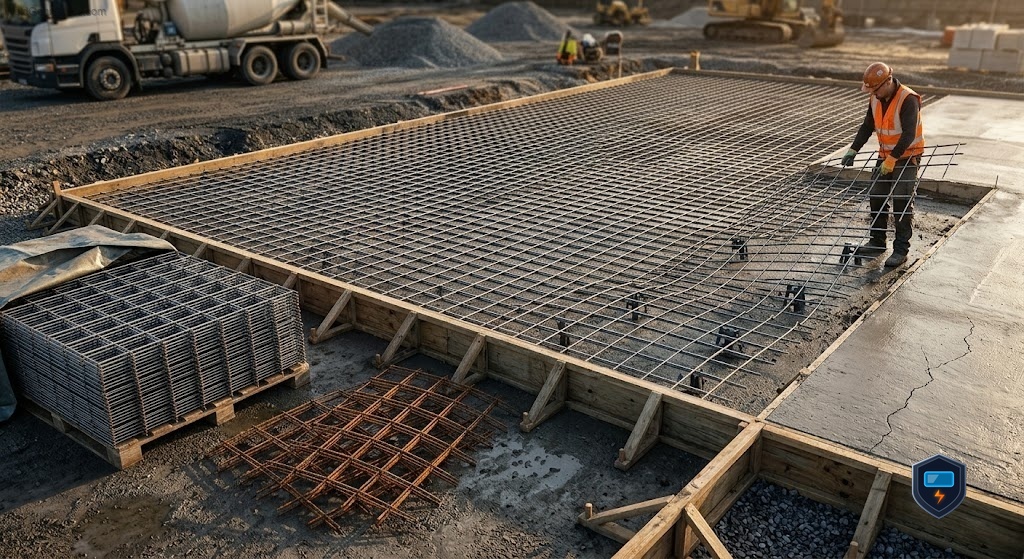
6x6 welded wire mesh comes in rolls and sheets. Rolls are typically 5 feet wide by 150 feet long. Sheets come in sizes like 5x10, 8x15, and 8x20.
Rolls are the standard choice for large flat pours where you can unroll, cut to length, and overlap. The problem with rolls is that they spring back. A rolled sheet wants to stay curled, and getting it flat on your rebar chairs takes two people and some patience. If you are working alone, sheets are easier to handle and lay flat.
Sheets are the easier option to place. They stack flat, they do not fight you, and you can carry one by yourself. For a small pour like a shed floor, sheets are the practical choice.
Storage: The Mistake That Ruins Mesh
Steel wire mesh rusts. A light surface rust is harmless and will not affect performance. But deep pitting reduces the cross-sectional area of the wire, and the W-number on the spec sheet assumes clean, full-area steel.
Store mesh off the ground on blocks or pallets. Cover it with a tarp if it will sit outside for more than a few days. If you are buying sheets, stack them flat and keep them under cover. Rolls should be stored upright, not lying in mud.
Galvanized welded wire mesh resists rust better than bare steel. If your mesh will be exposed to weather before the pour, or if you are using it for fencing rather than concrete, galv welded wire mesh is worth the upgrade. For concrete reinforcement, bare steel is standard because the concrete encases and protects it.
Welding 6x6 Welded Wire
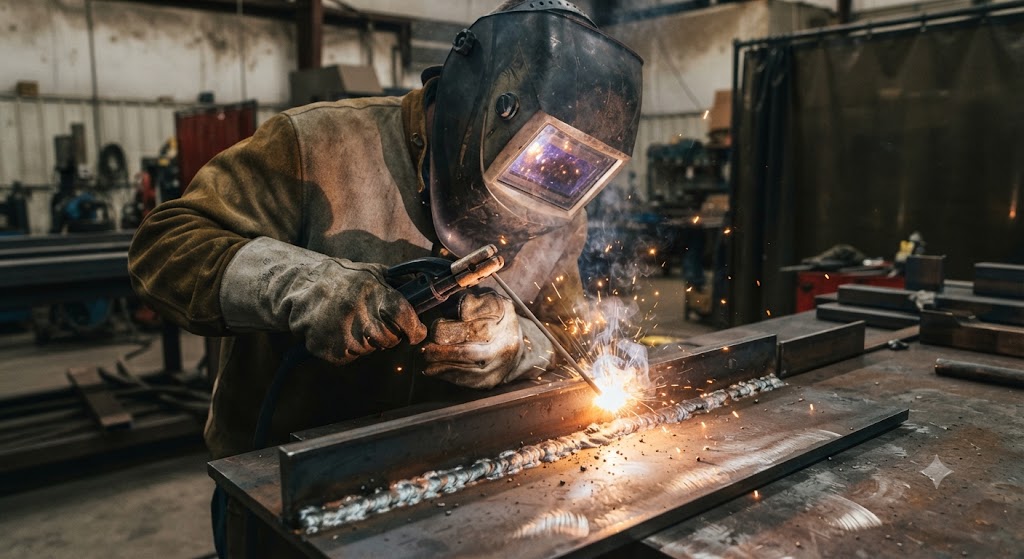
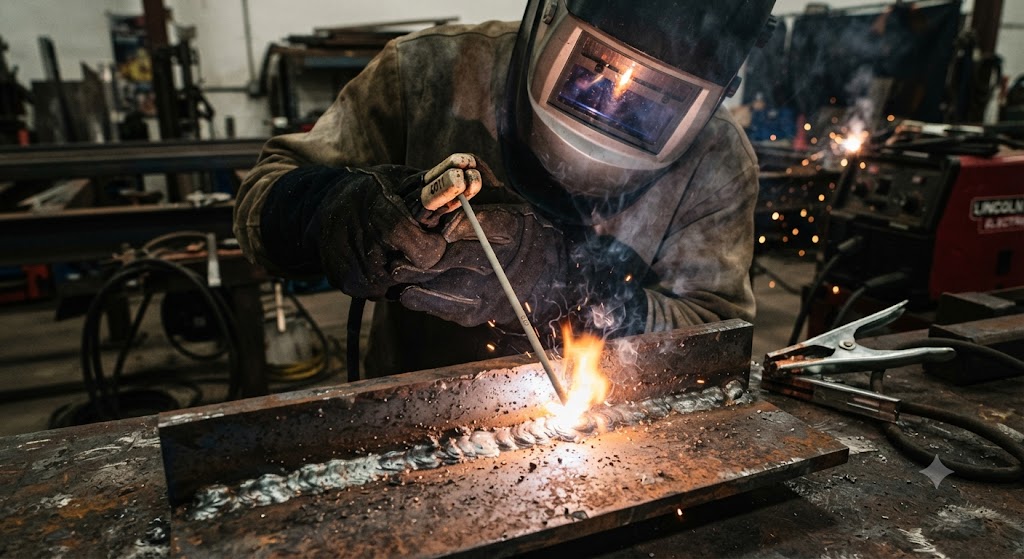
You do not typically weld 6x6 mesh itself. The intersections are resistance welded at the factory. But you may need to weld frames, tie-down points, or repair a sheet that was damaged during transport.
For welding carbon steel mesh or frames around it, ER70S-6 in .030 or .035 diameter under 75/25 argon-CO2 is the right filler. The higher deoxidizer content in ER70S-6 handles the light rust and mill scale common on construction-grade mesh. ER70S-3, with fewer deoxidizers, will work on clean, new mesh but will struggle on anything that has weathered.
If you are welding stainless mesh, use ER308L for 304 stainless or ER316L for 316 stainless, both under AWS A5.9. The shielding gas must be argon-based for stainless. DCEP polarity is standard for MIG welding in both cases.
Wire diameter selection follows the same logic as any sheet work: .030 for wire up to 10 gauge, .035 for 6 gauge and heavier. The mesh wire is thin enough that you can blow through it with .035 if you are not careful. If you are welding a frame around the mesh rather than the mesh itself, match the wire to the frame thickness, not the mesh gauge.
Common Mistakes Beyond Storage
Placing mesh at the bottom of the slab is the most common mistake. Mesh that sits on the ground or on the vapor barrier does nothing. It needs to be in the upper third of the slab, where tensile stresses concentrate when the concrete cracks. Use rebar chairs or mesh supports to hold it at the right height during the pour.
Not overlapping sheets enough is another. Sheets should overlap by at least one full mesh opening, meaning 6 inches in both directions. Tie the overlap with wire ties. A gap between sheets creates a weak plane in the slab.
Walking on the mesh during the pour and pushing it down is the third. Every step pushes the mesh toward the ground. If you are not using chairs, the mesh ends up at the bottom of the slab doing nothing. Set your chairs, pour, and rake the concrete gently without standing on the mesh.
Related Welded Wire Sizes
While 6x6 is the most common spacing, other sizes serve different purposes. 2x2 welded wire mesh and 2x2 welded wire panels use tighter spacing for finer reinforcement or fencing. 1/4 welded wire mesh is even tighter, used for screens and filters. A 4 ft welded wire fence uses 6x6 or tighter mesh in a lighter gauge for animal enclosures. Dog kennel welded wire typically uses 2x2 or tighter spacing with heavier gauge wire for durability. Concrete welded wire mesh in 6x6 spacing is the residential standard, but commercial work may use 4x4 or tighter patterns with heavier wire.
What Actually Matters
For a residential slab, 6x6 welded wire in W2.9 sheets is the practical choice. It is heavy enough to control cracking under vehicle loads, flat enough to place without fighting, and available at every masonry supply yard. Store it off the ground, set it on chairs in the upper third of the slab, and overlap your sheets. If you need to weld frames or tie-downs, ER70S-6 under 75/25 gas will handle the job. The mesh is not complicated. The mistakes that ruin it are.
Frequently Asked Questions
What does 6x6 welded wire mean?
6x6 welded wire refers to steel wire mesh with 6-inch spacing between wires in both directions, resistance welded at every intersection. The wire size is specified separately, such as W1.4 (10 gauge) or W2.9 (6 gauge).
What gauge 6x6 welded wire do I need for a garage slab?
For a garage slab that will see vehicle traffic, 6x6 W2.9/W2.9, which is 6 gauge, is the minimum recommended. For lighter applications like shed floors, W1.4/W1.4 (10 gauge) is adequate.
Should I use sheets or rolls of 6x6 welded wire?
Sheets are easier to handle and lay flat without springing back, making them better for small pours and solo work. Rolls are the standard choice for large pours but require two people to unroll and flatten, making them better for big flat areas.
How do I store welded wire mesh before pouring?
Store mesh off the ground on blocks or pallets, covered with a tarp if outside. Keep sheets stacked flat. Store rolls upright. Deep rust reduces the cross-sectional area of the wire and weakens the reinforcement.
Can I weld 6x6 welded wire mesh?
The intersections are factory resistance welded. You can weld frames, tie-down points, or repairs using ER70S-6 wire under 75/25 argon-CO2 for carbon steel. For stainless mesh, use ER308L or ER316L with argon-based gas.
What is the difference between W1.4 and W2.9 wire?
W1.4 has a cross-sectional area of 0.014 square inches (approximately 10 gauge, 0.135 inch diameter). W2.9 has 0.029 square inches (approximately 6 gauge, 0.192 inch diameter). W2.9 is roughly twice the steel area per lineal foot and is stronger for vehicle-loaded slabs.
Where should welded wire mesh be placed in a concrete slab?
Mesh should be in the upper third of the slab, supported on rebar chairs or mesh supports. Placing mesh on the ground or vapor barrier puts it where it does nothing. Tensile stresses concentrate in the upper portion of the slab when concrete cracks.
References
- Wire Reinforcement Institute, How to Specify, Order and Use Welded Wire Reinforcement
- AWS A5.18, Specification for Carbon Steel Electrodes and Rods for Gas Shielded Arc Welding
- Mid Continent Steel and Wire, How to Read Welded Wire Mesh Sizes
- Harris Supply Solutions, Steel Remesh Sizes
- ESAB, ER70S Wire Selection Guide