7014 Welding Rod: The Complete Guide
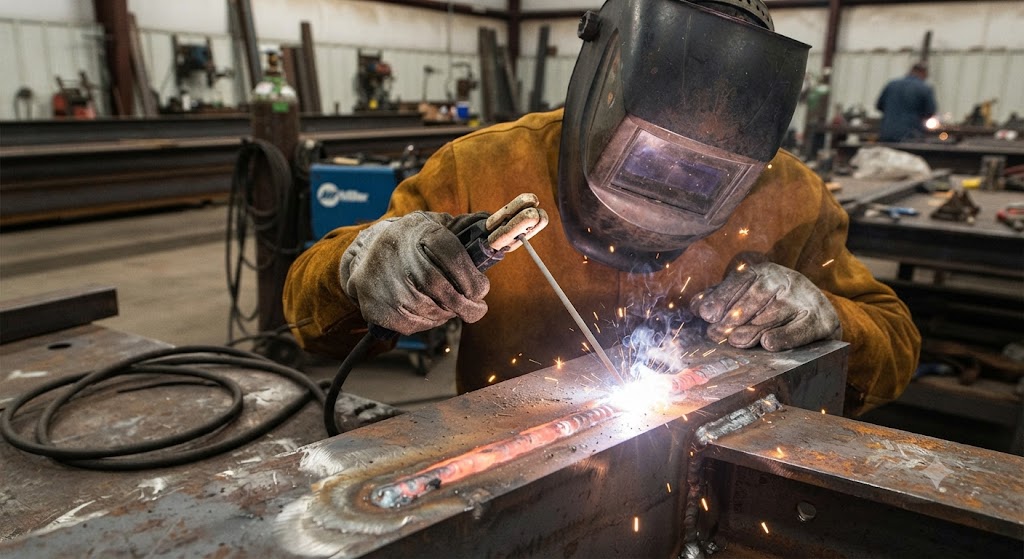
There is a rod that runs almost like MIG on a stick machine, laying metal fast and smooth with a slag that practically falls off on its own. That is 7014, the iron-powder rod that welders reach for when they want speed and a clean bead on clean steel without the fuss of 7018. It rarely gets the glory, but on the right job it is a joy to run.
The 7014 welding rod is an iron-powder, mild steel stick electrode rated at 70,000 PSI minimum tensile strength that runs on AC or DC in all positions, known for a smooth stable arc, high deposition, low spatter, and easy slag removal. Think of it as 6013’s stronger, faster cousin: similar easy handling, but with iron powder in the coating that lays more metal per pass. Here is where it fits and how it stacks up.
What the name means
Breaking down E7014: the 70 is 70,000 PSI minimum tensile strength, the 1 means all positions, and the 4 designates an iron-powder, medium-thickness rutile coating that runs on AC, DCEP, or DCEN. That iron powder is the key. It boosts deposition, so the rod fills a joint faster than 6013, and it produces a heavier slag that peels cleanly and leaves a smooth, rippled bead.
In practice that means medium-to-shallow penetration and a high-speed, easy-to-run rod best suited to clean metal. It is not a deep-penetrating rod and not a low-hydrogen rod, despite the 70 in the name.
Direct answer: what is 7014 used for?
7014 is used for fast, clean fill on mild steel where you want speed and a good-looking bead: general fabrication, sheet metal and ornamental iron on poorly fitted joints, and production-style work where deposition rate matters. Its iron-powder coating lets you lay metal quickly, and its stable arc and easy slag make it forgiving to run. It handles all positions, though like most iron-powder rods it is happiest flat and horizontal.
Where 7014 is the wrong choice: dirty, rusty, or painted metal, and deep-penetration or code-critical structural joints. On contaminated steel it tends to weld over the junk rather than dig through it, so reach for 6011 there. For high-strength, crack-resistant structural welds, use low-hydrogen 7018. 7014 trades penetration and low-hydrogen toughness for speed and ease of use.
7014 versus 6013
These two are close cousins, and the choice comes down to speed and heat. Both run smooth on clean metal with low spatter and shallow-to-medium penetration. The differences:
- 7014 has iron powder in the coating, so it deposits more metal faster and rates 70,000 PSI, but its heavier slag means you generally run a bit more amperage and a slightly longer arc to keep it from sticking.
- 6013 rates 60,000 PSI, runs at lower amperage, and is a touch easier to control on very thin sheet.
Choose 7014 when you want to fill faster on medium-thickness clean steel. Choose 6013 for the thinnest sheet and the lowest heat. Many welders keep both.
Amperage settings
7014 runs a little hotter than 6013 for the same diameter because of the iron-powder slag. A 3/32 inch rod typically runs around 70 to 100 amps, and a 1/8 inch rod roughly 110 to 150 amps, with larger 5/32 inch rods higher still. Keep a short arc, around 1/8 inch or less, and start at the lower end, climbing until the rod runs smoothly without stubbing. Always defer to the range printed on your rod’s box.
Technique notes
- Keep a tight arc. The heavy slag needs a short arc to run clean without sticking.
- Run it a bit hotter than 6013. The iron powder wants the extra current.
- Best flat and horizontal. It runs all positions, but vertical-up wants a slight whip or weave.
- Weld clean metal. 7014 does not dig through rust and paint; prep the joint.
Which 7014 to buy
The handy general size is 3/32 inch for lighter work, stepping up to 1/8 inch for faster fill on thicker clean steel.
- Forney 32005 E7014 3/32-inch electrodes are a strong pick for smooth, high-deposition welding on clean mild steel and poorly fitted joints. This is a well-established farm-store rod that delivers the easy arc and self-peeling slag 7014 is known for, in a 3/32 diameter that suits smaller machines. Its limitation is the same as the rod class: it will not weld dirty or rusty metal well, so keep it for clean steel.
How it compares to your other rods: keep 7014 for fast, clean fill, 6011 for rusty repair work, and 7018 for structural strength. They cover different jobs, and 7014 is the speed-and-ease specialist among them.
Who should skip 7014: anyone mainly welding dirty, rusty, or structural steel. If your metal is clean and you want to fill fast with a tidy bead, this is your rod; otherwise 6011 or 7018 will serve you better.
The bottom line
7014 is the rod for laying clean metal quickly. Its iron-powder coating gives high deposition, a smooth arc, and slag that peels itself, making it a pleasure on clean mild steel and poorly fitted joints. Just keep it off rusty metal and code-critical structural work, where 6011 and 7018 belong. Run it a touch hotter than 6013, keep the arc tight, and it will reward you with fast, good-looking welds.
FAQ
What is 7014 rod used for? Fast, clean fill on mild steel: general fabrication, sheet metal, ornamental iron, poorly fitted joints, and production work where deposition speed and a smooth bead matter. It runs best on clean metal.
How does 7014 compare to 6013? Both are smooth, shallow-to-medium penetration rods for clean steel. 7014 has iron powder for higher deposition and a 70,000 PSI rating, runs a bit hotter, and has heavier self-peeling slag. 6013 is lower heat and slightly easier on very thin sheet.
Is 7014 good for vertical welds? It runs all positions, but like most iron-powder rods it is happiest flat and horizontal. Vertical-up welds benefit from a slight whip or weave and careful heat control.
What amperage for 7014? Roughly 70 to 100 amps for 3/32 inch and about 110 to 150 amps for 1/8 inch, starting low. Defer to your rod’s printed range.
Can 7014 weld rusty metal? Not well. It tends to weld over contamination rather than dig through it. For rusty, painted, or dirty steel, use 6011.
Is 7014 a low-hydrogen rod? No. Despite the 70,000 PSI rating, 7014 is an iron-powder rutile rod, not a low-hydrogen rod. For low-hydrogen, crack-resistant welds, use 7018.
References
- Hobart Brothers, 7014 electrode datasheet with mechanical properties and welding procedures (manufacturer), hobartbrothers.com.
- Forney Industries, E7014 steel electrode product data (manufacturer), forneyind.com.
- Lincoln Electric stick electrode selection and iron-powder electrode documentation (manufacturer).