Aluminum Weld Wire: ER4043 vs ER5356 Selection Guide
Aluminum Weld Wire: ER4043 vs ER5356 and How to Feed It
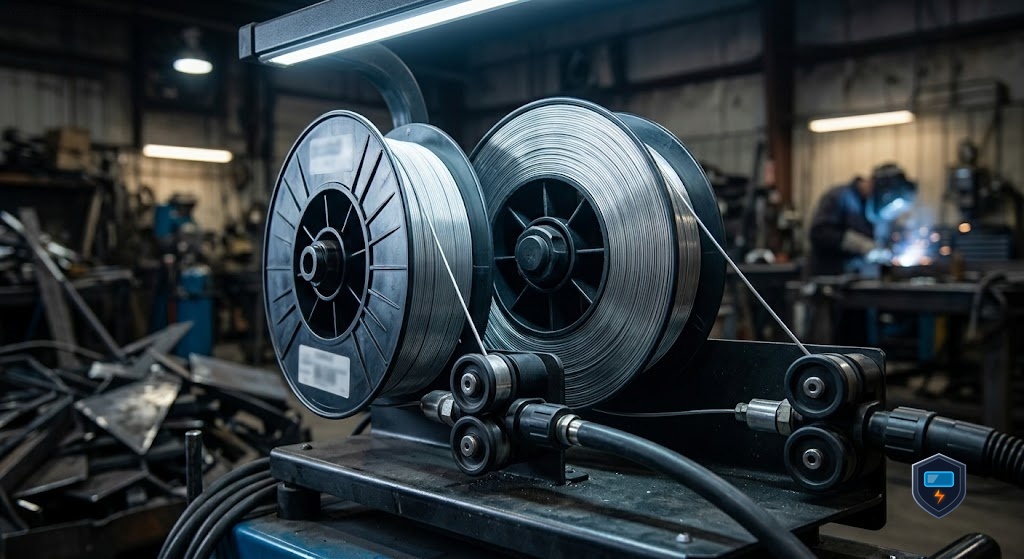
The first time you load aluminum weld wire into a MIG spool gun, it birdnests. The soft wire kinks between the drive roll and the liner, tangles into a ball, and jams. You pull the trigger and nothing feeds. You open the gun and find a mess that looks like a bird tried to nest in your welder. This is the most common aluminum welding failure, and it has nothing to do with your technique. It is about wire selection, drive roll geometry, and liner setup.
Aluminum weld wire is a filler metal spooled for gas metal arc welding (GMAW) or cut into rods for gas tungsten arc welding (GTAW), used to join aluminum alloys. The two dominant classifications are ER4043, a silicon-alloyed wire that flows easily and produces clean beads, and ER5356, a magnesium-alloyed wire that is stronger and stiffer. Together, these two account for roughly 80% of all aluminum filler wire sold worldwide, according to The Fabricator.
For most 6061 aluminum projects, ER4043 is easier to feed and produces a better-looking bead. ER5356 is stronger, holds up better for fillet welds, and matches color after anodizing. Choose ER4043 for ease of welding, reduced distortion, and brighter welds. Choose ER5356 for strength, color match after anodizing, and welding 5xxx series alloys with more than 2.5% magnesium.
Aluminum Weld Wire: ER4043 vs ER5356
These two wires are not interchangeable, and the choice changes the weld.
| Property | ER4043 | ER5356 |
|---|---|---|
| Alloying element | Silicon (4.5 to 6%) | Magnesium (4.5 to 5.5%) |
| Tensile strength | Lower | Higher |
| Ductility | Lower | Higher |
| Feedability (MIG) | Softer wire, harder to feed | Stiffer wire, feeds better |
| Bead appearance | Smoother, brighter | Good but slightly duller |
| Anodizing color match | Turns dark gray | Close match to base metal |
| Elevated temperature (above 150 F) | Suitable | Not suitable (stress corrosion cracking) |
| Crack resistance | Better (silicon reduces cracking) | Good but less than 4043 |
| Shear strength | Lower | Higher |
The ESAB engineering team notes that 4043 is a softer alloy in spooled form compared to 5356, which means feedability problems are more common with 4043 in a MIG gun. The higher magnesium content in 5356 makes the wire stiffer and easier to feed through a liner, but it also means the wire requires higher wire feed speed because the melt-off rate is faster.
Hobart Brothers, in their aluminum filler metal selection guide, recommends 5356 for higher shear strength, noting that it takes roughly three fillet passes of 4043 to equal the shear strength of one pass of 5356. They also recommend 4043 for reduced cracking and distortion, and 5356 for better anodized color match and higher ductility.
Who should skip ER4043: if you are welding parts that will be anodized after welding, 4043 turns dark gray and stands out against the base metal. Use 5356 for a closer color match.
Who should skip ER5356: if the welded part will see service temperatures above 150 F, the magnesium content in 5356 can cause stress corrosion cracking. Use 4043 instead.
Wire Diameter and Feeding Setup
Aluminum wire is soft. That single property causes most feeding problems. The wire deforms under pressure from standard V-groove drive rolls, flattening into an oval that jams the liner. The fix is a U-groove drive roll, which cradles the wire without crushing it.
Common wire diameters for aluminum MIG welding are 0.030, 0.035, and 0.045 inch. Miller Welds recommends starting with wire feed speed 30 to 100% higher than you would use for steel of the same diameter, because aluminum melts faster and requires more wire to maintain the arc.
For thin aluminum (14 gauge and lighter), 0.030 inch wire keeps the heat input low enough to avoid burn-through. For 1/8 inch and thicker, 0.035 or 0.045 inch wire deposits more metal per pass and reduces the number of passes needed.
The spool gun is the standard feeding solution for occasional aluminum welding. The spool sits on the gun itself, inches from the contact tip, eliminating the long liner run that causes birdnesting. The trade-off is weight and bulk. A spool gun is heavy, awkward in tight spaces, and the small spools run out quickly. For production work, a push-pull gun or a spool-on-gun with a larger spool is better.
Shielding Gas and Parameters
Aluminum MIG welding uses 100% argon shielding gas. Not a mix, not CO2, not the 75/25 argon-CO2 you use for steel. Argon provides the clean arc and stable puddle that aluminum requires. Flow rate is typically 30 to 50 cubic feet per hour.
The rule of thumb for amperage is 1 amp per 0.001 inch of material thickness. For 1/8 inch (0.125) aluminum plate, that means 125 amps. For 3/16 inch, 190 amps. These are starting points. Your machine, joint design, and travel speed will shift them.
Aluminum conducts heat away from the weld zone faster than steel. This means you need more amperage for the same thickness, and the workpiece heats up progressively as you weld. A pass that starts at the right temperature may be too hot by the end if the part has absorbed heat from previous passes.
While carbon steel wires like ER70S-2, ER70S-3, and ER70S-6 use manganese deoxidizer and silicon deoxidizer blends to handle dirty steel under AWS A5.18, and stainless wires like ER308L and ER316L follow AWS A5.9, aluminum wires use silicon (in ER4043) or magnesium (in ER5356) as their primary alloying elements and are classified under AWS A5.10. The 75/25 argon-CO2 mix and 100% CO2 that work for carbon steel will contaminate aluminum welds. Pure argon is the only correct choice.
Storage and Common Mistakes
Aluminum wire oxidizes and absorbs moisture. Spooled wire left on the welder for weeks develops a dull, chalky surface that feeds poorly and produces porous welds. Store spools in sealed bags with desiccant when not in use.
The most common mistakes, in order of frequency:
- Using V-groove drive rolls instead of U-groove. The wire flattens and jams.
- Too much drive roll tension. The wire birdnests at the drive roll instead of feeding through the liner.
- Using 75/25 argon-CO2 instead of 100% argon. The CO2 contaminates the aluminum weld.
- Not cleaning the base metal. Aluminum oxide has a higher melting point than the base metal. Brush the weld area with a dedicated stainless steel brush (never use one that has touched steel) to remove the oxide layer before welding.
- Using ER5356 for parts that will see service above 150 F. The magnesium content can cause stress corrosion cracking at elevated temperatures.
What to Buy
For ER5356, the Blue Demon ER5356 in 0.035 inch on a 16 lb spool is a high-strength aluminum wire for 5xxx series alloys and structural welds on 6061. Its flaw is feedability. Even though ER5356 is stiffer than ER4043, it still requires U-groove drive rolls and a spool gun for consistent feeding. Skip it if your parts will see service temperatures above 150 F, where the magnesium content can cause stress corrosion cracking.
For ER4043, the Hobart ER4043 in 0.035 inch is a general-purpose aluminum wire for 6xxx series alloys. It flows better than 5356 and produces a brighter, smoother bead. Its flaw is the soft wire. ER4043 birdnests more easily than ER5356 because the silicon-alloyed wire is softer and deforms under drive roll pressure. You need a spool gun with light tension and U-groove rolls. Skip it if you need maximum shear strength in fillet welds, where ER5356 is the better choice.
The Wire You Actually Need
For general fabrication in 6061, ER4043 in 0.035 inch is the easiest aluminum weld wire to live with. It flows well, looks clean, and resists cracking. If you need more strength, are welding 5xxx series alloys, or will anodize the finished part, switch to ER5356 in the same diameter. Either way, put it on a spool gun with U-groove rolls, run 100% argon, and store the wire dry. The wire is only as good as the feeding system behind it.
Frequently Asked Questions
What is the difference between ER4043 and ER5356 aluminum wire?
ER4043 contains silicon (4.5 to 6%) for better flow and crack resistance. ER5356 contains magnesium (4.5 to 5.5%) for higher strength and better anodizing color match. ER4043 is easier to weld with. ER5356 is stronger.
Can I use 75/25 argon-CO2 for aluminum welding?
No. Aluminum requires 100% argon shielding gas. CO2 in the mix contaminates the weld and causes porosity. Use 30 to 50 CFH of pure argon.
Why does my aluminum wire keep birdnesting?
The most common cause is using V-groove drive rolls, which crush the soft aluminum wire. Switch to U-groove drive rolls and reduce the drive roll tension. A spool gun also helps by shortening the feed path.
What diameter aluminum wire should I use?
0.030 inch for thin material (14 gauge and lighter). 0.035 inch for general-purpose welding on 1/8 inch and thicker. 0.045 inch for thick plate and high-deposition work.
Can I use ER5356 for parts that get hot?
ER5356 is not suitable for service temperatures above 150 F because its magnesium content can cause stress corrosion cracking at elevated temperatures. Use ER4043 instead.
Do I need to clean aluminum before welding?
Yes. Aluminum oxide has a higher melting point than the base metal and causes weld defects. Brush the weld area with a dedicated stainless steel brush (never one used on steel) and degrease with acetone before welding.
What welding wire specification covers aluminum filler metals?
Aluminum welding wire is classified under AWS A5.10. Carbon steel wires like ER70S-2, ER70S-3, and ER70S-6 fall under AWS A5.18, and stainless wires like ER308L and ER316L fall under AWS A5.9.
References
- AWS A5.18/A5.18M - Specification for Carbon Steel Electrodes for Gas Shielded Arc Welding
- AWS A5.9/A5.9M - Specification for Bare Stainless Steel Welding Electrodes and Rods
- Hobart Brothers - Filler Metal Guidelines for 4043/4943 or 5356
- ESAB - Should I Use 4043 or 5356 Filler Alloy?
- Miller Welds - How to Successfully MIG Weld Aluminum
- The Fabricator - Deciding Between 4043 and 5356 Filler Metal