Brazing Rod Buying Guide: How to Choose the Right One
Brazing is the quiet middle ground between soldering and welding, and the rod is where it all happens. A torch, a joint, and the right brazing rod let you join metals that would be a nightmare to weld: thin tubing, dissimilar metals, cast iron, copper pipe. The trick is that brazing rods are not one thing. Grab a copper-phosphorus rod for a steel repair and it will fail; grab an aluminum rod for a copper joint and nothing happens. Matching the rod to the metal is the whole game.
A brazing rod is a filler metal that melts above 840 degrees Fahrenheit but below the melting point of the base metals, joining them without melting the base metal itself. The main families are silver, copper-phosphorus, aluminum, and bronze, each suited to different metals. Choosing the right one means matching the rod family to the metals you are joining and knowing whether you need flux. Here is the guide.
How brazing is different from welding
Brazing and welding both join metal, but they work differently, and that difference explains the rod choice. In welding, the base metals melt and fuse together (often with filler added). In brazing, the base metals never melt; instead, a filler rod with a lower melting point flows into the joint and bonds to the surfaces, drawn in by capillary action. Brazing happens above 840 degrees Fahrenheit (below that it is soldering) but below the base metal’s melting point.
Because the base metal stays solid, brazing runs cooler than welding, which means less warping, the ability to join thin or dissimilar metals, and clean joints that can be filed and painted.
Direct answer: which brazing rod family to choose
Match the rod family to the metals you are joining:
- Copper to copper (plumbing, HVAC, refrigeration): copper-phosphorus rod, which is self-fluxing on copper.
- Steel, stainless, brass, dissimilar metals, strong joints: silver brazing rod (with flux), the versatile, strong, low-temperature option.
- Aluminum repairs (gutters, castings, thin aluminum): low-temperature aluminum brazing rod, used with a propane or MAPP torch.
- Steel, cast iron, copper, galvanized, general repair: bronze brazing rod (low-fuming bronze), a general-purpose torch rod.
Then decide on flux: copper-phosphorus is self-fluxing on copper, but almost every other combination needs flux (or a flux-coated rod) to prevent oxidation and help the filler flow.
The four rod families explained
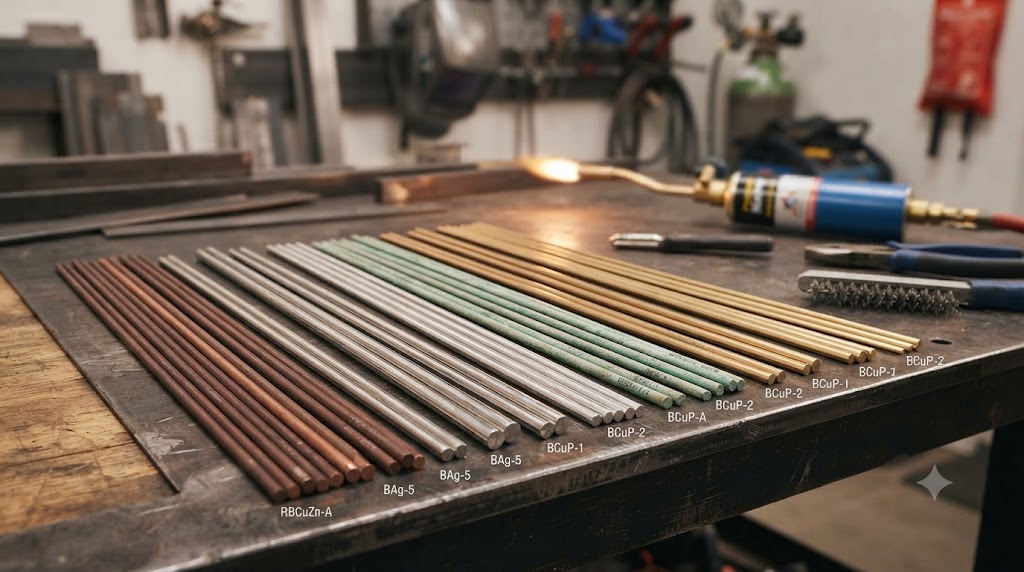
Each family has a clear lane:
- Silver brazing rods are silver-copper alloys (some with zinc, tin, or phosphorus). They melt at relatively low temperatures, flow beautifully, and make strong joints on a wide range of metals including steel, stainless, brass, and copper. They are the versatile choice, widely used in HVAC and plumbing.
- Copper-phosphorus rods are copper with a few percent phosphorus, and the phosphorus makes them self-fluxing on copper. They are the standard for copper-to-copper joints in plumbing and refrigeration, but must not be used on steel or iron, where phosphorus causes brittle joints.
- Aluminum brazing rods are low-temperature rods (melting around 720 to 750 degrees Fahrenheit) that let you repair aluminum with a common torch, since aluminum itself melts near 1,220 degrees Fahrenheit.
- Bronze brazing rods (low-fuming bronze) are copper-zinc alloys for general-purpose torch brazing of steel, cast iron, copper, and galvanized metal, popular for repairs and building up worn surfaces.
Do not forget the flux
Flux is not optional for most brazing, and skipping it is a common beginner mistake. Flux cleans the joint, prevents oxidation as the metal heats, and helps the molten filler flow and wet the surfaces. The main exception is copper-phosphorus rods on copper-to-copper joints, where the phosphorus self-fluxes. For everything else (silver on steel or brass, bronze on cast iron, and copper-phosphorus on brass), you need flux, either applied separately or built into a flux-coated rod. Matching the right flux to the rod matters as much as matching the rod to the metal.
Which brazing rods to buy
Here is a rod from each family to cover the common jobs.
- Harris Stay-Silv 15 phos-copper-silver brazing rod is the versatile silver-bearing choice for copper and copper-to-brass work, with a wide melting range that fills gaps and tolerates vibration, and it self-fluxes on copper. Its limitation is that phosphorus-bearing rods should not be used on steel or iron.
- Harris 0 phos-copper brazing rod is the silver-free copper-to-copper option for plumbing and refrigeration, self-fluxing on copper. The trade-off is a higher melting range than silver-bearing rods, so it wants close-fitting joints.
- Bernzomatic AL3 aluminum brazing and welding rods repair aluminum gutters, windows, and castings with a propane or MAPP torch at a low working temperature. The catch is a narrow working window, since the base aluminum melts not far above the rod.
- SÜA low-fuming bronze flux-coated brazing rod is the general-purpose torch rod for steel, cast iron, copper, and galvanized metal, with flux already coated on so you can start brazing. Its limitation is that it is an oxy-fuel brazing rod, so it wants enough heat to flow properly.
How to choose: for copper plumbing and refrigeration, use copper-phosphorus. For strong joints on steel, stainless, or brass and dissimilar metals, use silver (with flux). For aluminum, use a low-temperature aluminum rod. For general steel and cast iron repair, use bronze. Match the flux to the rod for every job except copper-phosphorus on copper.
The bottom line
A brazing rod joins metal without melting the base, flowing into the joint by capillary action above 840 degrees Fahrenheit. The four families each have a lane: copper-phosphorus for copper (self-fluxing), silver for strong joints on steel, stainless, and brass, aluminum rods for low-temperature aluminum repair, and bronze for general steel and cast iron work. Match the rod to your metals, use the right flux for everything except copper-phosphorus on copper, and brazing becomes one of the most useful skills in the shop.
FAQ
What is brazing rod made of? It depends on the family: silver rods are silver-copper alloys (sometimes with zinc, tin, or phosphorus), copper-phosphorus rods are copper with a few percent phosphorus, aluminum rods are low-temperature aluminum alloys, and bronze rods are copper-zinc alloys. Each suits different metals.
Do you need flux with brazing rod? Usually yes. Flux cleans the joint, prevents oxidation, and helps the filler flow. The main exception is copper-phosphorus rods on copper-to-copper joints, which are self-fluxing. Everything else needs flux, applied separately or as a flux-coated rod.
What is the difference between brazing rod and welding rod? A welding rod melts and fuses into the base metal, which also melts. A brazing rod melts at a lower temperature and flows into the joint by capillary action without melting the base metal, so brazing runs cooler and can join thin or dissimilar metals.
Which brazing rod is best for copper pipe? A copper-phosphorus rod, which is self-fluxing on copper and is the standard for plumbing, HVAC, and refrigeration copper joints. For added ductility on vibrating lines, a silver-bearing phos-copper rod is a common upgrade.
Can you braze steel with any brazing rod? No. Copper-phosphorus rods must not be used on steel or iron because phosphorus makes the joint brittle. Use silver (with flux) or bronze brazing rods for steel and cast iron.
What temperature does brazing happen at? Brazing occurs above 840 degrees Fahrenheit but below the base metal’s melting point. Below 840 degrees it is soldering, and above the base metal’s melting point it becomes welding.
References
- Harris Products Group, brazing alloy selection guides for silver, phos-copper, and bronze filler metals (manufacturer), harrisproductsgroup.com.
- American Welding Society brazing fundamentals and AWS filler metal classifications (BCuP, BAg, RBCuZn), aws.org.
- Lincoln Electric and Miller Electric brazing process guidance (manufacturers), lincolnelectric.com, millerwelds.com.