Flux Cored Welding Wire: How to Choose the Right Spool
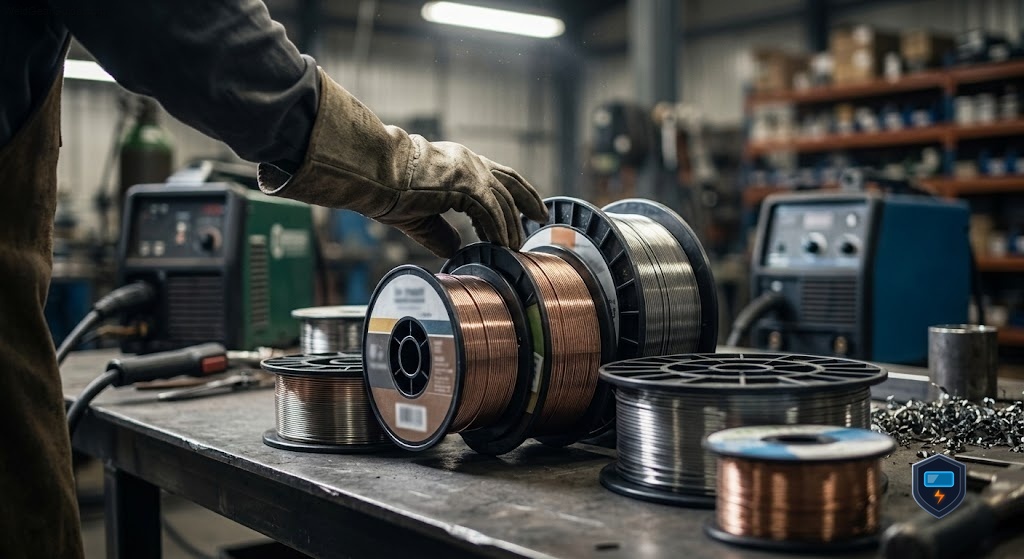
Walk down the wire aisle and everything looks interchangeable. Spools of grey wire, numbers on the label, prices that vary by a factor of three for what appears to be the same thing. Then you get home, load a spool, and find out that one wire lays down like butter and another spatters until the nozzle chokes.
The label tells you which is which, if you know what you are reading.
What flux cored welding wire is
Flux cored welding wire is a hollow tube of steel filled with flux compound. As the arc melts the wire, the flux inside generates shielding gas, forms protective slag, stabilises the arc and often adds alloying elements to the deposit. Self-shielded wire needs no gas cylinder; gas-shielded wire adds an external gas for cleaner, faster welding.
The direct answer for choosing: buy an E71T-11 wire in 0.030 inch for general work up to 3/16 inch, or 0.035 inch for 3/16 inch and heavier on a 240 volt machine. Use E71T-GS only for single-pass repairs. Buy the smallest spool you will genuinely use within a few months, because damp wire causes more problems than cheap wire.
Reading the classification
Take E71T-11 apart:
- E electrode
- 7 70,000 psi minimum tensile strength
- 1 all-position capable (a 0 means flat and horizontal only)
- T tubular, meaning flux cored
- -11 usability class: self-shielded, all-position, DC electrode negative
The classes you will actually meet:
| Wire | Shielding | Polarity | Multipass | Typical use |
|---|---|---|---|---|
| E71T-11 | Self-shielded | DCEN | Yes, limited | General fabrication and repair |
| E71T-GS | Self-shielded | DCEN | Single pass preferred | Light repair, thin material |
| E71T-1 | Gas-shielded | DCEP | Yes | Structural, high deposition |
| E308LFC-O | Self-shielded | DCEN | Yes | Stainless repair |
| ENiFe-Cl | Self-shielded | DCEN | Yes | Cast iron repair |
The E71T-11 versus E71T-GS distinction is the one that matters most to home welders, and it is the one most often ignored. GS wire is designed for single-pass work on thinner material. Using it to build up several passes on a thick joint increases the risk of inclusions and gives you mechanical properties the classification never promised.
Diameter, matched to thickness
| Wire diameter | Best material range | Notes |
|---|---|---|
| 0.030 in | 18 gauge to 3/16 in | The right default for 120 volt machines |
| 0.035 in | 1/8 in to 3/8 in | Needs 240 volt power to run at its best |
| 0.045 in and up | 1/4 in and heavier | Industrial machines, high deposition |
Running 0.030 inch wire on 1/4 inch plate is the most common mismatch. It works, in the sense that metal ends up in the joint, and it produces shallow penetration that looks acceptable from the top. Sizing up fixes it instantly.
Running 0.035 inch on sheet metal is the opposite mistake and produces burn-through faster than you can react.
Wires worth buying
Lincoln Innershield NR-211-MP
The Lincoln NR-211-MP in 0.030 inch on a 10 pound spool is the reference self-shielded wire for small machines. It runs smoothly, tolerates gaps and imperfect fit-up, releases slag cleanly, and produces the best bead appearance of the common gasless wires.
Its limit is published plainly: Lincoln recommends it to around 5/16 inch plate in the smaller diameters. It also costs more than value wire, and a 10 pound spool is more than a light user will get through before humidity becomes a factor. For occasional welding, the 1 pound spool is the smarter purchase despite the higher per-pound cost.
Hobart E71T-11
The Hobart H222106-R22 in 0.030 inch, 10 pound spool is the wire I would put on a beginner’s machine. Smooth feeding, tolerant of inconsistent travel speed, slag that lifts in curls.
Its weakness is spatter when run hot on thin material, enough to clog a nozzle during a session. Sheet metal workers should either drop the settings substantially or use gas MIG. For heavier work, the 0.035 inch version deposits faster and penetrates deeper.
The Hobart twin pack of 2 pound spools solves the storage problem for occasional users, at a higher price per pound.
Blue Demon E71T-11
The Blue Demon E71T-11 in 0.030 inch, 2 pound spool is honest value. It welds well enough for repair work and comes in a size that suits infrequent use.
It spatters more than the premium wires, so plan on cleaning the nozzle more often, and bead appearance is a step below Lincoln’s. If your work will be painted and nobody will inspect the beads, that is a reasonable trade. If appearance matters, spend more.
Forney E71T-GS
The Forney 42303 in 0.035 inch on a 10 pound spool suits high-volume single-pass work such as long fillets on light structure. The 42302 in a 2 pound spool is the occasional-use size.
The classification is the limitation. Do not use GS wire for multipass structural joints where an E71T-11 wire is the correct choice.
Specialty wires on the same machine
For stainless repair, Blue Demon 308LFC-O in 0.035 inch runs on the same DC electrode negative polarity. It produces hexavalent chromium fume, so extraction is required rather than optional.
For cast iron, Blue Demon ENiFe-Cl nickel wire in 0.035 inch allows machinable repairs on castings. It is expensive per pound and demands careful preheat and slow cooling, so it is a specialist purchase rather than a shelf staple.
Spool size, and the mistake of buying big
The per-pound saving on a large spool is real and often irrelevant. Flux cored wire absorbs moisture, and moisture causes porosity. A 10 pound spool that takes you three years to use will spend most of that time slowly degrading on an open machine in a garage that swings between humid summers and cold winters.
Rough guidance:
- Welding most weeks: buy 10 pound spools and store them sealed with desiccant between uses.
- Welding monthly: 2 pound spools.
- Welding a few times a year: 1 or 2 pound spools, and accept the premium.
Storage that actually works
Remove the spool from the machine when a project ends. Put it in a sealed plastic container with a desiccant pack. Keep the container somewhere with stable temperature rather than an unheated shed, because temperature swings cause condensation.
Wire showing surface rust or discolouration should be discarded. There is no way to recondition it, and the cost of a new spool is less than the cost of grinding out a porous joint.
Final verdict
Buy E71T-11 rather than E71T-GS unless your work is genuinely single-pass. Match diameter to thickness rather than buying one size for everything. And size the spool to your consumption rather than to the price per pound.
The most expensive wire in a workshop is the half-used spool that sat out for two years and now produces porosity in every bead. Nobody notices it happening, and everybody blames the machine.
Frequently asked questions
What is the best flux cored welding wire for general use? An E71T-11 wire in 0.030 inch for material up to 3/16 inch, or 0.035 inch for heavier work on a 240 volt machine.
What is the difference between E71T-11 and E71T-GS? E71T-11 supports limited multipass welding with better mechanical properties. E71T-GS is intended for single-pass work on lighter material.
Which wire diameter should I use? 0.030 inch for 18 gauge up to 3/16 inch, 0.035 inch for 1/8 inch through 3/8 inch on a machine with enough output.
Does flux core wire go bad? Yes. It absorbs moisture, which causes porosity, and it can develop surface rust. Store it sealed with desiccant and discard discoloured wire.
Can I use flux core wire in a MIG welder? Yes, if the machine allows a polarity switch to DC electrode negative and takes the wire diameter. Fit a knurled drive roll and the correct liner.
Is expensive flux core wire worth the money? For bead appearance, reduced spatter and consistent feeding, generally yes. For painted repair work where nobody sees the bead, value wire is adequate.
What wire welds stainless without gas? E308LFC-O for 304 and 308 grades. Use E316LFC-O for 316 and a 309 type filler for joining stainless to carbon steel.
Can flux cored wire weld cast iron? Yes, with a nickel-iron ENiFe-Cl wire, along with proper preheat and slow controlled cooling.