Forney 42300 E71T-GS Welding Wire: What It Suits and What It Does Not
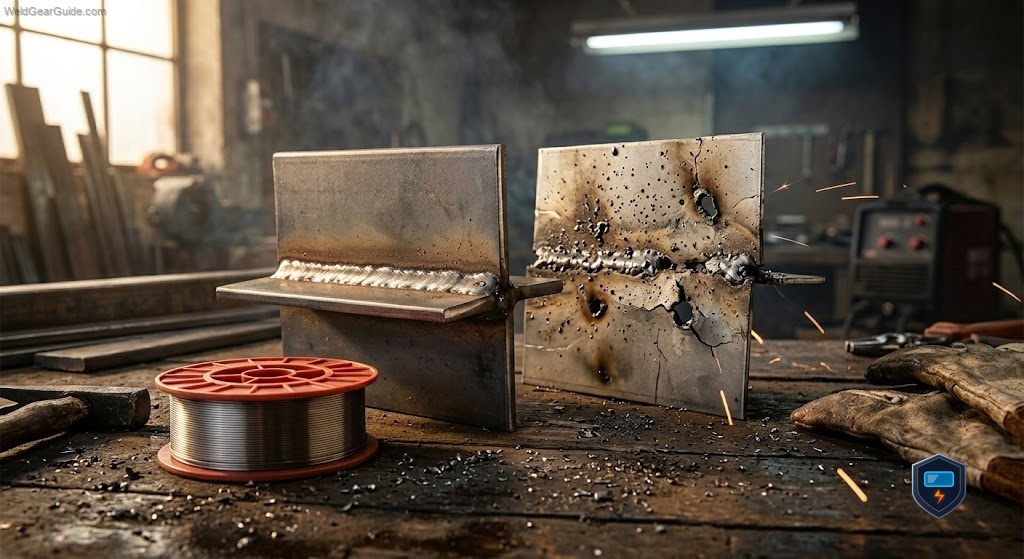
Small spools of welding wire have a specific job that nobody puts on the label. They are for people whose machine sits unused for months at a time, and who would rather buy two pounds three times than have eight pounds slowly rust in a damp garage.
The Forney 42300 lives in exactly that space, and understanding what it is designed for saves a lot of disappointment.
What the Forney 42300 is
The Forney 42300 flux core mild steel welding wire is an E71T-GS self-shielded flux cored wire in 0.030 inch diameter, supplied on a 2 pound spool. Self-shielded means no gas cylinder, and E71T-GS is a single-pass classification intended for light material.
The direct answer on where it fits: use it for quick repairs, tack welding, light brackets and thin mild steel up to about 1/8 inch on small 120 volt machines. Do not use it for multipass structural joints, thick plate build-up, or anything load-bearing where the mechanical properties of the weld need to be defensible. For that work, an E71T-11 wire is the correct choice.
What the GS classification actually means
Reading the designation:
- E electrode
- 7 70,000 psi minimum tensile strength
- 1 all-position capable
- T tubular, flux cored
- GS general classification for single-pass, self-shielded wire
That GS suffix is the part people skip. Unlike E71T-11, which supports limited multipass work, GS wires are formulated for single-pass welding. Building up several passes with GS wire increases the chance of slag inclusions between layers and produces a deposit whose properties were never specified for that use.
This is not a quality criticism of the wire. It is a scope statement, and Forney is not hiding it. The classification is printed on the spool.
Where the 42300 performs well
Light repair on mild steel. Mower decks, shop fixtures, garden equipment, light angle iron frames. Single passes, thin material, work that gets painted.
Tack welding. It lights easily and lays a quick tack without ceremony, which is genuinely useful when fitting up a project you will finish with a heavier wire.
Small machines. The 0.030 inch diameter is well matched to 120 volt output, where thicker wire runs cold. Machines like the Lincoln Electric Handy Core or a compact synergic unit such as the YESWELDER FLUX-135 run it comfortably.
Infrequent users. The 2 pound spool is the point. It fits tightly enclosed feeders, it does not sit for years absorbing moisture, and the higher per-pound cost buys you wire that is actually still good when you need it.
Where it falls short
Multipass structural work. Wrong classification. Use E71T-11.
Heavy plate. 0.030 inch wire on 1/4 inch steel produces shallow penetration that looks fine from the top. Step up to 0.035 inch and a machine with the output to run it.
Bead appearance. GS wires generally leave a rougher bead with more spatter than premium E71T-11 wire. If the weld will be seen, this is not the wire.
Volume work. A 2 pound spool disappears fast on a real project, and buying repeatedly at small-spool prices adds up. Regular users should buy larger spools of a better classification and store them properly.
Settings that suit it
| Material | Approach |
|---|---|
| 18 to 20 gauge | Lowest voltage setting, stitched short beads with pauses |
| 16 gauge | Low voltage, steady travel, watch for burn-through |
| 1/8 in | Mid voltage, single pass, comfortable range |
| 3/16 in | Upper voltage, bevelled joint, and honestly better suited to E71T-11 |
Polarity is DC electrode negative, like all self-shielded wire. Stickout of 1/2 inch. Drag the gun 15 to 20 degrees. Balance wire feed speed against voltage until the arc makes a steady crackle rather than irregular popping.
Expect more spatter than with premium wire, and keep anti-spatter spray and a nozzle scraper close.
How it compares to the alternatives
| Forney 42300 | Lincoln NR-211-MP | Hobart E71T-11 | YESWELDER E71T-GS | |
|---|---|---|---|---|
| Classification | E71T-GS | E71T-11 | E71T-11 | E71T-GS |
| Spool size | 2 lb | 1 lb and 10 lb | 2 lb and 10 lb | 10 lb |
| Multipass | Single pass preferred | Yes, within limits | Yes, within limits | Single pass preferred |
| Bead appearance | Adequate | Best of the group | Good | Adequate |
| Best for | Occasional light repair | General work, tidy results | Learning, general work | High volume single pass |
The Lincoln NR-211-MP in 1 pound is the direct alternative for someone who wants a small spool with multipass capability and a better finish. It costs more.
The Hobart twin pack of 2 pound spools gives you E71T-11 in the same convenient size, which is a better default for most people than a GS wire.
The YESWELDER E71T-GS 10 pound spool is the volume version of the same classification, sensible only if you have a lot of single-pass work and will use it before it degrades.
For larger repairs on medium stock, the Forney 42302 in 0.035 inch is the same classification in a larger diameter, needing more machine output.
Storage, because small spools exist for a reason
Buying small only helps if you also store properly. Take the spool off the machine when the project ends, seal it in a container with desiccant, and keep it somewhere temperature-stable rather than an unheated shed where condensation forms.
Wire showing surface rust or discolouration should go in the bin. There is no reconditioning process for flux cored wire, and the cost of a new small spool is far less than the cost of grinding out a porous joint.
Who should buy this wire
Someone with a small gasless machine who welds a handful of times a year on light mild steel, wants wire that will still be good the next time, and does not need the weld to look impressive. That is a genuinely common situation and this wire serves it well.
Who should skip it: anyone building anything structural, anyone welding over 1/8 inch regularly, anyone who cares about bead appearance, and anyone welding often enough to justify a larger spool of E71T-11.
Final verdict
The Forney 42300 is a well-scoped product rather than a compromise. Small spool, single-pass classification, small diameter, matched to small machines and occasional use. Judged against that brief it does exactly what it should.
The mistake is buying it as a general-purpose wire because the price and spool size are convenient, then using it on a multipass joint on 1/4 inch steel and wondering why the weld has inclusions. Read the classification, match it to the job, and this wire will never let you down inside its lane.
Frequently asked questions
What is the Forney 42300 used for? Single-pass welding on light mild steel, typically up to about 1/8 inch, on small gasless wire feed machines.
What polarity does it need? DC electrode negative, the same as all self-shielded flux cored wire.
Can I use it for multipass welds? It is not recommended. E71T-GS is a single-pass classification, and multipass use raises the risk of slag inclusions. Use E71T-11 for multipass joints.
What is the difference between E71T-GS and E71T-11? E71T-11 supports limited multipass welding with better specified mechanical properties. E71T-GS is intended for single-pass work on lighter material.
Is a 2 pound spool worth the higher cost per pound? For occasional welders, yes. Small spools stay fresh, and damp wire causes porosity that costs far more than the price difference.
Does it spatter a lot? More than premium E71T-11 wires. Anti-spatter spray and regular nozzle cleaning help.
What thickness can I weld with 0.030 inch wire? Comfortably from about 18 gauge to 1/8 inch in a single pass. Heavier material needs 0.035 inch wire and more machine output.
How should I store it between projects? Off the machine, sealed in a container with desiccant, at stable temperature. Discard wire that shows rust.