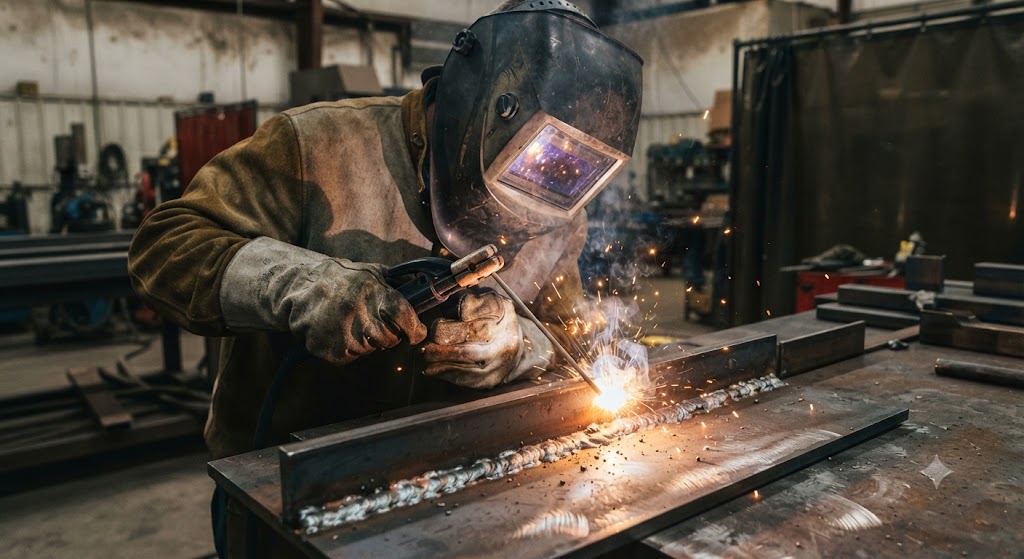
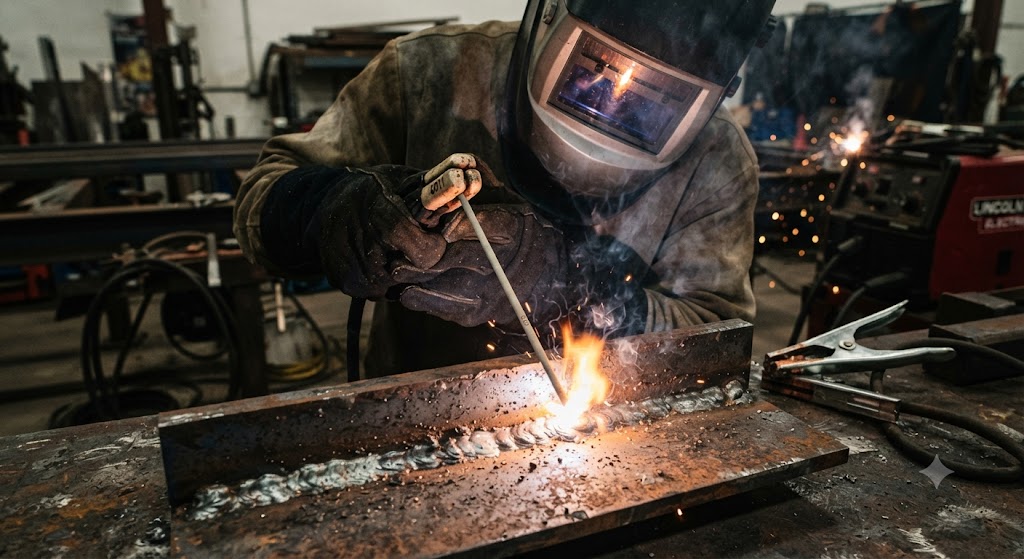
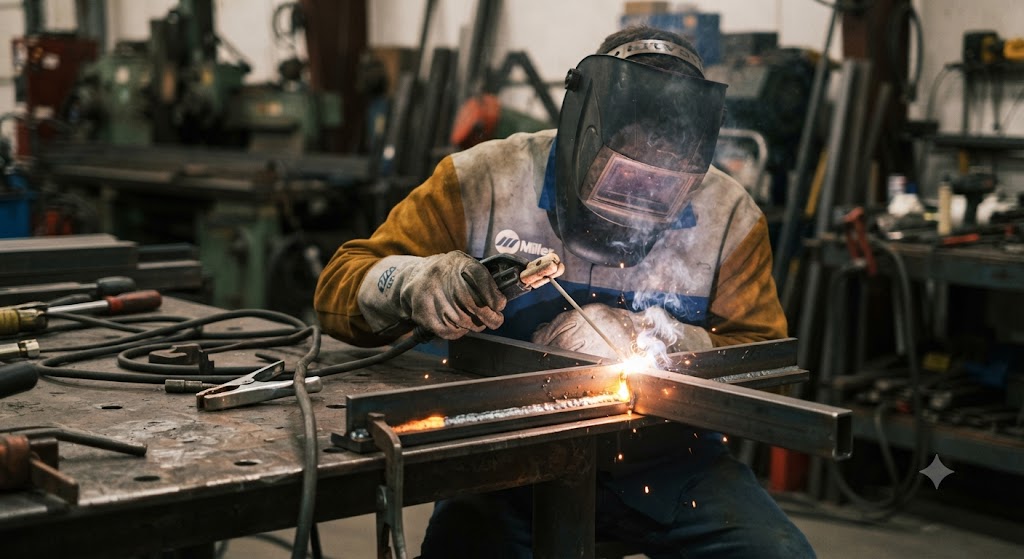
Grizzly G0879 Flux-Cored Wire Feed Welder: How to Dial In Cleaner Welds
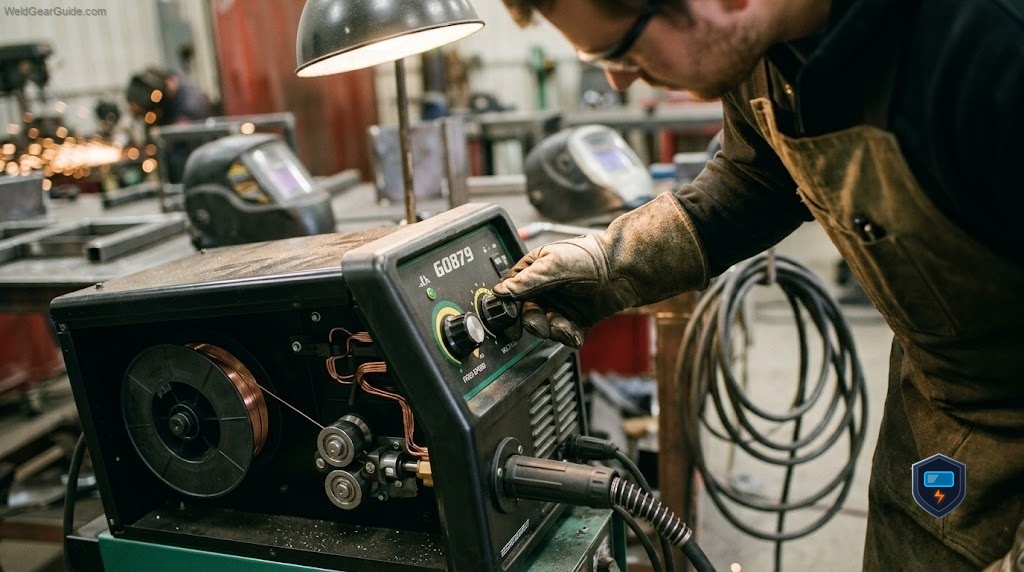
Small gasless wire feeders occupy a strange place in a workshop. They are too limited to build anything serious, and too useful to get rid of. The Grizzly G0879 is squarely in that category: a compact 120 volt flux-cored machine that will fix a mower deck on a Sunday and will never weld a trailer hitch you would trust.
Knowing which of those two jobs is in front of you is the whole skill of owning one.
What the Grizzly G0879 is
The Grizzly G0879 is a 120 volt, self-shielded flux-cored wire feed welder aimed at home and light shop use. Like most machines in this class it uses tapped voltage settings rather than infinite adjustment, paired with a continuously variable wire feed speed control. It runs gasless flux cored wire only, which means no cylinder, no regulator and no hose.
The direct answer on capability: expect comfortable single-pass welding on mild steel from roughly 18 gauge up to 1/8 inch, with 3/16 inch possible on a bevelled joint using multiple passes and patience. Anything heavier belongs on a 240 volt machine. Its strengths are simplicity and portability; its limits are output and duty cycle.
Understanding tapped settings
Machines like this give you a small number of voltage positions, often labelled with letters or numbers, and a wire speed dial. That combination is your entire adjustment range, and beginners often assume the wire speed dial is a heat control. It is not, exactly. Higher wire feed speed raises current, so it does change heat, but the voltage tap sets the arc characteristic.
A workable approach:
- Choose the voltage tap based on material thickness, following the chart inside the machine’s door.
- Set wire feed speed mid-range.
- Run a test bead on scrap of the same thickness.
- Listen. A correct arc makes a steady, even crackle. Popping and stuttering means wire speed is too low for the voltage; a soft, sputtering arc that piles up means it is too high.
- Adjust wire speed in small increments until the sound evens out.
Do this on scrap every time you change material thickness. Two minutes of setup saves an hour of grinding.
Polarity, first thing to check
Self-shielded flux core requires DC electrode negative. Machines sold configured for flux core usually arrive wired that way, but it is worth opening the wire feed compartment and confirming against the diagram before your first bead.
Wrong polarity produces exactly the symptoms people blame on cheap machines: heavy spatter, an arc that will not settle, and beads that sit on the surface without fusing. The wire manufacturers state polarity clearly, and Lincoln’s published data for Innershield NR-211-MP is a good example of the level of detail worth reading before running any new wire.
Wire that suits a small 120 volt machine
Small machines are least happy at both extremes of their range, and wire choice can hide or expose that.
Lincoln NR-211-MP in 0.030 inch is the wire that makes a modest machine look competent. It is forgiving of imperfect fit-up, all-position capable, and its slag lifts cleanly instead of fighting you. The tradeoff is that it costs more per pound than value wire, and the 10 pound spool is more than a light-duty machine will get through quickly. Anyone welding a few times a year should buy smaller.
Hobart E71T-11 twin pack of 2 pound spools in 0.030 inch solves that problem. Small spools stay fresh, fit tightly enclosed feeders, and match this machine’s realistic consumption. The per-pound cost is higher, which is the price of not throwing away oxidised wire.
Forney 42300 E71T-GS in 0.030 inch is a budget-friendly single-pass wire for quick repairs. Because E71T-GS is intended for single pass work, it is not the right wire for multipass joints on thicker stock, which is exactly the work you would attempt with a bevelled 3/16 inch joint. Use E71T-11 for that instead.
TOOLIOM E71T-GS in 0.030 inch is a low-cost option for practice welding. Spatter is heavier than with the premium wires, so expect more nozzle cleaning, and consistency between spools varies. For learning on scrap, that is an acceptable trade.
Six adjustments that clean up your beads
1. Stickout. Hold 1/2 inch from tip to work. Small machines are especially sensitive to this because their arc is less stable to begin with.
2. Drag, do not push. Angle the gun 15 to 20 degrees so slag stays behind the puddle.
3. Slow down the wire, not the hand. When beads look ropey, most people slow their travel and make it worse. Try reducing wire feed speed slightly first.
4. Clean the nozzle regularly. Gasless welding coats the nozzle in spatter, which distorts the arc. Anti-spatter spray and a quick scrape every few beads make a visible difference.
5. Fit-up matters more on small machines. A gap you could bridge with 200 amps becomes a burn-through with 90. Grind the joint to fit rather than filling the gap with wire.
6. Let it cool. Duty cycle on this class of machine is modest. Working through a thermal cutout does not damage anything, but standing around waiting is slower than pacing yourself.
How it compares to alternatives
| Grizzly G0879 class | Lincoln Handy Core | YESWELDER FLUX-135 | Millermatic 142 | |
|---|---|---|---|---|
| Input | 120 V | 120 V | 120 V | 120 V |
| Adjustment | Tapped voltage | Tapped voltage | Synergic control | Automatic setting |
| Processes | Flux core only | Flux core only | Flux core, stick, lift TIG | MIG and flux core |
| Thickness ceiling | About 1/8 to 3/16 in | About 1/8 in | About 1/4 in claimed | About 3/16 in |
| Weak point | Output and duty cycle | Very limited range | Basic gun and support | Price for the capability |
The Lincoln Electric Handy Core is the direct equivalent from a legacy brand, with the same simplicity and the same limitations. The YESWELDER FLUX-135 offers more for the money with synergic settings and extra processes, at the cost of basic accessories and thinner support. The Millermatic 142 is a considerably better machine in every mechanical respect and costs accordingly, and it adds gas MIG capability that changes what you can build.
Who should skip this class of machine entirely: anyone planning trailer, structural or automotive frame work, and anyone welding sheet metal panels where a gas MIG machine gives far better control.
What it does genuinely well
Garden equipment repair. Shop fixtures and jigs. Light angle iron frames. Tacking parts together before taking them to a bigger machine. Learning to read a puddle without spending real money.
That last one is undervalued. A small gasless machine is a fine way to find out whether you enjoy welding before committing to a proper setup.
Safety on a small machine is the same as on a big one
The arc from a 90 amp machine damages eyes exactly as thoroughly as one from a 250 amp machine. Self-shielded flux core also produces heavy fume, and small machines are usually used in enclosed garages, which is the worst combination. Open the doors, get air moving across the work rather than into your face, and use extraction if you weld regularly indoors.
Final verdict
The Grizzly G0879 and the machines like it are honest tools with a narrow band of competence. Inside 1/8 inch mild steel, with fresh E71T-11 wire, correct polarity, half an inch of stickout and a dragging gun, they lay welds that hold perfectly well for repair work.
The mistake is not buying one. The mistake is asking it to do the job of a 240 volt machine, then blaming the welds. If you find yourself bevelling joints and running four passes to get through 1/4 inch plate, the machine is telling you something, and the answer is a bigger machine rather than better technique.
Frequently asked questions
What thickness can a 120 volt flux core welder handle? Comfortably up to about 1/8 inch in a single pass, with 3/16 inch possible on a bevelled joint using several passes. Heavier work needs 240 volt input.
What wire should I use in a small gasless welder? E71T-11 in 0.030 inch is the best general choice. E71T-GS works for quick single-pass repairs but is not intended for multipass joints.
What polarity does a flux core wire feeder need? DC electrode negative for self-shielded wire. Check the diagram inside the wire feed compartment before your first bead.
Why is my bead sitting on top of the metal? Not enough heat, travelling too fast, or an unbevelled joint on material too thick for the machine. Increase the voltage tap and slow down slightly.
How do I stop so much spatter? Confirm polarity, hold 1/2 inch stickout, drag rather than push, and balance wire feed speed against the voltage tap. Nozzle spray helps keep the tip clean.
Can I use gas with this machine? Self-shielded flux core machines have no gas connection. Adding gas requires a machine with a solenoid, a regulator and a polarity change.
How long can I weld before it overheats? Small 120 volt machines typically manage short bursts at higher settings. Expect to pause regularly and let the fan run.
Is a small gasless welder worth buying? For light repair, learning, and shop fixtures, yes. For structural, automotive or trailer work, buy a larger dual-voltage machine instead.