GTAW (Gas Tungsten Arc Welding): A Complete Overview
Every trade has a benchmark skill, the one that tells you someone has truly learned the craft. In welding, that skill is GTAW. Gas tungsten arc welding is the process that produces the cleanest, most precise welds available, and it is the one that asks the most of the person holding the torch. Understanding it, what it is, how it works, and where it fits, explains a lot about welding as a whole.
Here is the complete overview.
What GTAW is
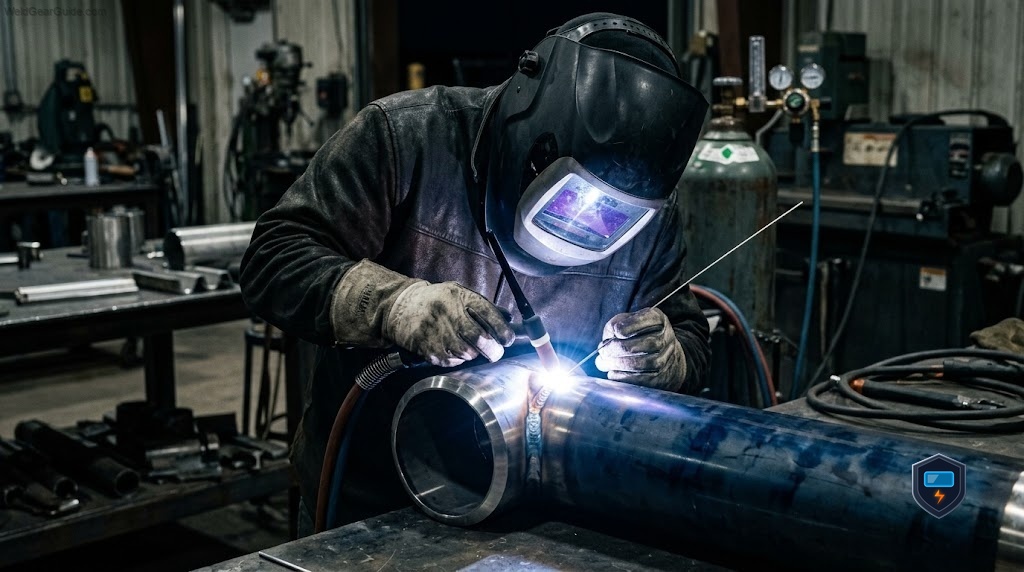
GTAW stands for gas tungsten arc welding, the formal designation used in codes and certifications. Its common name is TIG, tungsten inert gas. Both refer to the same process: a non-consumable tungsten electrode creates an electric arc that melts the base metal, an inert shielding gas (almost always argon) protects the tungsten and molten puddle from the air, and filler metal is added by hand when the joint needs it.
The defining feature is that the electrode does not melt into the weld. It only makes the arc. That separation of arc and filler is the source of everything GTAW does well.
How the process works
The welder holds a torch containing the tungsten electrode. When the arc starts, it jumps from the tungsten to the workpiece, creating intense, focused heat that forms a molten puddle. Inert gas flows continuously from the torch cup, shielding the weld zone.
When filler is needed, the welder feeds a rod into the leading edge of the puddle with the other hand, a little at a time. Amperage is usually controlled with a foot pedal, so heat can be ramped up to start and tapered down to finish. That is three coordinated actions at once, torch, filler and pedal, which is why GTAW takes the most practice of the common processes.
The strengths
The cleanest welds in welding. No spatter, no slag, and the neatest beads available. When a weld will be seen or must be exact, GTAW is the answer.
Precision and control. Managing arc, filler and heat independently gives command over the weld that no other common process matches.
Thin material. Fine heat control lets GTAW weld very thin sheet without blowing through.
Many metals. Steel, stainless, aluminum, chrome-moly, titanium, copper and magnesium. On AC it welds aluminum cleanly, a signature strength.
High-quality, high-integrity welds. For critical work, aerospace, nuclear, food and medical, GTAW’s control and cleanliness make it the process of choice.
The limitations
A steep learning curve. Coordinating three tasks at once makes GTAW the hardest common process to master.
Slow. Adding filler a dab at a time is deliberate and unhurried, not suited to high-volume production.
Fussy about cleanliness. GTAW is intolerant of contamination; metal must be clean, and drafts that blow away the shielding gas ruin welds, so it is largely an indoor process.
Higher cost. AC/DC machines that handle aluminum cost more than comparable MIG units, and the slow process adds labor.
The metals and where GTAW is used
GTAW welds virtually all weldable metals, and it is chosen wherever quality and precision outweigh speed:
- Aerospace and defense, for high-integrity welds.
- Food, dairy, pharmaceutical and medical, for clean, corrosion-resistant stainless.
- Motorsports and automotive, for aluminum and thin-wall tubing.
- Art, architecture and custom fabrication, where the weld is visible.
- Pipe and tube welding, especially root passes on critical systems.
Getting started with GTAW
A typical starter setup is an AC/DC machine (for aluminum capability), a stock of versatile 2% lanthanated tungsten, filler rod matched to your metals like ER70S-2 for steel, argon gas, a quality air-cooled TIG torch, thin TIG gloves and an auto-darkening helmet. From there, the path is practice: beads without filler, then filler on flat plate, then joints, then aluminum on AC.
The verdict
GTAW, gas tungsten arc welding, is the precise, clean, controllable benchmark of the welding trade: a non-consumable tungsten electrode, an inert gas shield, and filler added by hand under fine heat control. It is the same process as TIG, and its precision and difficulty both come from separating the arc, the filler and the heat.
Three things sum it up. Its strengths, the cleanest welds available, precision, thin-metal and multi-metal capability, and high-integrity results, make it the process of choice wherever quality outweighs speed. Its limits, a steep learning curve, slow pace, fussiness about cleanliness and higher cost, make it the wrong tool for fast, rough, high-volume work. And it welds virtually all metals, which is why it appears in aerospace, food and medical, motorsports, art and critical pipe work alike.
Learn GTAW and you have learned the demanding heart of welding. It rewards the patience it demands with welds nothing else can match.
Frequently asked questions
What does GTAW stand for? Gas tungsten arc welding. It is the formal name for the process commonly called TIG (tungsten inert gas). Both terms describe the same process, machine and skill.
How does GTAW work? A non-consumable tungsten electrode creates an arc that melts the base metal, an inert gas (usually argon) shields the weld, and filler is added by hand into the puddle. Amperage is typically controlled with a foot pedal.
Why is GTAW considered the hardest welding process? Because it requires coordinating three tasks at once, holding the torch, feeding filler by hand, and controlling heat with a foot pedal, while keeping a clean, steady arc. That coordination takes significant practice.
What metals can GTAW weld? Steel, stainless steel, aluminum, chrome-moly, titanium, copper and magnesium, among others. On AC it welds aluminum cleanly. GTAW handles virtually all weldable metals.
Why does GTAW produce such clean welds? The process separates the arc, filler and heat into independently controlled elements, uses an inert gas shield, and produces no spatter or slag, resulting in the neatest, most precise welds of the common processes.
Where is GTAW used? Aerospace and defense, food, dairy, pharmaceutical and medical equipment, motorsports and automotive, art and architecture, and critical pipe and tube welding, wherever quality and precision outweigh speed.
Is GTAW slower than other processes? Yes. Adding filler by hand a small amount at a time makes GTAW deliberate and slow compared with MIG’s continuous wire feed, so it is not suited to high-volume production.
What do I need to start GTAW welding? An AC/DC machine for aluminum capability, tungsten electrodes, filler rod matched to your metals, argon gas, a TIG torch, thin TIG gloves and an auto-darkening helmet, then practice in stages from beads to joints to aluminum.
References
- Wikipedia, Gas tungsten arc welding
- Miller Electric, How a TIG Welder Works and When to TIG Weld
- Lincoln Electric, Square Wave TIG 200 TIG Welder specifications