HVAC Brazing Rod: What the Pros Use on Refrigerant Lines
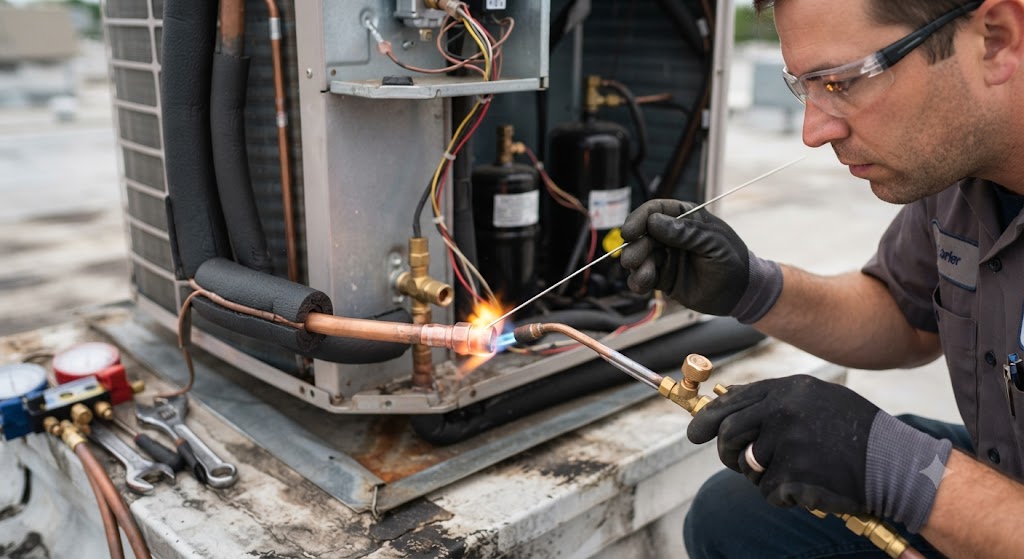
Watch an HVAC tech braze a refrigerant line and you will notice they are fussy in ways that seem like overkill: a specific rod, a tank of nitrogen hissing through the tubing, careful heat. There is a reason for every bit of it. A refrigerant line runs under pressure, vibrates with the compressor, and must stay perfectly clean inside, because a flake of oxide scale can wreck an entire system. The rod they choose is built for exactly those demands.
The standard HVAC brazing rod is a phos-copper-silver alloy, most commonly 15 percent silver (BCuP-5), prized because it is ductile enough for vibrating lines, has a wide melting range that fills gaps, and self-fluxes on copper. Here is what the pros use, why, and the practices that go with it.
Why HVAC needs a specific rod
Refrigerant lines make unusual demands that ordinary brazing does not always face:
- Pressure: the joint must hold refrigerant under pressure without leaking.
- Vibration: compressor and AC lines vibrate constantly, so the joint needs ductility to resist fatigue cracking.
- Internal cleanliness: any oxide scale inside the tubing can circulate and damage the compressor and metering devices.
A phos-copper-silver rod meets these demands. The silver adds ductility for vibration, the wide melting range fills the small gaps in tubing joints, and the phosphorus self-fluxes on copper so there is no flux residue left inside a copper-to-copper joint.
Direct answer: which HVAC brazing rod to use
The workhorse choices:
- Copper to copper, vibrating lines (most refrigerant and AC work): a 15 percent silver phos-copper rod (BCuP-5, such as Stay-Silv 15 or Sil-Fos 15). Self-fluxing on copper, ductile, gap-filling.
- Copper to copper, lower demand or tighter joints: a lower-silver phos-copper rod (2 to 5 percent silver, BCuP-3 or BCuP-6), still self-fluxing on copper.
- Copper to brass or dissimilar fittings: a phos-copper-silver rod plus flux on the brass side.
- Copper to steel: not phos-copper, since phosphorus embrittles steel; use a silver BAg rod with flux.
For most refrigerant and AC line work, the 15 percent silver phos-copper rod is the reliable default, with lower-silver rods used where vibration and gaps are less of a concern.
Why 15 percent silver is the sweet spot
Silver content is a balancing act, and 15 percent hits a sweet spot for HVAC. More silver lowers the melting range, improves flow, and adds ductility, all of which help on vibrating, pressurized lines with imperfect gaps. The 15 percent silver phos-copper rod has a wide melting range (roughly a solidus around 1,190 degrees Fahrenheit and liquidus around 1,475 degrees Fahrenheit), which lets it fill gaps rather than demanding a perfect fit, and it stays ductile against compressor vibration. Lower-silver rods (2 to 5 percent) are used for less demanding joints, while 15 percent is the go-to for critical and vibrating connections. All of them self-flux on copper-to-copper joints.
The nitrogen purge: not optional
Here is the practice that separates a proper HVAC braze from a system-killer. When you heat copper in open air, the inside of the tubing forms copper oxide scale, a black, flaky layer. In a sealed refrigerant system that scale breaks loose and circulates, clogging metering devices and damaging the compressor. To prevent it, techs flow a low, steady stream of dry nitrogen through the tubing while brazing, which displaces oxygen so no internal scale forms. Skipping the nitrogen purge is one of the most damaging shortcuts in HVAC work, because the harm is hidden inside the lines and shows up later as a failed system.
Copper to copper vs dissimilar joints
Knowing when you need flux keeps your joints sound:
- Copper to copper: the phosphorus self-fluxes, so no separate flux is needed, which is ideal since there is no residue inside the line.
- Copper to brass (some service valves and fittings): the brass contains zinc that phosphorus does not clean well, so use flux on the brass side.
- Copper to steel: do not use phos-copper rods, because phosphorus makes brittle joints on ferrous metal. Use a silver BAg rod with flux.
Most line work is copper to copper, which is why the self-fluxing phos-copper-silver rod is so convenient for the trade.
Which HVAC brazing rods to buy
Here are dependable options for refrigerant and AC line work.
- Harris Stay-Silv 15 phos-copper-silver brazing rod (BCuP-5) is the industry-standard 15 percent silver rod for refrigerant and AC lines, ductile for vibration with a wide melting range that fills gaps, and self-fluxing on copper. Its limitation is that, as a phos-copper rod, it must not be used on steel.
- 15% silver brazing rods,AWS BCuP-5 are another 15 percent silver phos-copper option that flows into copper joints by capillary action for clean, ductile connections. The same phos-copper caution applies: copper and brass only.
- Harris 0 phos-copper brazing rod is a silver-free copper-to-copper rod for tight, lower-demand joints, self-fluxing on copper. The trade-off is a higher melting range and less gap-filling ductility, so it wants close-fitting joints and is less forgiving on vibrating lines than a silver-bearing rod.
How to choose: for critical, vibrating refrigerant and AC lines, use a 15 percent silver phos-copper rod. For tight, lower-demand copper joints, a silver-free or lower-silver rod works. Flux the brass side of dissimilar joints, and always purge with nitrogen.
Who should skip phos-copper rods: anyone joining copper to steel, who needs a silver BAg rod with flux to avoid a brittle joint.
The bottom line
The HVAC standard is a phos-copper-silver brazing rod, most often 15 percent silver (BCuP-5), because it is ductile enough for vibrating refrigerant lines, fills gaps with its wide melting range, and self-fluxes on copper. Lower-silver rods handle less demanding joints, and copper-to-steel needs a silver BAg rod instead. Beyond the rod, the practices matter just as much: flux the brass side of dissimilar joints, and always purge the lines with nitrogen to keep the inside of the tubing clean.
FAQ
What brazing rod is used for HVAC refrigerant lines? A phos-copper-silver rod, most commonly 15 percent silver (BCuP-5, such as Stay-Silv 15 or Sil-Fos 15). It is ductile for vibrating lines, fills gaps with its wide melting range, and self-fluxes on copper-to-copper joints.
Why is 15 percent silver used for HVAC brazing? Fifteen percent silver balances flow, a wide gap-filling melting range, and ductility for compressor and AC line vibration. Lower-silver rods (2 to 5 percent) work for less demanding joints, but 15 percent is the go-to for critical, vibrating connections.
Do you need flux to braze HVAC copper lines? Not for copper-to-copper joints, because the phosphorus in phos-copper-silver rods self-fluxes. You do need flux on the brass side of copper-to-brass joints, such as some service valves and fittings.
Why purge with nitrogen when brazing refrigerant lines? Heating copper in open air forms copper oxide scale inside the tubing, which can break loose and damage the compressor and metering devices. Flowing dry nitrogen through the lines while brazing prevents that internal scale from forming.
Can you use HVAC brazing rod on steel? No. Phos-copper rods embrittle steel and iron because of the phosphorus. To join copper to steel, use a silver BAg rod with the proper flux instead of a phos-copper rod.
What is the difference between Sil-Fos and Stay-Silv? Both are phos-copper-silver brazing alloys used in HVAC. Sil-Fos is Harris’s trade name for its phos-copper-silver alloys, and Stay-Silv is a related Harris line. A 15 percent silver version of either (BCuP-5) is a common refrigerant-line choice.
References
- Harris Products Group, Stay-Silv and Sil-Fos phos-copper-silver alloy documentation, including 15 percent silver melting ranges and HVAC applications (manufacturer), harrisproductsgroup.com.
- ASHRAE and HVAC industry guidance on brazing copper refrigerant lines and nitrogen purging (industry standard practice), ashrae.org.
- American Welding Society AWS A5.8 classification for BCuP phos-copper filler metals, aws.org.