Lincoln Electric Welding Rods: The Complete Guide
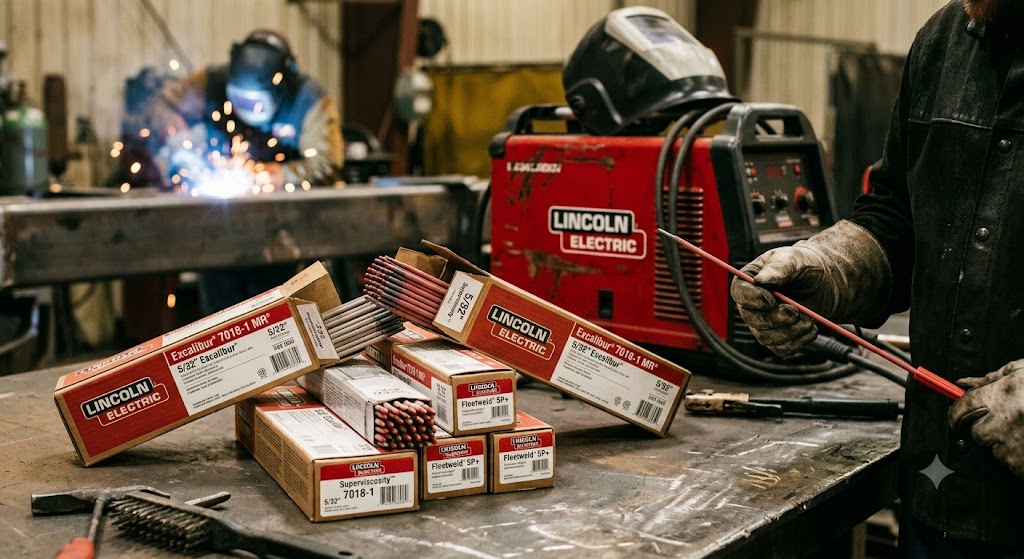
Ask a welding instructor which rods to learn on and Lincoln Electric comes up again and again. The company has been making stick electrodes for over a century, and its Fleetweld and Excalibur lines are fixtures in classrooms, farm shops, and pipeline rigs alike. When you buy a Lincoln rod, you are buying a known quantity, which is exactly why so many welders never bother switching.
Lincoln Electric’s main stick electrode lines are Fleetweld (covering the everyday 6010, 6011, and 6013 rods) and Excalibur (its premium 7018 low-hydrogen rod), each carrying trade names like Fleetweld 5P+, Fleetweld 180, Fleetweld 37, and Excalibur 7018 MR. Choosing among them is really about matching the rod type to your job, with Lincoln’s consistency as the throughline. Here is the lineup decoded.
Decoding the Lincoln names
Lincoln gives its rods trade names on top of the AWS classification, which confuses newcomers. Here is the translation for the core lineup:
- Fleetweld 5P+ (E6010): the deep-penetration, cellulosic pipe rod, DC only, famous for pipeline root passes.
- Fleetweld 180 (E6011): the AC-capable deep-penetration rod for dirty, galvanized, or coated steel on small AC welders.
- Fleetweld 37 (E6013): the easy, mild-steel rutile rod for sheet metal and low open-circuit-voltage AC machines.
- Excalibur 7018 MR (E7018): the premium low-hydrogen structural rod, with a moisture-resistant coating.
Once you know Fleetweld equals the 60-series workhorses and Excalibur equals the premium 7018, the shelf stops being intimidating.
Direct answer: which Lincoln rod for your job?
Match the Lincoln rod to your metal and machine:
- Pipe root passes or deep penetration on a DC machine: Fleetweld 5P+ (E6010).
- Dirty, rusty, galvanized, or coated steel, especially on an AC welder: Fleetweld 180 (E6011).
- Thin, clean sheet metal or general light work, especially on small AC machines: Fleetweld 37 (E6013).
- Strong, structural, or crack-sensitive welds on clean steel: Excalibur 7018 MR (E7018).
The logic is the same as choosing any stick rod: penetration and dirty-metal ability from the 6010 and 6011, easy clean-metal welds from the 6013, and structural strength from the 7018. Lincoln’s versions are simply well-made, consistent examples of each.
Why welders trust the Lincoln name
Consistency is the real selling point. Lincoln rods tend to run the same way box after box, which matters when you are learning (so the rod is not the variable) and when you are producing (so results are repeatable). The Excalibur 7018 MR earns particular praise for clean arc starts, excellent bend ability, and strong moisture resistance, the MR designation meaning the low-hydrogen coating tolerates air exposure longer than ordinary 7018. Lincoln also publishes detailed specification sheets, so you can look up exact amperage ranges and mechanical properties for each rod and diameter.
That combination of consistency and documentation is why Lincoln is a default choice in training programs and professional shops.
The MR advantage on 7018
One Lincoln feature worth calling out is the MR (moisture resistant) coating on the Excalibur 7018. All 7018 rods are low-hydrogen and absorb moisture from the air, and moisture undermines their strength benefit and invites hydrogen cracking. The MR coating tolerates exposure longer than standard 7018, which is a real advantage for welders who cannot store rods in a heated rod oven. It does not make the rods immune to moisture, so you still store them dry, but it buys you more margin, which is why the Excalibur line is popular with field welders and home shops alike.
Which Lincoln rods to buy
Here are dependable Lincoln options across the core types.
- Lincoln Electric Fleetweld 5P+E6010 electrodes are the go-to deep-penetration pipe rod for DC machines, with the fast-freeze, digging arc pipeliners rely on for root passes. The limitation is that it runs on DC only and has a demanding arc, so beginners on AC machines should choose Fleetweld 180 instead.
- Lincoln Electric Fleetweld 37 E6013 electrodes are an easy-running choice for thin, clean sheet metal and small AC welders, with excellent bead appearance and forgiving arc starts. The trade-off is light penetration, so they are not for thick or structural joints.
- Lincoln Excalibur 7018 MR electrodes are the premium pick for strong, structural welds on clean steel, adding the moisture-resistant coating and clean arc starts Lincoln is known for. The catch is the same as any 7018: keep them dry, though the MR coating gives you more margin.
How to build a Lincoln rod kit: start with Fleetweld 180 (6011) for dirty repairs and Excalibur 7018 MR for strong clean welds, add Fleetweld 37 (6013) for thin sheet metal, and add Fleetweld 5P+ (6010) if you run a DC machine and weld pipe. That mirrors the standard stick rod kit, built from one trusted brand.
Who should skip a particular Lincoln rod: AC-only welders can skip the DC-only Fleetweld 5P+ (6010) and use Fleetweld 180 (6011) for deep penetration instead.
The bottom line
Lincoln Electric’s rod lineup is easy once you translate the names: Fleetweld covers the everyday 6010, 6011, and 6013, and Excalibur is the premium 7018. Match the type to your job the same way you would with any brand, and let Lincoln’s consistency and detailed specs work in your favor. For the 7018, the MR coating is a genuine advantage if your storage is not ideal. Buy the types your work needs and you are welding with a century of refinement behind the arc.
FAQ
What are Lincoln Electric’s main welding rod lines? Fleetweld covers the everyday 60-series rods (Fleetweld 5P+ is E6010, Fleetweld 180 is E6011, Fleetweld 37 is E6013), and Excalibur is the premium E7018 low-hydrogen rod, sold as Excalibur 7018 MR.
Which Lincoln rod is best for beginners? Fleetweld 37 (E6013) is the easy, forgiving rod for thin, clean metal and small AC welders, making it a good learning rod. Add Fleetweld 180 (E6011) for dirty metal and Excalibur 7018 for strong welds as you progress.
What does MR mean on Lincoln 7018? Moisture resistant. The coating tolerates air exposure longer than standard 7018, which helps welders who cannot store rods in a heated oven. You still store them dry, but the MR coating gives more margin.
What is Fleetweld 5P+? Lincoln’s E6010 cellulosic stick electrode, a deep-penetration rod that runs on DC only and is favored for pipe root passes and dirty steel. For AC machines, use Fleetweld 180 (E6011) instead.
Are Lincoln rods good for pipe welding? Yes. Fleetweld 5P+ (E6010) is a classic pipe root rod on DC machines, and welders often follow the root with a 7018 fill and cap. Lincoln’s consistency is valued for pipe work.
Where can I find amperage settings for Lincoln rods? Lincoln publishes detailed specification sheets for each rod and diameter with amperage ranges and mechanical properties. Always confirm settings against the box or the published spec sheet.
References
- Lincoln Electric, Fleetweld 5P+, Fleetweld 180, Fleetweld 37, and Excalibur 7018 MR product pages and specification sheets (manufacturer), lincolnelectric.com.
- Lincoln Electric stick electrode selection and low-hydrogen storage guidance (manufacturer documentation).
- American Welding Society AWS A5.1 carbon steel covered electrode classification, aws.org.