
MIG Wire Size Chart: Choosing the Right Diameter
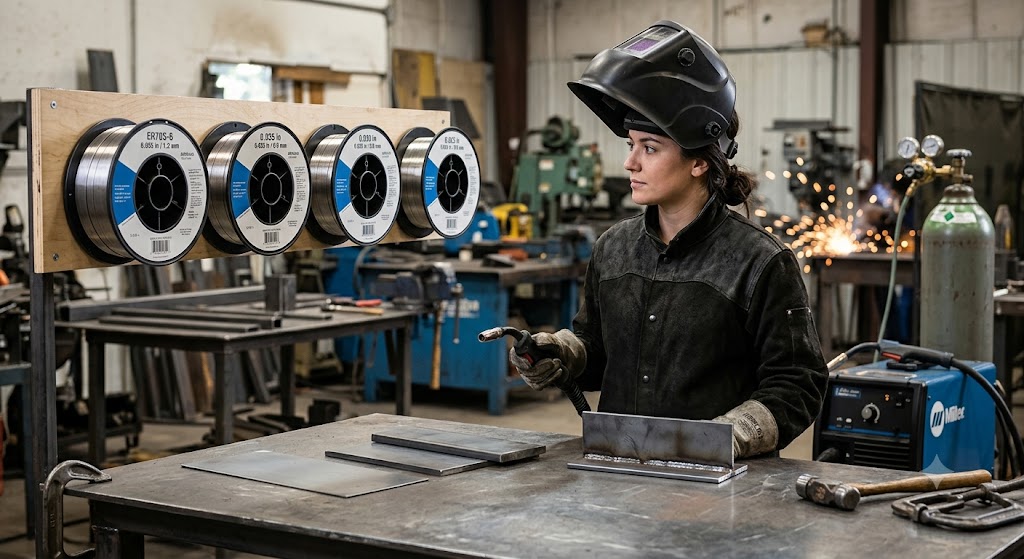
Grab the wrong diameter MIG wire and the symptoms show up immediately: burn-through and warping if the wire is too thin for a hot weld, or a cold, ropey bead that will not tie in if the wire is too thick for a low setting. Wire diameter is one of the quietest settings on a MIG welder and one of the most important, because it sets the whole range of thicknesses your machine can handle well.
MIG wire size refers to the wire’s diameter, with the common options being .023, .030, .035, and .045 inch, and each size suits a range of material thickness and amperage. As a rule of thumb, thinner wire welds thinner metal at lower amperage and thicker wire welds thicker metal at higher amperage. Here is the chart and how to use it.
Why wire diameter matters
Wire diameter controls how much current the wire can carry, how much metal it deposits, and how deeply the weld penetrates. A thin wire concentrates less heat, so it welds thin sheet without blowing through. A thick wire carries more current and lays down more metal, so it fills thicker joints faster but would melt straight through thin sheet. Picking the diameter is really picking the thickness range you want your machine to be good at.
The practical upshot: choose the size that best fits the thickness you weld most often, since one size cannot do everything well.
MIG wire size chart
These ranges are typical starting points for solid mild steel wire; your machine and joint will shift them.
| Wire diameter | Material thickness | Typical amperage |
|---|---|---|
| .023 inch | 24 gauge to 1/8 inch | about 30 to 130 amps |
| .030 inch | 20 gauge to 1/4 inch | about 40 to 145 amps |
| .035 inch | 14 gauge to 1/4 inch and up | about 50 to 180 amps |
| .045 inch | 1/8 inch and thicker | about 75 to 250 amps |
Notice the overlap: .030 and .035 inch together cover most of what a home welder does, which is why they are the two most popular sizes. The .023 inch size is the specialist for very thin sheet, and .045 inch is for heavy industrial work.
Direct answer: which size should you pick?
Match wire diameter to the thickness you weld most:
- Auto body and thin sheet metal: .023 inch, for minimal burn-through on light gauge.
- General home and hobby work: .030 inch, the most versatile size, good from thin sheet up to about 1/4 inch.
- Heavier fabrication and thicker steel: .035 inch, which handles general work and steps up to thicker material.
- Thick industrial welding: .045 inch, for high-amperage production.
If you can only stock one size, .030 inch is the best all-rounder for most home machines. If you often jump between thin and thick, keep both .030 and .035 inch on hand.
The rules of thumb that keep you close
Two simple guidelines get you in the right zone before fine-tuning:
- Amperage from thickness: roughly 1 amp per .001 inch of material thickness. So 1/8 inch (.125 inch) steel wants about 125 amps, which points you toward .030 or .035 inch wire.
- Flux core runs one size larger: because flux-cored wire deposits differently, use about .045 inch flux core where you would use .035 inch solid wire for similar material.
These are starting points, not gospel. Always test on scrap of the same thickness and adjust wire feed speed and voltage until the arc sounds steady and the bead ties in cleanly.
Do not forget the contact tip
Here is the detail that causes mysterious feeding problems: your contact tip must match the wire diameter exactly. A .030 inch wire needs a .030 inch tip, and a .035 inch wire needs a .035 inch tip. Run the wrong tip and you get erratic arcs, poor feeding, and burnbacks. When you change wire size, change the tip and the drive rolls to match, and set the wire feed speed for the new diameter.
Which MIG wire to buy
Start with the two most useful home sizes in a quality ER70S-6.
- INEFIL ER70S-6 MIG wire (.030 inch, 10 lb spool) is the versatile everyday size, welding thin sheet up to about 1/4 inch cleanly with shielding gas. Its limitation is that very thick steel is better served by a larger diameter at higher amperage.
- PGN ER70S-6 MIG wire (.035 inch, 10 lb spool) steps up for general to heavier work, carrying more current and filling thicker joints faster. The trade-off is that on very thin sheet metal it is easier to burn through than .030 or .023 inch.
How to choose: for a single do-everything spool on a home machine, go .030 inch. If you regularly weld 3/16 inch and thicker, add .035 inch. For auto body and light gauge, keep a spool of .023 inch. And always match your contact tip to the wire.
Who should skip .045 inch wire: home and hobby welders, whose machines rarely reach the amperage that thick wire needs. Reserve .045 inch for high-amperage industrial machines.
The bottom line
MIG wire diameter sets the thickness range your machine handles well: .023 inch for thin sheet, .030 inch as the versatile all-rounder, .035 inch for heavier work, and .045 inch for thick industrial jobs. Match the size to the metal you weld most, lean on the 1 amp per .001 inch rule to get close, remember flux core runs a size larger, and always match your contact tip to the wire. Get the diameter right and the rest of your settings fall into place.
FAQ
What are the common MIG wire sizes? The common diameters are .023, .030, .035, and .045 inch. For most home welders, .030 and .035 inch cover the majority of work, with .023 inch for thin sheet and .045 inch for heavy industrial jobs.
What size MIG wire for 1/8 inch steel? Around .030 or .035 inch works well for 1/8 inch steel. Using the 1 amp per .001 inch rule, 1/8 inch (.125 inch) points to about 125 amps, which suits those diameters.
What is the best all-around MIG wire size? .030 inch is the most versatile size for home and hobby welding, handling thin sheet up to about 1/4 inch. If you often weld thicker steel too, keep .035 inch on hand as well.
What size wire for auto body and sheet metal? .023 inch is the go-to for thin sheet metal and auto body work because it welds light gauge with minimal burn-through.
Does the contact tip have to match the wire size? Yes. The contact tip must match the wire diameter exactly (.030 wire needs a .030 tip). A mismatch causes erratic arcs, poor feeding, and burnbacks.
Is flux-cored wire sized the same as solid wire? Flux-cored wire generally runs one size larger for equivalent material, so use about .045 inch flux core where you would use .035 inch solid wire. Match the diameter to your material and machine.
References
- Miller Electric, MIG welding: setting the correct parameters, including wire size versus amperage ranges (manufacturer), millerwelds.com.
- Yaskawa / Motoman and Baker’s Gas welding wire size charts by material thickness (industry references).
- Lincoln Electric MIG (GMAW) wire and contact tip selection guidance, lincolnelectric.com.