Tungsten Electrode Sharpener: Do You Need One?
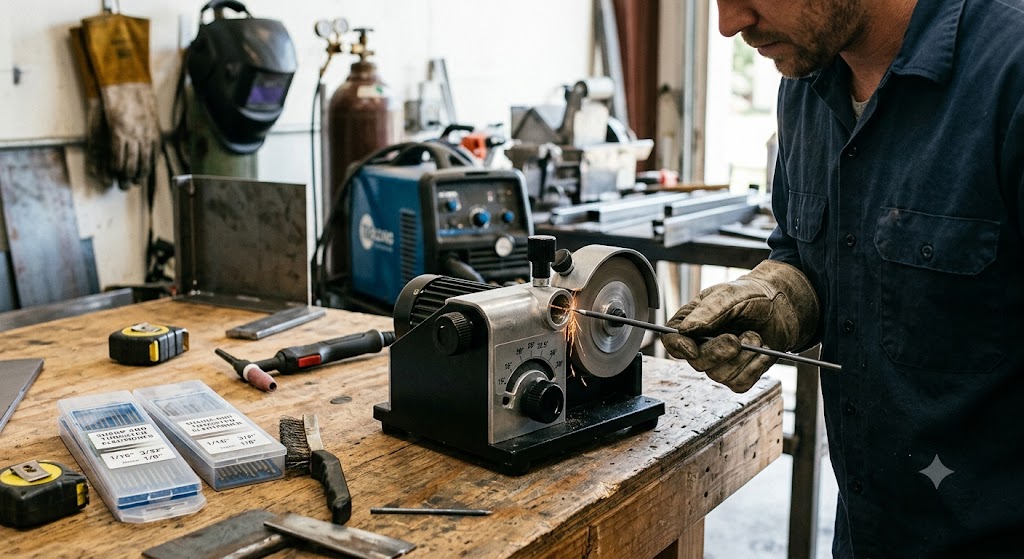
The way you grind your tungsten shows up in the weld. Grind it right and the arc is tight, focused, and starts where you point it. Grind it wrong, with radial scratch marks running around the tip, and the arc wanders, wobbles, and dances off target like it has a mind of its own. That is why serious TIG welders get particular about how they sharpen tungsten, and why a dedicated sharpener is one of the small tools that punches above its weight.
A tungsten electrode sharpener is a purpose-built grinder, usually with a diamond wheel, that grinds a consistent, repeatable point on your tungsten with the grind marks running lengthwise for a stable arc. You do not strictly need a dedicated one, but it makes a real difference in arc quality, consistency, and safety compared with a bench grinder. Here is what to know and how to choose.
Why how you grind matters
The direction of the grind marks is the single most important thing, and it is where casual grinding goes wrong. When you grind tungsten across its width (radially), the tiny grooves run around the electrode, and the arc tends to follow them and wander. When you grind lengthwise (along the electrode, parallel to its length), the grind marks run straight to the tip, and the arc stays focused and stable. A dedicated sharpener is built to grind lengthwise automatically, which is the whole point.
That one detail, longitudinal versus radial grinding, is why a tungsten ground on a random bench grinder often welds worse than the same tungsten ground on a proper sharpener.
Direct answer: do you need a dedicated sharpener?
You do not absolutely need one, but you will benefit from one if you TIG weld regularly. Here is the honest breakdown:
- Get a dedicated sharpener if you TIG often, want consistent arc quality, care about repeatable point angles, or weld with thoriated tungsten (a sharpener with a shield helps contain the radioactive dust).
- A bench grinder can work if you weld only occasionally, understand you must grind lengthwise, and dedicate a wheel to tungsten only so you do not contaminate the tip with other metals.
For anyone past the occasional weld, a dedicated sharpener pays off in cleaner starts, less wasted tungsten, and a more stable arc.
Getting the angle right
The point angle you grind affects how the arc behaves, and it should match your amperage:
- A sharper, longer point (narrow angle) concentrates the arc for low amperage and thin material, giving precise, focused control.
- A blunter point or a small flat (truncated tip) handles higher amperage without the tip eroding, and holds up better on thicker metal.
A common approach is to grind the taper roughly 2 to 2.5 times the electrode diameter in length, sharper for low amps and blunter for high amps. Many dedicated sharpeners let you set and repeat a specific angle, which is a real advantage over freehanding on a grinder.
Why a diamond wheel
Tungsten is extremely hard (it has the highest melting point of any metal), and grinding it on a standard abrasive wheel wears the wheel quickly and grinds slowly. A diamond wheel cuts tungsten cleanly and lasts, which is why dedicated tungsten sharpeners use them. A diamond wheel also produces a finer, cleaner tip, which contributes to better arc starts. If you do go the bench grinder route, at minimum keep a dedicated fine wheel for tungsten only.
Which tungsten sharpener to buy
Here are options from compact handheld units to angle-setting grinders.
- SONNLER tungsten electrode sharpener with rotary tool is a convenient handheld set that pairs an angle guide with a rotary grinder, good for shop or field use where portability matters. Its limitation is that a compact handheld unit is less rigid than a bench-style sharpener for high-volume grinding.
- PZLVAME tungsten electrode sharpener grinder head with diamond wheel uses a high-hardness diamond wheel to grind tungsten cleanly and can also cut electrodes to length. The trade-off is that a grinder head attaches to a rotary tool, so you need a compatible tool to drive it.
- 3mirrors aluminum-body tungsten electrode sharpener offers multiple preset angles and a horizontal hole for cleaning up tungsten that has picked up metal during welding, useful for repeatable results. As a multi-angle unit it is a bit more setup than a single-angle grinder for someone who only ever grinds one angle.
How to choose: for regular TIG work, a sharpener that sets a repeatable angle and grinds lengthwise with a diamond wheel is the sweet spot. For occasional use or field grinding, a compact handheld unit is fine. Whatever you pick, grind lengthwise and match the angle to your amperage.
Who should skip a dedicated sharpener: someone who TIG welds only rarely and is disciplined about grinding lengthwise on a clean, dedicated wheel. Everyone welding regularly benefits from a purpose-built unit.
The bottom line
A tungsten electrode sharpener is not strictly required, but it earns its place fast if you TIG regularly. The reason is the grind direction: a dedicated sharpener grinds lengthwise for a focused, stable arc, uses a diamond wheel to cut hard tungsten cleanly, and lets you set a repeatable angle matched to your amperage. A dedicated wheel on a bench grinder can substitute in a pinch if you grind lengthwise and keep it tungsten-only, but for consistent arc quality and safer grinding of thoriated tungsten, a purpose-built sharpener is worth it.
FAQ
Do I need a dedicated tungsten sharpener? Not strictly, but you will benefit from one if you TIG weld regularly. It grinds lengthwise for a stable arc, sets repeatable angles, and (with a shield) helps contain thoriated tungsten dust. Occasional welders can use a dedicated bench grinder wheel if they grind lengthwise.
What angle should I grind tungsten to? Match the angle to your amperage. A sharper, longer point (narrow angle) suits low amperage and thin material for precise control, while a blunter point or small flat handles higher amperage without eroding. A taper about 2 to 2.5 times the electrode diameter is a common starting point.
Can you sharpen tungsten with a regular bench grinder? Yes, if you grind lengthwise (along the electrode, not across it) and dedicate a clean wheel to tungsten only to avoid contamination. A dedicated sharpener does this more consistently and contains dust better, especially for thoriated tungsten.
Why do I need to grind tungsten lengthwise? Grinding across the electrode leaves grooves that run around the tip, and the arc tends to follow them and wander. Grinding lengthwise leaves marks running straight to the tip, which keeps the arc focused and stable.
Why use a diamond wheel for tungsten? Tungsten is extremely hard, so a standard abrasive wheel wears quickly and grinds slowly. A diamond wheel cuts tungsten cleanly, lasts longer, and produces a finer tip for better arc starts.
Is grinding thoriated tungsten dangerous? Thorium is radioactive, and grinding creates dust you should not breathe or ingest. Use proper ventilation and dust collection, and a dedicated sharpener with a shield helps contain the dust. Many welders use lanthanated or ceriated to avoid the concern.
References
- Miller Electric, tungsten preparation and grinding guidance for TIG welding (manufacturer), millerwelds.com.
- The Fabricator, guidelines for tungsten electrode preparation and grinding direction (industry publication), thefabricator.com.
- Lincoln Electric TIG (GTAW) electrode preparation guidance (manufacturer), lincolnelectric.com.