Welding Rod Buying Guide: Stick Electrodes Explained
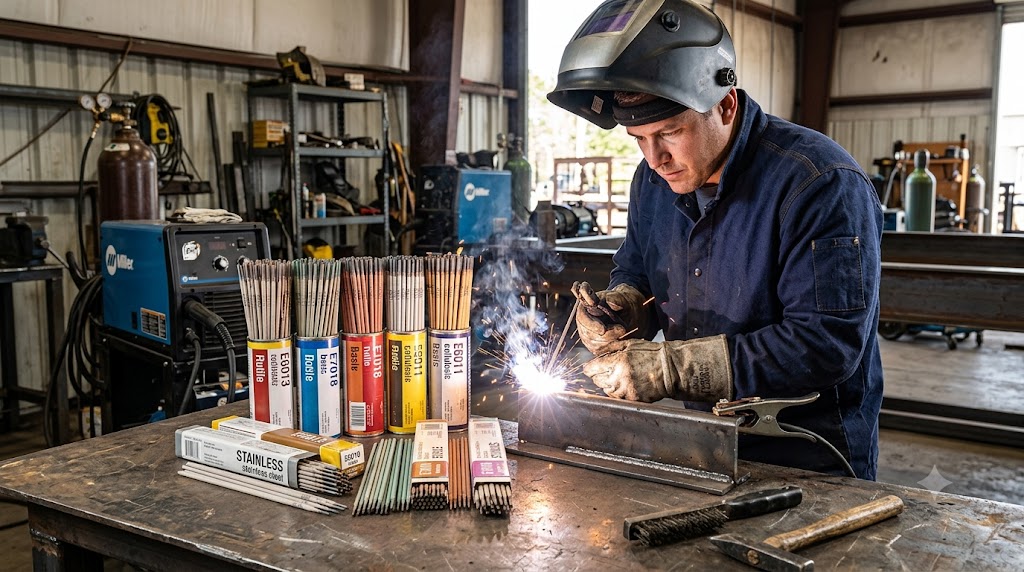
The first time you stand in front of a wall of welding rod, the numbers blur together. 6010, 6011, 6013, 7018, each in three or four diameters, each in a box that looks nearly identical to the one beside it. Grab the wrong one and your first bead either sticks the rod to the plate like glue or runs so hot it blows through. The good news is that those four-digit numbers are not random. Once you can read them, choosing a rod stops being a guessing game.
A welding rod, or stick electrode, is a metal filler rod coated in flux that both adds metal to your joint and shields the weld as it cools. The four-digit classification tells you the rod’s strength, the positions it can weld, and the coating and current it likes. This guide breaks down what the numbers mean and walks through the rods most people actually reach for, so you can match the electrode to the job instead of the label.
How to read the numbers
Every stick electrode carries an AWS classification like E7018. Here is what each part tells you:
- E stands for electrode.
- The first two digits (or three on a five-digit number) give the minimum tensile strength in thousands of pounds per square inch. So 60 means 60,000 PSI, and 70 means 70,000 PSI.
- The third digit tells you the welding positions the rod can run. A 1 means all positions, including vertical and overhead. A 2 means flat and horizontal only.
- The fourth digit describes the flux coating and the type of current the rod runs best on, such as AC, DC electrode positive, or DC electrode negative.
So E7018 reads as a 70,000 PSI electrode, all-position, with a low-hydrogen coating. E6011 reads as a 60,000 PSI electrode, all-position, with a coating that runs on AC and DC and digs deep. Once you internalize that, the wall of boxes turns into a menu.
The four rods you will meet most
E6010: the pipeliner’s deep-digging rod
6010 runs on DC electrode positive only and is famous for deep penetration and a fast-freezing puddle, which is why it dominates pipeline root passes. It bites through light surface contamination and gives that tight, snappy arc pipe welders love. The catch is that it demands DC and has a stiff, aggressive arc that is unforgiving for beginners, and it is not the rod to learn on if your machine is AC only.
E6011: the do-anything, run-anywhere rod
6011 is essentially the AC-capable cousin of 6010. It offers similar deep penetration and the same ability to cut through rust, paint, dirt, and galvanized coatings, but it runs on both AC and DC. That single difference makes it the go-to for anyone with an AC buzzbox or a basic stick machine, and for farm and repair work on metal that is anything but clean. Its flaw is a rougher, more spattery arc and a less tidy bead than a low-hydrogen rod. If your work needs to look pretty or meet strict structural specs, 6011 is not it.
E6013: the beginner’s best friend
6013 lights easily, runs a soft and stable arc, and lays a smooth bead with minimal spatter, which makes it the rod most people should learn on. It is ideal for thin mild steel and sheet metal and runs on AC or DC. The trade-off is shallow penetration, so it is not built for thick sections or high-strength structural joints. Learn on it, then graduate.
E7018: the structural workhorse
7018 is the low-hydrogen, all-position rod that structural and heavy fabrication work is built on. It runs a smooth arc, leaves a beautiful bead, and produces strong, crack-resistant 70,000 PSI welds. The trade-off is fussiness: its flux coating absorbs moisture from the air, and a damp 7018 rod can put hydrogen into the weld and cause cracking, so it needs to be kept dry, ideally in a rod oven. It also prefers clean metal, unlike the dirt-eating 6011.
Which rod for which job
- Learning to weld on thin mild steel: start with E6013 for its forgiving arc.
- Farm, ranch, and repair on rusty or painted steel with an AC machine: E6011 for its penetration and tolerance of dirty metal.
- Pipeline or deep-penetration root passes on a DC machine: E6010.
- Structural, heavy, or code work needing strength and clean beads: E7018, kept dry.
Diameter and amperage, briefly
Rod diameter should match your metal thickness and your machine’s output. Thin material and lower amperage call for smaller rods like 1/16 inch or 3/32 inch, while thicker plate and higher amperage suit 1/8 inch and up. A common starting point for general work is a 3/32 inch or 1/8 inch rod, since those cover a wide range of home and shop jobs. As a rough rule, more metal thickness means a larger rod and more amperage.
What to actually buy
For most home shops and hobby welders, the smartest starter kit is not one rod but two: a forgiving general rod and a penetrating dirty-metal rod.
- Forney E6011 1/8-inch stick electrodes are a reliable pick for AC and DC machines when you need to weld rusty, painted, or less-than-clean steel. This is the rod that gets farm and repair jobs done.
- Forney E7018 3/32-inch AC low-hydrogen electrodes are a strong choice when you move up to structural-strength welds and want that smooth low-hydrogen bead. The 3/32 diameter is friendly for smaller machines. Keep them dry.
If you are brand new and just want clean practice beads on thin steel, add a box of 6013 to the cart before you tackle either of the rods above.
Who should skip a big multi-rod haul: if you only ever weld one kind of clean mild steel on one machine, do not overbuy variety. Get the single rod that matches your work and your current type, and buy more only when a job actually calls for it. Rod that sits around, especially 7018, degrades if it takes on moisture.
The bottom line
Welding rods are not interchangeable, and the four-digit code exists precisely so you can pick the right one. Learn to read strength, position, and coating from the number, match the diameter to your metal, and keep a forgiving rod and a penetrating rod on hand. Do that and you will spend your time welding instead of scraping stuck electrodes off your workpiece.
FAQ
What do the numbers on a welding rod mean? The first digits are the tensile strength in thousands of PSI, the third digit is the welding position (1 is all-position, 2 is flat and horizontal), and the fourth digit describes the flux coating and the current the rod runs best on.
What is the best all-around welding rod for beginners? E6013 is the most beginner-friendly for thin mild steel thanks to its soft, stable arc and easy starts. E6011 is a great second rod for penetration and dirty metal on AC machines.
What is the difference between 6010 and 6011? Both dig deep and handle dirty metal, but 6010 runs on DC electrode positive only, while 6011 runs on both AC and DC. That makes 6011 the choice for AC machines.
Why does 7018 need to be kept dry? Its low-hydrogen flux coating absorbs moisture from the air, and a damp rod can introduce hydrogen into the weld and cause cracking. Store it in a sealed container or a rod oven.
What size welding rod should I use? Match diameter to metal thickness and machine amperage. Thin steel suits smaller rods like 3/32 inch, while thicker plate suits 1/8 inch and larger. A 3/32 or 1/8 inch rod covers most general work.
Can I use the same rod on AC and DC? Some rods can. 6011 and 6013 run on both AC and DC, while 6010 needs DC and many 7018 rods have AC-friendly versions. Check the rod’s fourth digit and the box.
References
- Hobart Brothers, technical articles on stick electrode classification and selection (manufacturer documentation), hobartbrothers.com.
- The Fabricator, articles explaining 6010, 6011, and 7018 stick electrode characteristics, thefabricator.com.
- Lincoln Electric and Miller Electric stick electrode selection guidance and AWS classification references (manufacturer documentation).