Welding Rod Sizes and Amperage: The Complete Chart and Guide
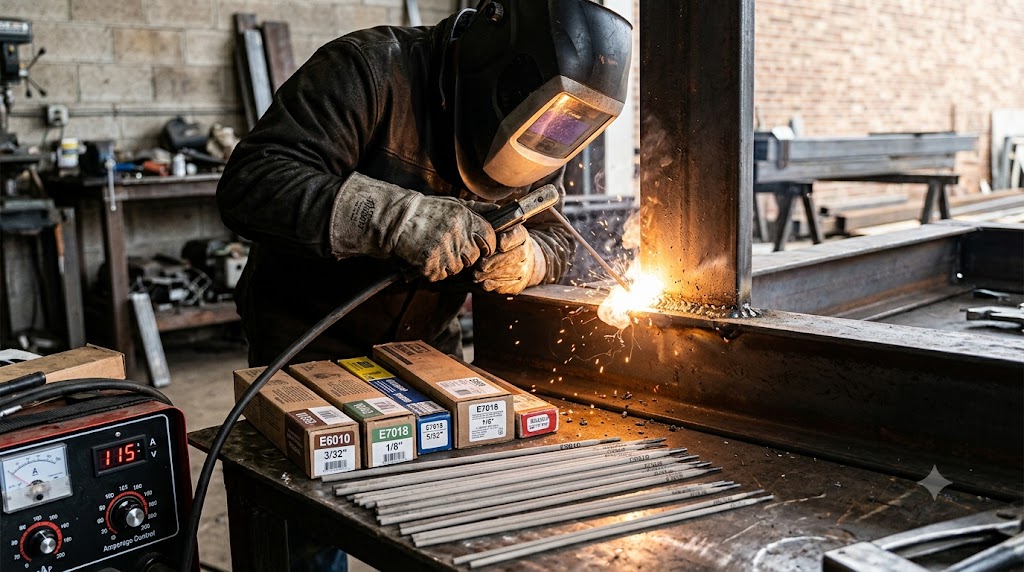
The fastest way to frustrate yourself at the welder is to run the wrong amperage for your rod. Too low and the rod sticks and stutters and the arc keeps dying. Too high and you burn through the metal and blow holes in your work. Between those two failures is a comfortable range where the arc is smooth, the puddle behaves, and welding suddenly feels easy. That range is set mostly by two things: the diameter of your rod and its type.
Welding rod size refers to the electrode’s diameter (commonly 3/32, 1/8, and 5/32 inch), and each size runs best within a specific amperage range that also depends on the rod type. As a rough starting point, 3/32 inch rods run around 40 to 100 amps, 1/8 inch around 75 to 150 amps, and 5/32 inch around 110 to 180 amps. Here is how to read the chart and dial it in.
How rod size and amperage relate
A thicker rod carries more current and deposits more metal, so it needs more amperage and welds thicker material. A thinner rod needs less amperage and suits thinner metal. The classic beginner rule of thumb is roughly 1 amp per 0.001 inch of rod diameter, so a 1/8 inch (0.125 inch) rod lands near 125 amps as a middle-of-the-road setting. It is only a starting point, but it gets you close.
The rod type shifts the numbers too. A 6013 and a 7018 of the same diameter do not run at identical amps, because their coatings and penetration differ. Always treat the manufacturer’s printed range on the box as the real authority, and use charts as a starting point.
Amperage chart by rod type and size
These ranges are typical starting points; your machine, position, and joint will shift them, so confirm against the rod maker’s box.
| Rod | 3/32 in | 1/8 in | 5/32 in |
|---|---|---|---|
| 6010 | 40 to 80 | 75 to 125 | 110 to 165 |
| 6011 | 40 to 90 | 75 to 125 | 110 to 160 |
| 6013 | 40 to 90 | 80 to 130 | 110 to 180 |
| 7014 | 70 to 100 | 110 to 150 | 150 to 210 |
| 7018 | 70 to 100 | 90 to 140 | 110 to 165 |
| 7024 | 90 to 130 | 140 to 190 | 180 to 250 |
Notice how the iron-powder rods (7014 and especially 7024) run hotter than a 6013 of the same size, because they deposit more metal. Notice too that the ranges overlap, which is why the rod’s own box beats any generic chart.
Direct answer: which size rod should you use?
Match rod diameter to your metal thickness:
- Thin material (up to about 1/8 inch): use a 3/32 inch rod at lower amperage to avoid burning through.
- General work (around 1/8 to 1/4 inch): a 1/8 inch rod is the everyday all-rounder and the size most home welders use most.
- Thick material (1/4 inch and up): step up to 5/32 inch (or run multiple passes with 1/8 inch) for enough heat and fill.
A practical rule: pick the rod diameter close to or slightly under your material thickness, then set amperage in the middle of that rod’s range and adjust. If the arc stutters and sticks, raise the amps; if you are burning through or the puddle runs wild, lower them.
How to fine-tune from the starting number
Charts get you close; the metal tells you the rest. Read these signs:
- Too low: the rod sticks or the arc keeps going out, the bead piles up narrow and tall, and slag is hard to remove. Raise the amperage.
- Too high: you burn through, undercut the edges, the puddle is hard to control, and spatter increases. Lower the amperage.
- Just right: a steady, crackling arc, a puddle you can steer, a bead that ties in smoothly, and slag that peels cleanly.
Position matters too. Vertical and overhead welds usually run at the lower end of the range so the puddle does not sag, while flat welds can take the higher end.
The bottom line
Welding rod size is diameter, and diameter plus rod type sets your amperage. Use 3/32 inch for thin metal, 1/8 inch for general work, and 5/32 inch for thick material, and start near the middle of the rod’s printed range. Treat the chart as a launch point, then let the arc, puddle, and slag guide your final setting. Dial it in and welding stops fighting you.
FAQ
What are the common welding rod sizes? The most common diameters are 3/32, 1/8, and 5/32 inch, with 1/16 inch for very thin work. The 1/8 inch rod is the everyday all-rounder for most general welding.
What amperage for a 1/8 inch welding rod? Roughly 75 to 150 amps depending on the rod type, with about 125 amps as a common middle setting. A 6010 or 6011 runs lower than a 7014 or 7024 of the same diameter, so check the box.
How do I match rod size to metal thickness? Pick a rod diameter close to or slightly under the metal thickness: 3/32 inch for thin material, 1/8 inch for general work around 1/8 to 1/4 inch, and 5/32 inch for thick material.
What is the 1 amp per thousandth rule? A starting-point rule that sets amperage at about 1 amp per 0.001 inch of rod diameter, so a 1/8 inch (0.125 inch) rod starts near 125 amps. Adjust from there based on the arc and puddle.
How do I know if my amperage is wrong? Too low and the rod sticks, the arc dies, and slag clings. Too high and you burn through, undercut edges, and get heavy spatter. A steady arc, controllable puddle, and easily peeling slag mean you are dialed in.
Do different rod types need different amperage? Yes. Iron-powder rods like 7014 and 7024 run hotter than a 6013 of the same size because they deposit more metal. Always confirm against the amperage range printed on the rod’s box.
References
- Lincoln Electric and Miller Electric stick electrode amperage selection guides (manufacturer documentation).
- Hobart Brothers and Forney Industries electrode data sheets with per-diameter amperage ranges (manufacturer documentation).
- American Welding Society stick welding (SMAW) parameter guidance, aws.org.