Aluminized and Foundry Welding Jacket Guide
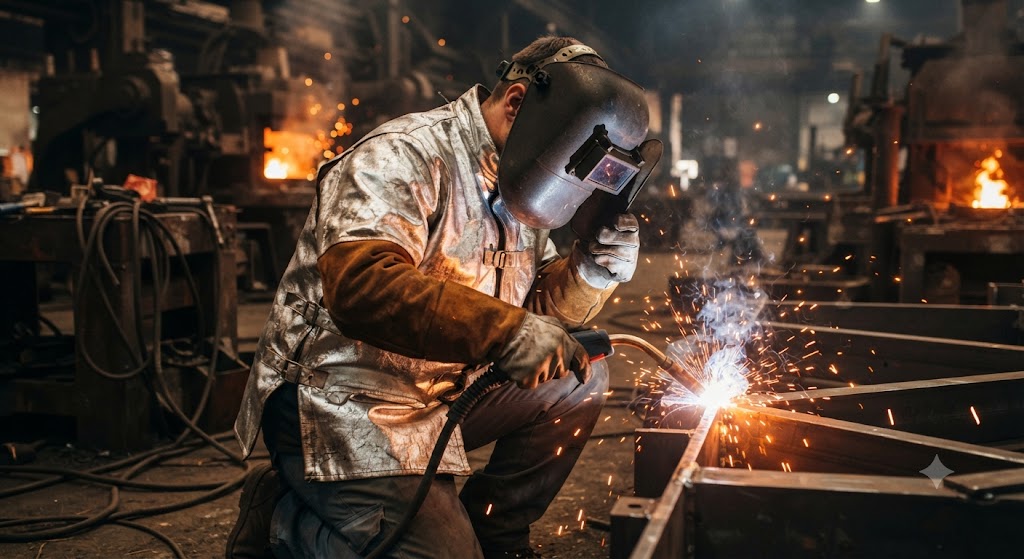
Standard FR cotton and leather welding jackets are designed for the radiant heat and spatter exposure of arc welding. For foundry workers, furnace operators, and anyone working near molten metal or extreme radiant heat sources, these materials are insufficient. Aluminized jackets are the specialized solution for these environments.
What Is an Aluminized Welding Jacket Used For?
Aluminized jackets are designed for high radiant heat environments - situations where the primary hazard is thermal radiation rather than arc flash or standard weld spatter:
- Foundry work - proximity to molten metal pours and furnace openings
- Furnace tending - loading and monitoring industrial heat treatment furnaces
- Metal casting - pouring and handling molten metal
- Steel mill work - near ladles and electric arc furnaces
- Forge work - handling hot forgings and working near forge furnaces
- High-amperage overhead welding - some heavy structural welders use aluminized sleeves
The reflective aluminum coating on the outer surface deflects radiant heat rather than absorbing it - the critical difference from standard FR cotton and leather.
Is Aluminized Fabric Better Than Leather for Radiant Heat?
Yes - for radiant heat specifically. The comparison:
| Material | Radiant Heat Reflection | Molten Splash Resistance | Weld Spatter | Weight |
|---|---|---|---|---|
| Leather | Moderate | Good | Best | Heavy |
| FR Cotton | Poor | Poor | Moderate | Light |
| Aluminized Rayon | Excellent | Poor | Poor | Light |
| Aluminized Carbon Kevlar | Excellent | Good | Moderate | Medium |
Aluminized Rayon (AR): Lightweight, excellent radiant heat reflection. Not recommended for molten metal splash - the rayon backing can ignite on contact with molten metal.
Aluminized Carbon DuPont Kevlar (ACK): Heavier, excellent radiant heat reflection plus resistance to molten metal splash. The high-temperature asbestos replacement for foundry and furnace environments.
Tillman Aluminized Jacket Lineup
Tillman 7230 - Aluminized Rayon Jacket (40”)
- 16 oz. aluminized rayon construction
- 40” length
- Excellent radiant heat reflection
- Not for molten metal splash contact
- For foundry-adjacent work where molten splash risk is low
Tillman 8230 - Aluminized Carbon Kevlar Jacket (30”/40”/50”)
30” - ($150–200)
40” - (see rayon above; search 8230 for ACK)
50” - ($200–280)
Check on Amazon
- 19 oz. aluminized carbon Kevlar construction
- Multiple lengths (30”, 40”, 50”)
- Radiant heat reflection + molten metal splash resistance
- High-temperature asbestos replacement
- Recommended for foundry and furnace work with molten metal exposure
Do Foundry Workers Need Different Gear Than Typical Welders?
Yes - significantly:
| Hazard | Typical Welder | Foundry/Furnace Worker |
|---|---|---|
| Arc flash | Primary hazard | Rare |
| Weld spatter | Primary hazard | Secondary |
| Radiant heat (sustained) | Brief exposure | Primary hazard |
| Molten metal splash | Rare | Primary hazard |
| Infrared radiation | From arc | From furnaces and ladles |
Foundry gear requirements beyond standard welding PPE:
- Aluminized jacket or coat (ACK for molten splash environments, AR for radiant-only)
- Foundry leggings/chaps - protect legs from spatter when standard pants are insufficient
- Full face shield with IR-tinted lens - for furnace viewing and pouring
- Foundry gloves (Tillman 990XL double wool, Caiman 3136 pigskin) - heavier than standard welding gloves
- Metatarsal boots - foot protection against molten metal drops
- Aluminized spats/boot covers - for molten metal splash environments
Aluminized vs. Standard Leather Jacket: When to Use Each
Use standard leather jacket for:
- All arc welding processes (MIG, TIG, stick, flux-core)
- Standard shop welding with typical spatter exposure
- Overhead welding where spatter and slag are the primary hazard
Use aluminized jacket for:
- Foundry pouring and furnace operations
- Steel mill and casting environments
- Any application where sustained radiant heat - not spatter - is the dominant hazard
FAQs
What is an aluminized welding jacket used for? Primarily for foundry, furnace, and casting environments where sustained radiant heat and/or molten metal splash are the dominant hazards - not standard arc welding.
Is aluminized fabric better than leather for radiant heat? Yes - the reflective coating deflects radiant heat rather than absorbing it. Aluminized Carbon Kevlar also provides molten metal splash resistance.
Do foundry workers need different gear than typical welders? Yes. Foundry environments require aluminized jackets, foundry-grade gloves, metatarsal protection, and aluminized spats/leggings that arc welding environments do not.