Ariat Welding Boots Full Review
There’s a specific welder who keeps showing up in the comment sections of every Ariat boot review: the guy who switched from Timberland PRO or Red Wing and says he’s never going back. He’s usually a fabricator or pipefitter, usually working on his feet for ten-plus hours, and his main complaint about every boot before Ariat was that it made his feet feel beat by hour seven.
Aariat’s reputation comes directly from western boot heritage. Before they crossed over into work boots, they were making performance equestrian footwear with a specific obsession over how a boot fits, moves, and supports the foot over long periods. That DNA shows up in the WorkHog and the welding-ready work boot lineup in ways that safety-spec-first boot companies don’t always match.
For welding work specifically, Ariat’s square-toe design, Duratread outsole, and ATS (Advanced Torque Stability) technology make their work boots a real consideration for welders who are on their feet for long shifts. Here’s what the specs mean, where the boots perform well, and where they fall short for the specific demands of a welding environment.
Under OSHA’s foot protection standard, 29 CFR 1910.136, employers must provide appropriate protective footwear where foot injury hazards exist. Ariat’s ASTM F2413-rated work boots meet the minimum safety toe, electrical hazard, and slip-resistance requirements that standard specifies.
The Ariat WorkHog: What It Is
The WorkHog is Ariat’s flagship work boot. Wide square toe, pull-on design, 11-inch shaft, 1.5-inch heel. It’s built on ATS Max technology - a dual-density foam midsole system combined with a moisture-wicking footbed designed to reduce foot fatigue over long shifts. The Duratread outsole is highly abrasion-resistant and slip-resistant, with a self-cleaning tread pattern that sheds debris rather than packing it in.
The Goodyear welt construction means the sole can be resoled, extending the life of the boot significantly beyond what a cement-construction boot offers. For welders who wear boots hard and run through soles in under a year on rough concrete, this matters.
The steel-toe WorkHog meets ASTM F2413 for impact and compression protection. The electrical hazard rating provides secondary protection against contact with live circuits. These are the same certifications you’ll find on the Timberland PRO and Red Wing boots in this category.
The square toe is relevant for more than aesthetics. A wide square toe box reduces forefoot compression during long shifts, which is a real comfort factor for welders who stand on concrete all day. The wider toe also distributes the load from a steel safety toe across a broader surface, reducing the localized pressure that makes narrow steel-toe boots uncomfortable by midday.
What Makes a Square Toe Boot Better for Welders
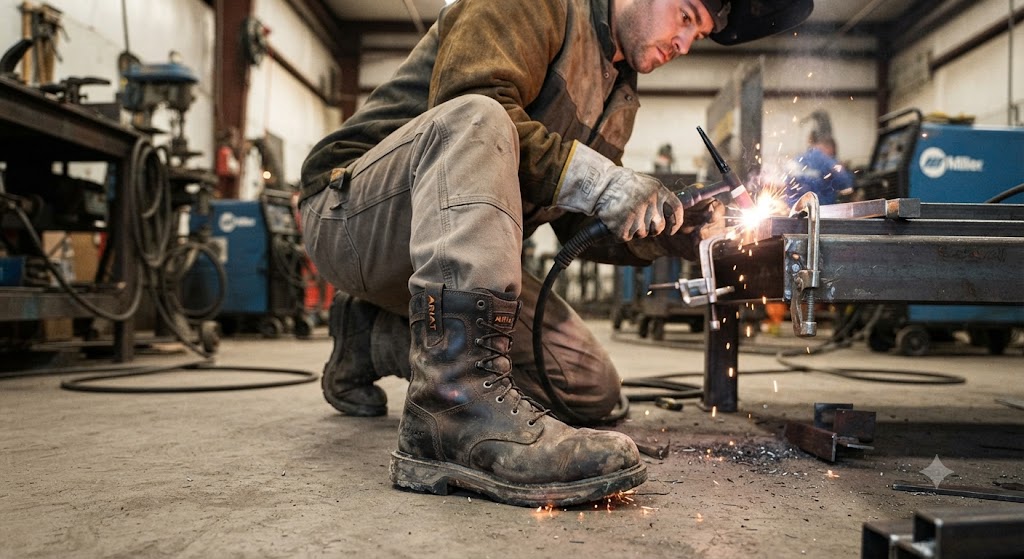
The standard welding posture - leaning over a workpiece, weight shifted forward, sometimes crouching - puts unusual pressure on the forefoot and toe box. A round or narrow toe concentrates that pressure at the narrowest point of the boot, which is also where the safety toe cap sits.
A wide square toe like the WorkHog’s redistributes that pressure across the full width of the forefoot. After a ten-hour shift alternating between standing and crouching, that redistribution is the difference between functional feet and aching ones.
The WorkHog’s 1.5-inch heel also provides a subtle biomechanical benefit on sloped or uneven shop floors, keeping the foot in a position that reduces Achilles strain compared to flat-soled work boots.
Welding-Specific Performance: What Ariat Gets Right
The full-grain leather upper on the WorkHog resists spark and light spatter reasonably well. It’s not a purpose-built welding boot with heat-resistant thread on every seam, but for light-to-moderate MIG and TIG work it holds up. The leather is thick enough to absorb minor spatter hits without burn-through.
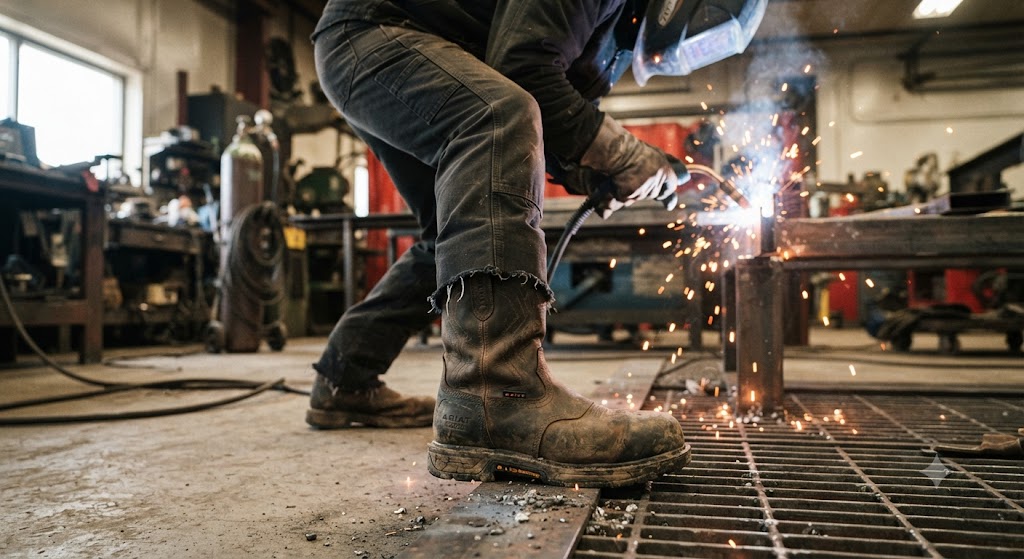
The slip-resistant Duratread outsole handles oily concrete, metal shavings on the floor, and the general debris of a fabrication shop. Its traction on metal grating, which shows up in many structural steel shops, is solid.
The pull-on design means no laces to catch a spark. Lace-up boots in welding environments can have laces damaged by spatter or heat exposure over time; the WorkHog eliminates that maintenance issue entirely.
The Honest Flaws
Aariat boots are not purpose-built welding boots, and there are real gaps.
First: the WorkHog has no metatarsal guard. If your environment involves crane lifts, falling plate, or any overhead material handling, the WorkHog does not provide the metatarsal protection that OSHA may require and that Timberland PRO’s External Met Guard delivers. For those environments, skip the WorkHog and get a rated met-guard boot.
Second: the shaft stitching on WorkHog boots is not always heat-resistant thread. On welding-specific boots like the Timberland PRO External Met Guard, heat-resistant thread on the welt and upper is a stated specification. Ariat’s WorkHog is a work boot, not a welding boot, and regular thread is more vulnerable to spatter contact over time. Heavy spatter exposure will degrade the stitching faster than it would on a boot with heat-resistant construction.
Third: the western-inspired design means this boot is recognizably a western-style work boot. In some professional environments or for workers who prefer a more conventional appearance, this matters.
Who should skip the WorkHog for welding: anyone in an environment with OSHA-required metatarsal protection, anyone doing significant overhead Stick or flux-cored welding where spatter falls on the boot regularly, and anyone whose employer has a specific footwear spec that requires dedicated welding footwear.
Ariat vs Timberland PRO: Honest Comparison
Timberland PRO’s External Met Guard is the right boot when the hazard profile demands metatarsal protection, heat-resistant construction, and a boot specifically engineered for welding environments. It covers the safety spec sheet more completely.
Aariat’s WorkHog wins on comfort, particularly for long shifts. The ATS Max technology, wider toe box, and Goodyear welt construction produce a boot that many welders find significantly more comfortable over a ten-hour shift than the Timberland PRO options. If your welding work is moderate - light-to-medium MIG or TIG in a controlled shop environment without met-guard requirements - the WorkHog delivers better all-day comfort at a comparable price point.
The honest answer is that these boots solve different problems. Timberland PRO solves the safety-specification problem. Ariat solves the all-day-comfort problem. If your environment requires both, you’re either pairing met-guard protection with a lighter boot, or you’re looking at Ariat’s WorkHog MetGuard model, which adds external metatarsal protection to the WorkHog platform.
Comparison Table
| Feature | Ariat WorkHog | Timberland PRO Ext. Met Guard |
|---|---|---|
| Toe protection | Steel, ASTM F2413 | Steel, ASTM F2413 |
| Metatarsal guard | No (MetGuard version available) | Yes, hinged external |
| Toe shape | Wide square | Round |
| Shaft height | 11 inches | 6 inches |
| Waterproof | Option available | No |
| EH protection | Yes | Yes |
| Sole replacement | Goodyear welt (resoleable) | Not designed for resoling |
| Best for | Long-shift comfort, light-med welding | Met-guard required environments |
| Flaw | No met-guard, non-welding-specific thread | Short shaft, non-removable footbed |
FAQ
Are Ariat boots good for welding? For light to moderate MIG and TIG welding in shop environments without met-guard requirements, yes. The WorkHog’s leather upper, steel safety toe, EH protection, and slip-resistant outsole meet the basic requirements. They are not purpose-built welding boots, which is relevant if your environment produces heavy spatter or requires metatarsal protection.
What makes a square toe boot better for welders? A wide square toe box reduces forefoot compression during long shifts, redistributes pressure from the safety toe cap, and accommodates the leaning and crouching postures common in welding work more comfortably than a narrow round toe.
How do Ariat welding boots compare to Timberland PRO? Aariat wins on long-shift comfort, shaft height for lower-leg protection (11 inches vs 6 inches), and the resoleable Goodyear welt construction. Timberland PRO wins on metatarsal protection, heat-resistant construction details, and the welding-specific features of their External Met Guard model. For pure comfort on a long shift without a met-guard requirement, Ariat. For a safety-complete welding boot, Timberland PRO.
Does the Ariat WorkHog meet OSHA requirements for welding footwear? The steel-toe, EH-rated WorkHog meets the basic protective footwear requirements of 29 CFR 1910.136. If your workplace’s hazard assessment requires metatarsal protection specifically, the standard WorkHog does not satisfy that requirement. Ariat’s WorkHog MetGuard model does.
What is Ariat ATS Max technology? ATS Max (Advanced Torque Stability) is Ariat’s dual-density foam midsole system combined with a moisture-wicking, molded footbed. It’s designed to reduce foot fatigue on hard surfaces over long periods by providing cushioning at heel strike and stability through the midfoot.
Is the Ariat WorkHog available with a composite toe? Yes. The WorkHog is available in steel-toe and composite-toe configurations. The composite toe is non-conductive, lighter, and does not set off metal detectors, which matters in some industrial environments. ASTM F2413 safety ratings apply to both.
References
- https://www.osha.gov/laws-regs/regulations/standardnumber/1910/1910.136 (29 CFR 1910.136, OSHA foot protection standard)
- https://www.astm.org/f2413-18.html (ASTM F2413 standard)
- https://www.ariat.com/workhog-collection
- https://www.ariat.com/10006961_884849359129.html (WorkHog Wide Square Toe Steel Toe)
Slug: ariat-welding-boots-full-review Excerpt: The Ariat WorkHog brings western-boot comfort DNA to the work boot category. For light-to-moderate welding on long shifts, it outperforms most competitors on comfort. Here’s what it lacks for dedicated welding use and who it’s actually right for.