Auto Body Welding Gloves: The Best Thin Goatskin Picks for Car Restoration Work
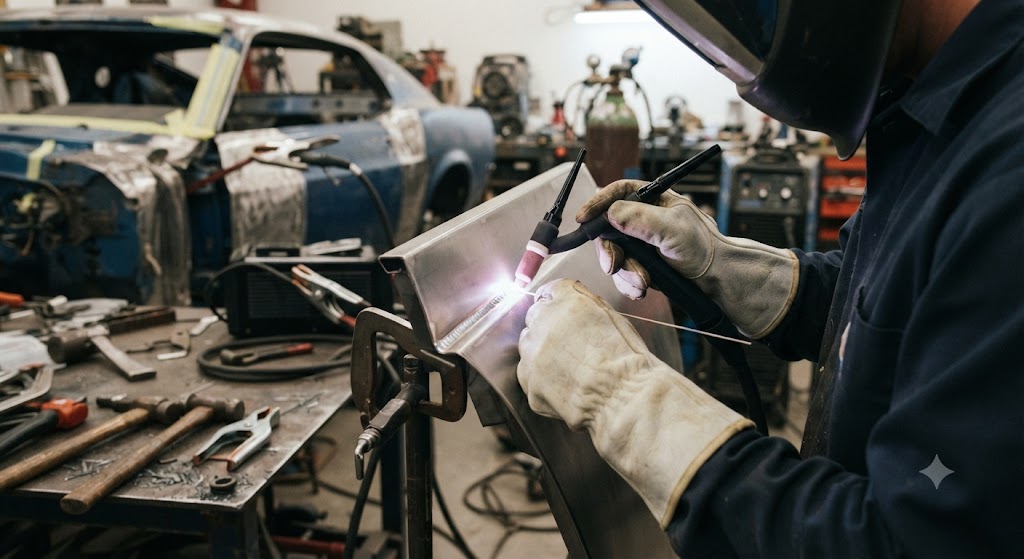
You’re doing bodywork on a quarter panel - thin 20-gauge steel, tight seams, and a TIG torch that needs to go exactly where you tell it. You reach for your stick welding gloves and immediately feel like you’re trying to thread a needle wearing oven mitts. That’s the moment most restoration welders figure out that panel work has its own PPE, and the gloves are the most critical piece.
Auto body welding is almost entirely TIG and MIG on thin sheet metal. The heat is lower, the arcs are shorter, and the filler rod wants tactile feedback from your fingertips. A goatskin TIG glove built for that kind of work is a completely different tool from a heavy cowhide MIG glove. Here’s what separates a good auto body welding glove from one that will frustrate you on every panel, and the two picks that get it right.
The short answer: For TIG welding sheet metal panels, you want an unlined top-grain goatskin glove with a short to medium cuff, Kevlar stitching, and as little bulk as possible. The Tillman 1338 and the TOOLIOM goatskin TIG glove are the two I’d put on a restoration welder’s bench.
Why Auto Body Welding Demands Thin, Dexterous Gloves
Sheet metal for car body panels typically runs 18 to 22 gauge. At that thickness, heat input matters enormously - too much and you warp the panel or burn through entirely. TIG welding thin steel demands that you feel the filler rod between your fingers. You’re feeding wire with your fingertips, not gripping a gun. Any glove thick enough to insulate that sensation will cost you weld quality.
Spot welding and MIG tack welding on body panels also favors thinner gloves, because you’re constantly repositioning clamps, adjusting panel gaps, and moving your hands around metal with no room for extra bulk. A thick cowhide glove that’s fine on a fabrication table becomes a liability when your hands are inside a door jamb.
The tradeoff with thin gloves is obvious: less thermal protection from spatter and heat. For auto body work, that’s acceptable because the heat levels in panel TIG are much lower than structural or pipe welding. A goatskin TIG glove rated for TIG applications handles auto body work cleanly. What you’re not using these for is overhead stick welding or heavy FCAW - those demand a different glove entirely.
The Two Best Auto Body Welding Gloves
Tillman 1338 Top Grain Goatskin TIG Glove - Best Overall for Panel Work
The Tillman 1338 is the closest thing to a standard-issue TIG glove in professional shops, and it earns that status on body work specifically. The top-grain pearl goatskin is thin and soft enough that you can feel the filler rod through the palm on fine welds. It’s unlined, which is the right call for low-amperage TIG - no liner means the glove fits like a second skin rather than a pouch.
The GlidePatch on the side of the hand is a small but real detail for auto body work. When you’re dragging a TIG torch along a panel seam, the side of the glove takes constant contact with sharp metal edges. That reinforcement patch keeps the glove from wearing through at the one spot restoration welders actually use it hardest. The 4-inch split cowhide cuff gives heat protection on the wrist without being so long it gets in the way in tight areas. Kevlar-sewn seams mean the stitching outlasts the leather on most pairs.
The flaw you’ll hit: the pearl goatskin picks up carbon smudges and discolors quickly. This is cosmetic but worth knowing. More practically, the thin leather burns through faster if you’re doing higher-amperage MIG tacks repeatedly - this glove is optimized for TIG and light MIG, not for running heavy wire all day.
Who should skip it: If you’re doing primarily production MIG work on body panels rather than TIG, move to a slightly heavier glove. The 1338 is built for TIG dexterity first.
TOOLIOM Premium Goatskin TIG Welding Gloves - Best Value for the Restoration Shop
The TOOLIOM goatskin TIG glove fills the gap for welders who want genuine goatskin construction without the Tillman price point. The palm and fingers use top goatskin with a cowhide split leather cuff, and the soft lining gives a small amount of comfort padding without killing dexterity. The wing thumb design - a curved ergonomic construction rather than a flat stitched thumb - actually improves grip on the torch when you’re welding in awkward positions around a wheel arch or floor pan.
At 14 inches, the cuff is longer than the Tillman 1338, which some restoration welders prefer when doing work near exhaust components or closer to the engine bay where ambient heat is a factor. Kevlar stitching throughout means the seams hold up on production-style day work.
The honest flaw: the lining, while comfortable, reduces tactile feedback compared to the unlined Tillman. If you’re doing precise TIG beads on thin aluminum panels, you’ll notice the difference. For steel body panel work and MIG tack sequences, it doesn’t matter much.
TIG vs. MIG vs. Spot Welding for Auto Body Panels
TIG welding is the preferred process for precision auto body work. It gives you full control over heat input, produces cleaner welds with minimal distortion, and handles very thin metal without blowing through. The tradeoff is speed - TIG is slower than MIG, which matters less in restoration work where panel fit and finish take priority over production rate.
MIG welding is faster and more forgiving on thicker replacement panels (quarter panels, floor pans), but requires dialing in wire speed and voltage carefully to avoid burning through at the edges. Short-circuit MIG at low parameters works well. A thin goatskin glove works for panel MIG - you want the dexterity for repositioning and clamping more than heavy thermal protection.
Spot welding with a resistance welder uses no filler and creates minimal spatter. For spot welding, a light leather glove or even a good work glove is sufficient - you’re not dealing with arc radiation or filler rod.
For most restoration welders doing a mix of all three, one pair of TIG gloves handles everything without compromise.
Do You Need a Different Helmet for Thin Sheet Metal Welding?
TIG welding on sheet metal panels typically runs at very low amperage - sometimes 20 to 60 amps for thin gauge work. Standard auto-darkening helmets set to shade 9 or 10 work fine. What matters more than shade level for panel work is a fast lens reaction time (1/25,000 second or better) to prevent any flash exposure at arc start.
A clear cover lens over your ADF is worth replacing more frequently when doing panel work, since spatter from MIG tacks accumulates and reduces visibility exactly when you need to see your panel gap clearly. This is a consumable, not a helmet upgrade.
Glove Comparison: Tillman 1338 vs. TOOLIOM
| Feature | Tillman 1338 | TOOLIOM Goatskin |
|---|---|---|
| Material | Top-grain goatskin palm, cowhide cuff | Goatskin palm, cowhide split cuff |
| Lining | Unlined | Soft lining |
| Cuff length | 4 inches | 14 inches |
| Stitching | Kevlar | Kevlar |
| GlidePatch | Yes | No |
| Best for | Precision TIG, thin panel | TIG/MIG mix, longer cuff preference |
How to Make Gloves Last Longer in Auto Body Work
Goatskin dries out faster than cowhide when exposed to cleaning solvents and metal cleaners common in body shops. After each session, a light application of leather conditioner keeps the grain supple and prevents the fingertips from cracking. Cracked leather at the fingertips is where most TIG gloves fail first - the repeated micro-bending from filler rod feeding fatigues the leather at that spot.
Store gloves flat or lightly stuffed, not folded. A folded glove develops a crease at the palm that becomes a wear point.
FAQ
What gloves work best for auto body panel welding? Unlined or lightly lined top-grain goatskin TIG gloves. The Tillman 1338 is the professional standard for panel TIG work. The thin goatskin gives you the tactile feedback needed to feed filler rod accurately on 18 to 22 gauge steel without losing heat protection for the amperage levels involved.
Do you need a different helmet for thin sheet metal auto work? Not a different helmet, but different settings. For TIG on thin sheet metal at low amperage, shade 9 to 10 works well. More important is a helmet with fast switching speed (1/25,000 second or faster) and a clear, unscratched cover lens so you can see your panel gap clearly during setup.
What is the best welding process for car restoration panels? TIG for precision and minimal distortion on thin panels. MIG for faster work on thicker replacement sections like floor pans. Spot welding where original factory spot welds need replication. Most restoration shops use all three - TIG for visible areas and thin gauge, MIG for structural sections, spot welding for floor work.
Can I use MIG welding gloves for TIG auto body work? Technically yes, but you’ll sacrifice dexterity. Standard MIG gloves are thicker and stiffer, which makes feeding filler rod difficult on precise panel welds. A TIG-specific goatskin glove costs about the same and makes a real difference in weld quality on thin material.
How do goatskin gloves compare to cowhide for TIG welding? Goatskin is thinner and naturally softer, which means better feel and dexterity at the cost of slightly lower heat resistance. For TIG welding at low amperages on thin sheet metal, that tradeoff is correct - you don’t need the heat resistance of cowhide, and you do need the tactile sensitivity. The American Welding Society recommends tight-fitting goatskin, deer, or sheepskin gloves for GTAW and low-amperage applications specifically.
Are leather gloves required for auto body welding by OSHA? OSHA does not mandate a specific glove material for welding, but requires appropriate hand protection against heat, spatter, and electrical hazards. The AWS ANSI Z49.1 standard requires all welders to wear protective gloves that are flame resistant, dry, and capable of providing protection from electrical shock. Leather gloves satisfy this requirement for all standard arc welding processes.
What glove size should I use for panel TIG work? Fit matters more for TIG gloves than for MIG. A glove that’s one size too large kills the tactile feedback you need for filler rod control. Size down if you’re between sizes - you want the fingertips to be snug, not loose.
The Verdict
For auto body welding gloves, the Tillman 1338 is the pick I’d put in a professional restoration shop without hesitation. The unlined goatskin and the GlidePatch are the two details that make it genuinely better for panel TIG work than a generic glove at any price. The TOOLIOM is the right call if you want a longer cuff for engine bay work or prefer a lined glove for day-long comfort at a lower investment. Neither will do the welding for you, but both will stop the gloves from being what slows you down.
Buy thin, buy goatskin, and replace them before the fingertips crack - that’s the whole strategy.
References
- https://www.aws.org/magazines-and-media/welding-digest/wd-oct-23-choosing-ppe-for-welding/
- https://aws-p-001-delivery.sitecorecontenthub.cloud/api/public/content/Fact-Sheet-No.37
- https://www.osha.gov/laws-regs/regulations/standardnumber/1915/1915.153
- https://jtillman.com/product/goatskin-tig-welding-gloves-1338-glidepatch-straight-thumb/
- https://tooliom.com/products/tooliom-tig-welding-gloves
URL slug: auto-body-welding-gloves Excerpt: Auto body panel welding demands thin, dexterous goatskin TIG gloves - not the heavy cowhide used for stick or MIG. This guide covers what makes a glove right for sheet metal work and ranks the two best options for restoration welders.